FinOps assessment guide
FinOps is not a linear process, but a continuous practice with no clear start or end. FinOps teams must constantly improve their skills and adapt to the organization's needs in a changing cloud environment. Use this guide with the FinOps Framework to assess your current operational maturity and identify areas that require focus.
Introduction
This assessment guide provides concepts and metrics to help you analyze the current state of your FinOps practice and plan for the future. You can conduct an assessment at any level of your organization, such as a specific functional team, a department, or an entire business unit. The assessment criteria in this guide are consistent and easy to understand.
When you conduct a FinOps Framework assessment, the goal is not to obtain a precise score for your FinOps practice. Instead, the goal is to outline the current state and identify key areas for the FinOps team to explore or develop. You do not have to assess all FinOps Framework capabilities at once. You can focus on a single capability or a group of related capabilities within a domain for a deep-dive analysis. This type of analysis is especially important when an initial assessment reveals that a capability requires urgent improvement.
In each assessment sheet, specify the following:
-
Scope: Which capabilities will you assess?
-
Target group: Which group in the organization will you assess?
Include people who have a significant impact on the selected scope and target group. You should also consider potential future assessment targets so these individuals can better understand the process.
Key terms
Dimension
The term "dimension" is used to discuss how to examine and analyze a FinOps practice. These dimensions are different functional perspectives for evaluating framework capabilities. Each dimension requires specific work and supporting evidence.
Domain
A FinOps domain represents an area of activity or knowledge that an organization engages in to achieve results.
Capability
A FinOps capability represents a function that supports its corresponding FinOps domain. Each capability includes a definition, key roles, performance metrics, and the functional activities involved in the FinOps practice.
Framework
The FinOps Framework provides structured guidance for the entire FinOps practice. It covers FinOps domains, capabilities, lifecycle, maturity model, and principles.
Maturity
Maturity is a measure of the experience, breadth, and outcomes of a framework capability. Assessing maturity is not about reaching a final state. It is about continuously improving capabilities to create value as you handle more complex cloud usage or organizational needs.
Discovery phase
Open-ended questions help you understand the maturity levels in the assessment.
Target score
During the assessment process, the term "target score" describes the desired goal for a specific FinOps practice. For example, if the maximum score for a capability is 20 (across five dimensions, with a maximum of 4 points per dimension), what level is the capability expected to reach at this stage? How important is this capability? On the development roadmap, a score of 12 might be considered "good enough," especially for a new capability.
Assessment dimensions
The following five dimensions describe how to successfully apply FinOps capabilities. They help you identify the strengths and weaknesses of your organization's capabilities and where to focus your efforts.
A full understanding of each dimension is key to a consistent analysis. You can also compare your improvement results in subsequent assessments.
Each dimension is divided into five levels, with corresponding descriptions of expectations. You can compare these descriptions with your organization's current state. This comparison helps you understand how mature organizations respond to complex environments. You do not need to pursue a higher maturity level constantly. Instead, assess whether your organization can benefit from a more mature operating model. Understanding how your organization operates in each dimension helps you clearly identify areas for improvement and enhance your overall practice.
Dimension 1: Awareness
The Awareness dimension considers the breadth of understanding and recognition of a capability within the target group. When assessing this dimension, consider the following: Is the capability communicated clearly? How widespread is the knowledge of its concepts, mechanisms, terminology, and processes?
|
Maturity |
Characteristic |
Description |
|
0 |
No awareness |
The target group has almost no awareness of the capability as defined by the framework. There is no discussion about this capability, and no one is actively trying to learn more. |
|
1 |
Initial awareness |
Key stakeholders and individuals have an initial awareness of the assessed capability, but it is not widespread within the target group. |
|
2 |
Basic awareness |
A small number of key stakeholders have a basic awareness of the capability, but not at scale. |
|
3 |
Widespread awareness |
The target group has a widespread awareness of the assessed capability. It is part of new employee onboarding and is regularly reinforced through training or other appropriate communication methods. |
|
4 |
Mastery |
The target group promotes this capability to other groups and the wider industry. They use the deep knowledge of individuals within the group to raise awareness and develop new insights about the capability. |
Dimension 2: Process
Process includes not only the series of actions taken to achieve the assessed capability but also the documentation, definition, and recording of these actions. Consider the effectiveness, feasibility, and prevalence of these processes.
|
Maturity |
Characteristic |
Description |
|
0 |
No process |
The target group has not established any processes to uniformly manage the assessed capability. |
|
1 |
Process in implementation |
Processes to standardize the capability are being formed, defined, and possibly tested. However, these processes are not yet integrated into the target group's daily business activities. |
|
2 |
PoC process in development |
Relevant functional processes are now established and consistently recognized. At least some teams are following these processes. |
|
3 |
Process at scale |
Scaled processes are now established and documented. A regular feedback mechanism has also been implemented. |
|
4 |
Mature (agile) process |
Clearly defined, transparent, and coherent processes are now widely established. This does not mean every task has a separate process, but that existing processes share these characteristics. These processes are continuously iterated based on feedback from key stakeholders and continuous agile improvements. |
Dimension 3: Metrics
Is this capability evaluated? Can you measure and confirm the progress made? How are these metrics determined, and how relevant are they?
Note that this dimension does not focus on the metric scores themselves, but on how the metrics are defined and used.
|
Maturity |
Characteristic |
Description |
|
0 |
No metrics |
There are currently no metrics to directly assess the progress or current state of this capability. |
|
1 |
Metrics identified |
A set of key metrics has been identified that are valuable for making trade-off decisions about this capability. |
|
2 |
Baseline metrics |
Initial, manually generated metrics have been established. They use three colors (red, yellow, green) to simply indicate the current state of the capability. |
|
3 |
Metrics established and target data being collected |
Key Performance Indicators (KPIs) are now established for at least some capabilities within the target group. A data collection cadence is also in place. |
|
4 |
Mature global KPIs |
KPIs based on the SMART principle are implemented globally. They are automated and iterated at a fixed cadence. These KPIs are directly linked to business goals and performance. |
Dimension 4: Adoption
Assess the target group's capability by considering Awareness, Process, and Metrics. Evaluate the extent of adoption and recognition of the capability, whether it is considered an essential function, and its prevalence and applicability across the entire group.
|
Maturity |
Characteristic |
Description |
|
0 |
Not adopted |
The target group has not adopted the capability. |
|
1 |
Individual adoption |
Individual groups are beginning to experiment with adopting some elements of the capability, but there is a lack of standardization and best practices. |
|
2 |
Initial standardized adoption |
A few members of the target group are standardizing and reviewing the initial elements of the capability. |
|
3 |
Focused adoption |
Standardized elements of the capability are fully established and integrated into the daily business activities of most of the target group. |
|
4 |
Full adoption |
The capability is fully implemented within the target group, and all parties are actively participating in related work. |
Dimension 5: Automation
Automation saves valuable time by handling repetitive tasks that involve predictable decision points and iterative processes. This improves consistency, efficiency, and scalability for the target group.
|
Maturity |
Characteristic |
Description |
|
0 |
No automation |
At this stage, almost all necessary actions within the scope of this capability are performed manually. |
|
1 |
Automation opportunities identified |
Automation needs are being identified and planned. Solutions are being sought to reduce manual effort and time costs. |
|
2 |
Pilot automation |
Some early key actions have been optimized through automated workflows and solutions. |
|
3 |
Basic automation |
The main or most complex actions have now been converted to automated solutions. |
|
4 |
Full automation |
All significant repeatable tasks within this capability are automated. As the capability evolves, all new tasks are reviewed for automation potential or included in an automation implementation plan. |
Assessment phase 1: Introduction
When selecting the assessment scope, you must define several key parameters:
-
Target group: Which groups in the organization will be assessed?
-
Target scope: Which capabilities will be assessed?
-
Dimension weighting: What is the relative importance of the different assessment dimensions?
-
Target score: What is the expected score for this stage?
Target group
When identifying a target group, focus on one or two groups that excel in a particular area, rather than averaging scores across multiple groups with widely varying maturity levels.
When defining the target group and scope, you can filter the groups to assess based on certain properties. For example, the following properties can help you define the scope:
-
Cloud cost allocation groups
-
Engineering teams
-
Products or services
-
Projects or programs
-
Business owner
If you plan to observe trends or baselines in regular assessments, use the same target scope and target group for each assessment. This consistency improves data validity and builds business trust in the results.
Also, save the assessment scope, framework baseline, and analysis cases to ensure consistency and coherence.
Define test parameters
Target scope
After defining the environment scope, you must also consider the target scope. Analyzing all 22 capabilities of the FinOps Framework is a complex task.
When defining the target scope, focus on capabilities that you believe create high business value, especially those that are worth the FinOps team's time to develop. If your organization is just starting, you can focus on the Understanding Cloud Costs domain. If your organization is more mature, you might consider the Optimizing Cloud Costs, Quantifying Business Value, or Managing the FinOps Practice domains. To make the assessment more targeted, focus on a small number of capabilities. Remember, you can start small, build muscle memory from repetitive practice, and then scale up in size and complexity. This mirrors the nature of FinOps itself.
Different capabilities are often interdependent, and their value depends on the nature and strengths of a business. Therefore, consider which capabilities are most valuable to you at your current stage in the FinOps journey. For example, when an organization is just starting to implement a FinOps culture, it may need to focus on basic capabilities, such as cost allocation, reporting and analytics, data ingestion (especially if not using third-party tools), rate optimization, workload optimization, and FinOps training and enablement. Later in the implementation, the focus might shift to capabilities that improve internal collaboration, such as forecasting management, budget management, and unit economics.
In theory, you can assess all framework capabilities, but this requires significant time and effort from you and the target group members. To make the assessment repeatable, meaningful, and more targeted, you can focus on specific areas where you want to make progress in your FinOps journey.
Dimension weight
Within your target scope and target group, rank Awareness, Process, Metrics, Adoption, and Automation. Determine what is currently achievable and which areas require the most improvement. For example, consider whether the organization has the minimum required awareness and processes. If not, you might increase the weight of Awareness and Process in the assessment and lower the weight of the Automation score, because the score for Automation is likely to be low if the necessary awareness and processes are not in place. Consider these issues in the context of your work goals.
Target score
When selecting a target score, consider the level of success you want to achieve for each identified capability. Some capabilities may require a high maturity level, while others may be new and require time to mature. What level do you hope to achieve in the foreseeable future? Set a reasonable short-term target score to measure success based on the current level of completion.
Identify stakeholders and domain experts
Once you have determined the target scope and target group, you can quickly identify stakeholders and relevant domain experts. Note that different capabilities may require different stakeholders and roles. To obtain the most accurate analysis, you may also need to hold targeted discussions. When evaluating data, record detailed information about stakeholders and their evidence or data contributions. Retain contextual information for future baseline analysis. Involve stakeholders when setting target scores.
Assessment phase 2: Measurement
Once you have defined the target scope, target group, dimension weights, and target scores, and identified the relevant stakeholders and domain experts, you can begin the iterative FinOps assessment. For each selected capability within the target scope, you can start planning your interviews and discussions. Consider grouping capabilities that share the same domain experts or stakeholders.
Capability overview
First, outline the target scope to ensure that all participants agree on the capability's definition and business scope. Then, confirm the defined scope and provide clear context before the discussion begins. Use this initial phase as an opportunity to reinforce FinOps training and ensure that all relevant parties fully understand what is being assessed.
Evidence collection
Before addressing the questions for the five dimensions, ask some discovery questions. You can build and maintain a library of discovery questions for specific capabilities. These questions help you begin collecting evidence and data to support the scoring for each dimension of the assessment. Collect documented evidence whenever possible. Ensure this evidence is linked to other assessment information to provide context and increase confidence in the accuracy of the results.
Run the assessment
Determine the maturity score for each dimension based on input from the evidence collection discussion and the capability's overall performance in its specific context. Score consistently and fairly, and focus on the reasonable FinOps goals set for the capability.
Disagreements that arise among the stakeholders you interview are a positive sign. They may indicate that you have found an area that lacks consensus or shared experience. You can use this as an opportunity to address these issues. Alternatively, disagreements can indicate that participants are highly engaged. In this case, you can use the opportunity for training, enablement, and alignment.
The maximum score for a capability is calculated by multiplying the number of dimensions by the maximum maturity score. For example, if maturity scores range from 0 to 4 and you are assessing 5 dimensions, the maximum score for a capability is 20 (5 × 4). You can then assign a weight to each dimension based on current business priorities. The following figure shows possible scores for five capabilities. Note that the 2024 framework updates are not reflected in this sample data.
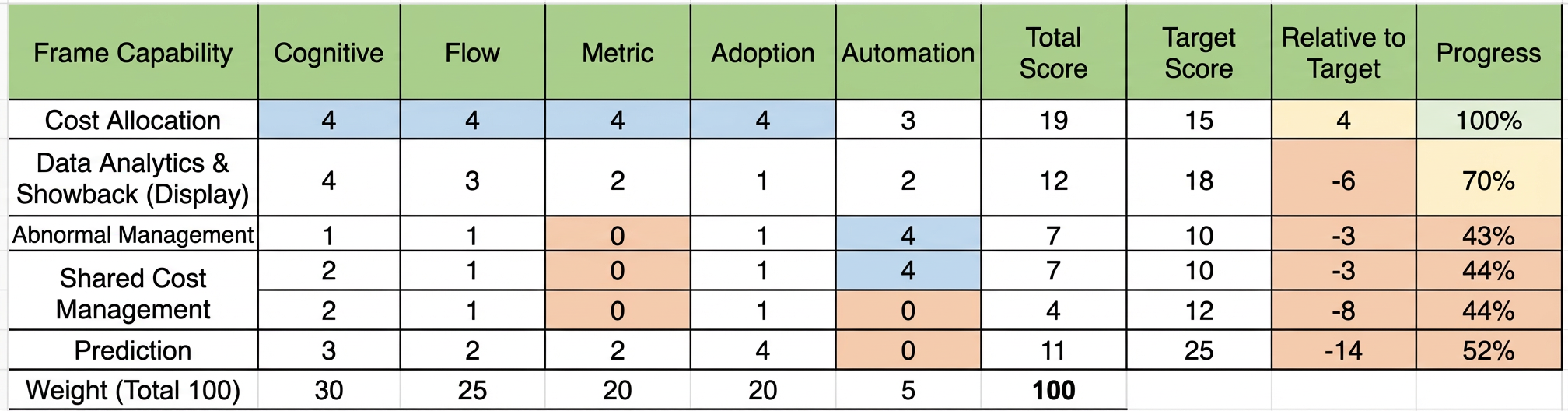
After assessing multiple capabilities and obtaining their metrics, you can aggregate the scores to generate an overall assessment. Highlight capabilities with low or zero scores to support your analysis of the results.
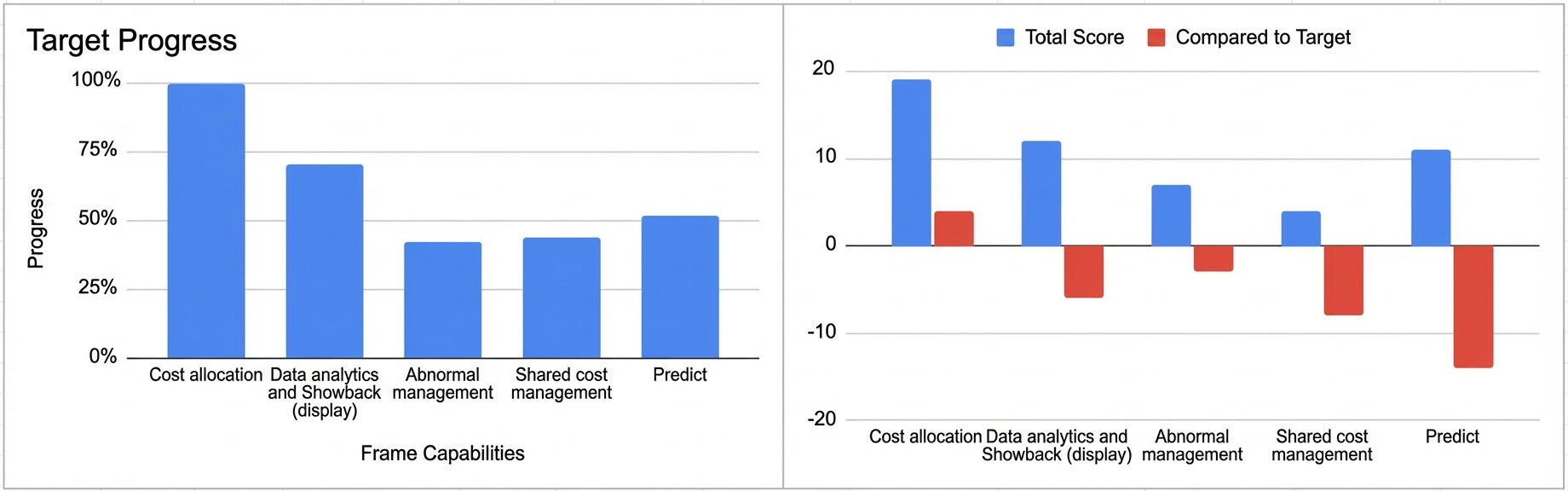
Assessment phase 3: Results
Trend analysis and emerging patterns
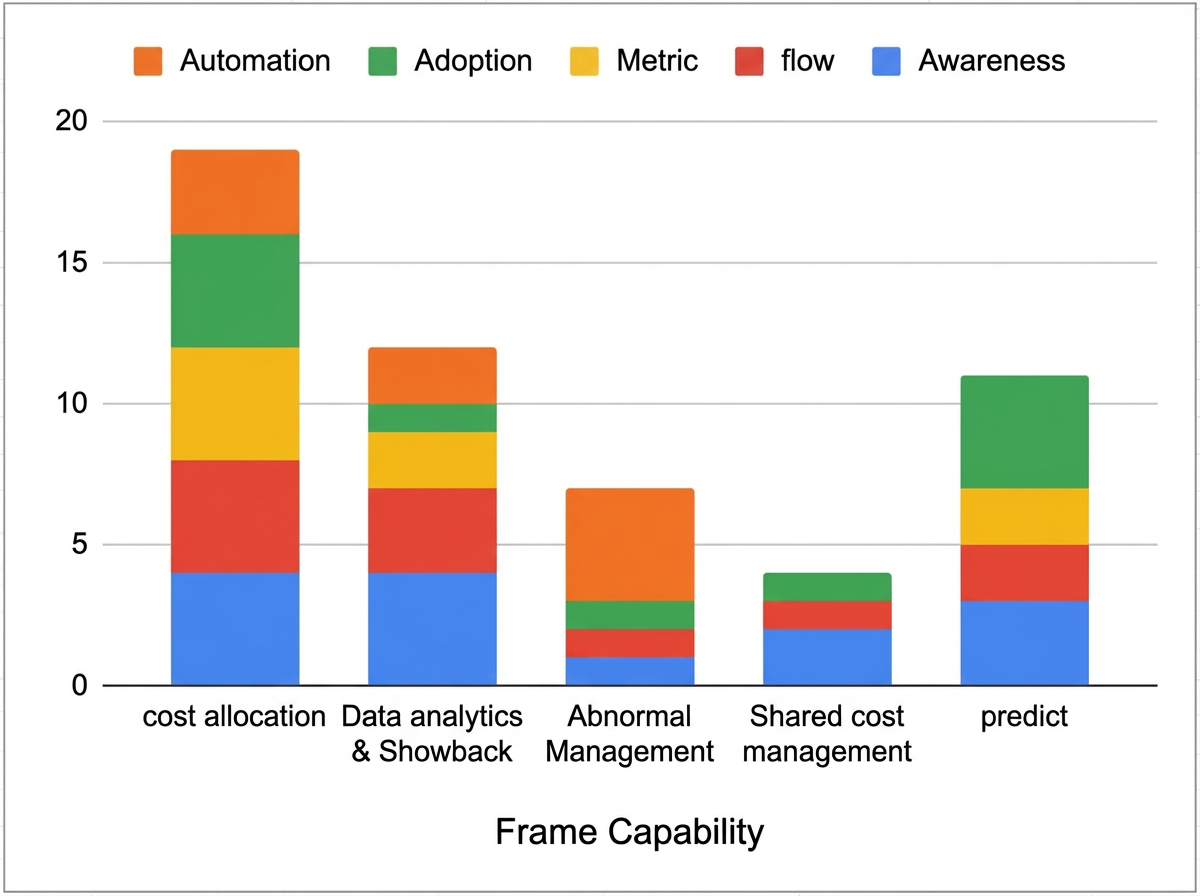
In the preceding fictional case, a breakdown of the capability set across the five dimensions highlights its strengths and weaknesses. This analysis pinpoints the areas that require the most improvement and suggests a direction for future efforts.
Significance of data
Clearly, most capabilities score high in the Awareness and Process dimensions, and performance in the Adoption dimension is also strong. However, there is still room for improvement in Metrics maturity, and some capabilities have begun to transition to Automation. Many capabilities have not yet leveraged tools to improve efficiency. Your previous efforts to drive improvements in reporting and analytics have resulted in high total scores for the cost allocation and data analysis and cost visibility capabilities. This provides a solid foundation for developing other highly dependent areas, such as anomaly management.
This data clearly identifies areas for improvement. Use this information to guide further discussions, uncover potential obstacles, and develop a roadmap for achieving measurable improvements in the next assessment.
You can save this data and regularly repeat the assessment using the same scope and criteria. The column chart helps you easily visualize score changes and track improvements.
Assessment phase 4: Focus
Now that you have analyzed the results, refer to the discovery questions you developed in the "Collect evidence" phase to delve deeper into specific areas.
Determine how to highlight key areas of concern. Then, identify which dimension has shortcomings that affect a capability and its related capabilities.
Consider the Shared Cost Management capability, which is part of the allocation capability in the 2024 framework. This capability has significant room for growth, given its score of 0 in both the metrics and automation dimensions. A score of 0 indicates that you cannot accurately measure progress or effectiveness in this domain and that no supporting tools are available. However, your organization is beginning to understand this capability, has taken initial action, and its adoption rate is increasing. Therefore, the organization may still be able to allocate and manage shared cloud costs to achieve the desired capability.
However, is this capability being implemented optimally?
Determine specific actions
First, without effectiveness metrics, you cannot determine if shared costs are being managed effectively. Second, the lack of automation means that the success of this capability relies heavily on manual operation. This poses a risk, especially when business priorities conflict. Establishing metrics and automation for this capability improves efficiency and frees up employees to create more value in other areas.
Categorization and sorting
Review the capability priorities discussed in the "Target scope" section to identify which capabilities will be used repeatedly in the next phase of the roadmap. You can combine this insight with the analysis from "Phase 3: Results" and the discovery questions to prioritize your next major focus of work.