Security posture report - June 2026
1. Platform attack and defense posture
Cloud platform default defense
Default defense is the baseline protection capability provided by the Alibaba Cloud platform. Leveraging extensive cloud security threat intelligence, it blocks large-scale attacks that target cloud customers. This defense provides out-of-the-box security with no manual configuration.
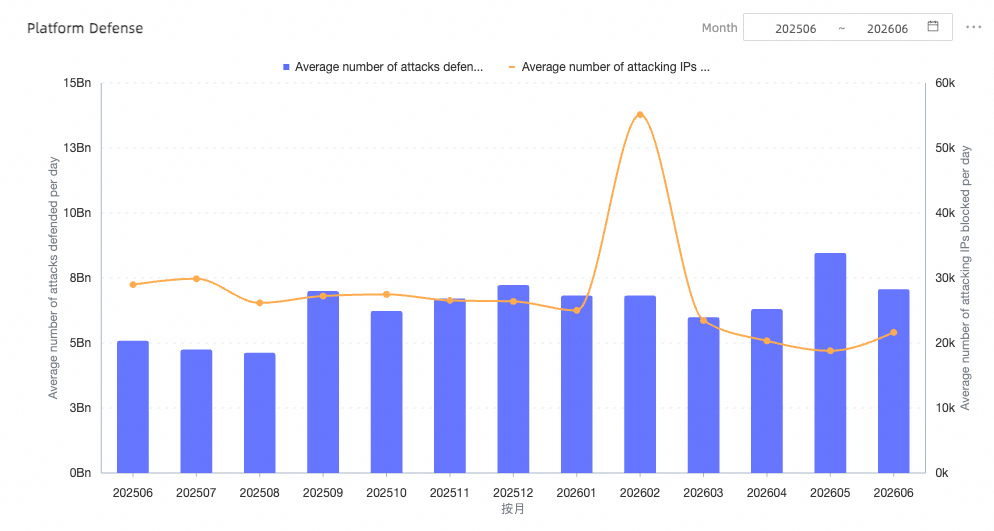
In June 2026, the cloud platform provided the following average daily defenses:
Blocked 7.067 billion attacks, a 16.5% decrease month-over-month.
Blocked 21,600 malicious IP addresses, a 15.1% increase month-over-month.
DDoS attack interceptions
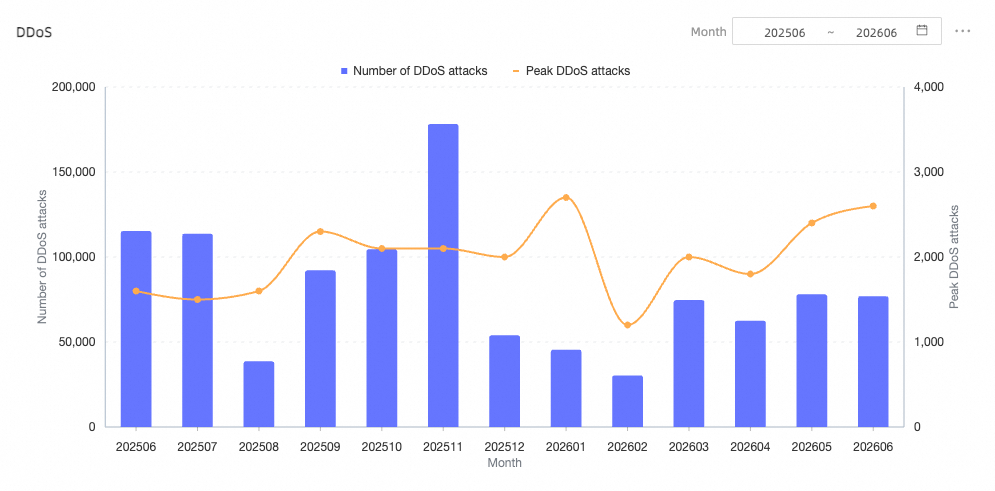
In June, the Alibaba Cloud platform detected and blocked:
DDoS attacks: 77,000, a 1.45% decrease from the previous month.
Peak DDoS traffic: 2,600 Gbps, an 8.33% increase from the previous month.
2. Recent attack techniques and trends
Trend 1: Frequent SSH brute-force attacks
In June, SSH brute-force attacks continued to be a prevalent threat on the cloud platform, and the OCNET and OUTLAW attack groups were particularly active. Both groups primarily use SSH weak password brute-force as their main entry point, but they differ in their persistence strategies, payloads, and operational characteristics.
OCNET group
The OCNET group has been active since late May, launching multiple large-scale SSH brute-force attacks. After gaining access to a host by using a weak password, the group implants a mining program and various persistence backdoors, including SSH public key backdoors and hidden backdoor files.
Compared to previous brute-force groups, OCNET is distinguished by its strong persistence capabilities. It ensures long-term control over compromised hosts by implanting SSH public key backdoors, continuously reactivating existing backdoors, and deploying new ones. The group is also notably active in DDoS attacks, frequently deploying DDoS backdoors and launching attacks.
Tactics
Initial Access: Uses automated tools to launch weak password brute-force attacks against public-facing SSH services to gain host login credentials.
Persistence: Writes an SSH public key to
~/.ssh/authorized_keys, deploys multiple hidden backdoor files, and maintains long-term control by periodically reactivating existing backdoors and deploying new ones.Payload delivery: Downloads and executes a mining program and a DDoS attack backdoor, which can dynamically switch between mining and DDoS modes based on commands.
Lateral movement: Uses compromised hosts as pivot points to continue scanning and brute-forcing other targets in the same network segment or other networks, expanding the botnet.
Typical IOCs
ocnet@goat666.xyz
cnet.goat666.xyz
google.kasin.xyz
fa83031a6964319843f67713fdd56b80
0e94a61a1690e53cf211dbc6163c75b5
138ba58259d3c64b34a2b9c5d0b8b178
e49c610315ff35dca6729fda138553d5
72b1b3948704c886233ad5b7d43d7a6d
329de3d499fae917826818b9a86a1387
OUTLAW group
OUTLAW is another active group that primarily uses SSH brute-force attacks. In June, it continued to attack cloud tenants' hosts. This group mainly gains access through SSH weak passwords, then downloads a malicious archive, such as dota3.tar.gz, to deploy its mining payload. The attack process is relatively direct, and it also demonstrates some persistence capabilities.
Tactics
Initial Access: Gains host login credentials through an SSH weak password brute-force attack.
Payload delivery: After logging in, directly downloads a malicious archive, such as
dota3.tar.gz, and executes the built-in mining program after decompression.Basic persistence: Uses conventional methods, such as SSH public keys and scheduled tasks, to keep the mining process running. No advanced persistence backdoors have been found.
Resource Consumption: Primarily focuses on a single mining payload, continuously occupying host computing resources.
Typical IOCs
dota3.tar.gz
a803de211bbdc0dfae46c5e2af7b2591
01a3ca860b8d0dc45c339d121a8dd44a
1c8a4f64d73112bcda7018741b53e4d9
08b13458bc0ae06e5b6c6d1e791ea38a
Security recommendations
Harden SSH authentication: Replace all weak passwords with strong passwords that are at least 12 characters long and contain a mix of uppercase letters, lowercase letters, numbers, and special characters. Disable direct root login via SSH; use a standard user account and elevate privileges with
sudo. Prioritize SSH key-pair authentication over passwords, and disable password authentication by settingPasswordAuthentication noin/etc/ssh/sshd_config.Reduce the attack surface: Avoid exposing port 22 to the public internet unless necessary. If it must be exposed, configure your security group to allowlist only trusted source IP addresses, or control access through a VPN or a bastion host.
Remediate infected hosts: If your host has been compromised by a botnet backdoor, refer to the ECS-Exclusive Free Security Protection Benefits documentation. In Cloud Security Center, go to Protection Configuration > Virus Scan to perform a deep scan. This action will automatically remove malicious programs, backdoor files, unauthorized SSH public keys, and persistence startup items.
Trend 2: Prevalent ransomware attacks
Ransomware attacks against cloud tenants have remained frequent in recent months. In June, attacks continued to primarily use web application vulnerability scanning and RDP weak password brute-force as entry points, targeting various business systems such as ERP, logistics, and finance. Active ransomware families this month included Mallox, Phobos, Sorry (Tellyouthepass), and Weaxor (.weax).
Tactics
Attackers primarily gain initial access through the following three paths:
Web application vulnerability scanning: Attackers automatically scan public-facing web business systems, such as ERP, OA, and logistics platforms. They exploit known remote code execution (RCE), deserialization, or unauthorized access vulnerabilities at the HTTP/HTTPS layer to directly implant ransomware.
RDP weak password brute-force: Attackers probe for public-facing RDP services (port 3389) and use weak password brute-force or credential stuffing to gain remote desktop control.
Private protocol port exploitation: Attackers target non-standard TCP ports, such as 211/TCP used by enterprise management software like GuanJiaPo. They exploit unauthorized access flaws in the private binary protocol to directly execute system-level commands.
The first two methods remain the most common due to their wide attack surface and low barrier to entry. Although the third method is less common, its stealthiness and evasiveness make it an increasingly popular supplementary path for some ransomware families.
Frequently scanned applications
The following applications were among the most frequently targeted in ransomware-related scanning attacks in June. Attackers primarily exploited their historical vulnerabilities (SQL injection, arbitrary file upload, RCE), unauthorized access interfaces, or default weak passwords as entry points:
Chanjet T+ ERP system
TOMS logistics management system
Yonyou NC Cloud / U+ series
GuanJiaPo management software series
Kingdee K/3 Cloud
Security recommendations
If you have deployed any of the applications listed above, take the following hardening measures immediately:
Reduce internet exposure: Avoid directly exposing management consoles, API interfaces, databases, and private protocol ports to the public internet. In security group inbound rules, avoid using
0.0.0.0/0. Instead, restrict access to trusted source IPs or use a VPN or bastion host for access control.Patch application vulnerabilities or upgrade to a secure version: Immediately check for security bulletins from vendors like Chanjet, Yonyou, Kingdee, and GuanJiaPo. Prioritize patching high-risk vulnerabilities such as RCE, deserialization, and unauthorized access. For systems that cannot be upgraded immediately, follow Recommendation 1 to reduce their exposure.
Alibaba Cloud has sent security alerts to some users who may be at risk of ransomware attacks. If you have received such an alert, please follow the instructions to take immediate action. If you have any questions, submit a security ticket for assistance.
3. Frequently exploited vulnerabilities
(1) Newly disclosed critical vulnerabilities
Nezha Monitoring vulnerabilities (Nezha Probe)
Nezha Monitoring (Nezha Probe) is a widely used open-source server monitoring tool. In May-June 2026, seven security vulnerabilities were disclosed that can be chained to create a complete attack path from initial access to full control. A large number of victim servers have been compromised with the gary@gary SSH backdoor public key, mining programs, and DDoS tools.
Affected versions: < v2.0.14 | Patched versions: ≥ v2.0.14
CVE ID | CVSS | Type | Core impact |
CVE-2026-53519 | 9.1 | Unauthenticated path traversal | No authentication required. Two GET requests can read the config file and forge an admin identity to take over the panel. |
CVE-2026-46716 | 9.9 | Cross-tenant remote code execution | Allows a low-privilege user to execute arbitrary system commands on all monitored servers. |
CVE-2026-46717 | High | SSRF (with response body reflection) | Allows a low-privilege user to probe the internal network and read data from the cloud metadata service. |
CVE-2026-47124 | Medium-High | WebSocket cross-tenant data leak | Allows any authenticated user to access telemetry data from all servers. |
CVE-2026-48119 | — | Agent data spoofing | Allows cross-tenant tampering of monitoring status, triggering false alerts. |
CVE-2026-49396 | — | CSRF to trigger scheduled tasks | Tricks an administrator's browser into automatically executing malicious tasks. |
CVE-2026-49397 | — | Private service information leak | Allows unauthenticated visitors to enumerate hidden services. |
If you are using Nezha Monitoring, perform the following checks as soon as possible:
Upgrade to v2.0.14 or later. After upgrading, check for any unauthorized SSH keys (especially gary@gary), unknown scheduled tasks, and unexpected administrator accounts.
Avoid exposing the management port (usually 8008) directly to the public internet. Use a security group to restrict access to trusted IPs only.
LiteLLM Gateway vulnerability chain
LiteLLM is an open-source AI gateway proxy library. In June 2026, a security research firm disclosed a complete attack chain that escalates from a low-privilege account to arbitrary code execution, with a composite CVSS score of 9.9. An attacker can start with the default low-privilege account internal_user, bypass authorization to gain access to all routes, and then achieve RCE through privilege escalation or by directly calling the MCP test endpoint. A successful exploit allows an attacker to steal all model API keys, database credentials, and all prompts and responses passing through the gateway. It also allows attackers to tamper with model outputs to hijack downstream AI agent behavior, posing an AI supply chain poisoning risk.
Affected versions: < v1.83.14-stable | Patched versions: ≥ v1.83.14-stable
CVE ID | CVSS | Type | Core impact |
CVE-2026-47101 | — | Authorization bypass | A low-privilege user can gain access to all routes via |
CVE-2026-47102 | 8.7 | Privilege escalation | Allows a user to change their role to |
CVE-2026-42271 | — | Command injection (CISA KEV) | The MCP test endpoint accepts command/args parameters, enabling arbitrary system command execution. |
CVE-2026-40217 | — | Sandbox escape | An attacker can bypass the |
If you are using LiteLLM, upgrade to v1.83.14-stable or later immediately, remove the default internal_user account, and disable unnecessary endpoints such as the MCP test endpoint.
(2) Other frequently exploited vulnerabilities
No. | Vulnerability | Identifier |
1 | React Server Components deserialization remote code execution vulnerability | |
2 | xxl-job remote code execution vulnerability | |
3 | Docker daemon API unauthorized access vulnerability | |
4 | PHP CGI for Windows remote code execution vulnerability | |
5 | Hadoop YARN REST API command execution vulnerability | |
6 | PHP-FPM misconfiguration remote code execution vulnerability (php < 7.1.32) | |
7 | Redis unauthorized access vulnerability | |
8 | PostgreSQL arbitrary code execution vulnerability | |
9 | Apache ActiveMQ remote code execution vulnerability |