Estimating the value of enterprise cloud migration
In a traditional value chain model, only primary activities generate value, while other activities only affect costs and efficiency. In the digital age, support activities and the entire upstream and downstream supply chain can also create value. This expands the overall potential for value creation. By adopting a cloud strategy, an enterprise can easily incorporate digital elements and methods into these activities. This allows more activities to generate value and creates a "cloud-driven digital value loop". This loop consists of four main parts: technology, operations, business, and organization.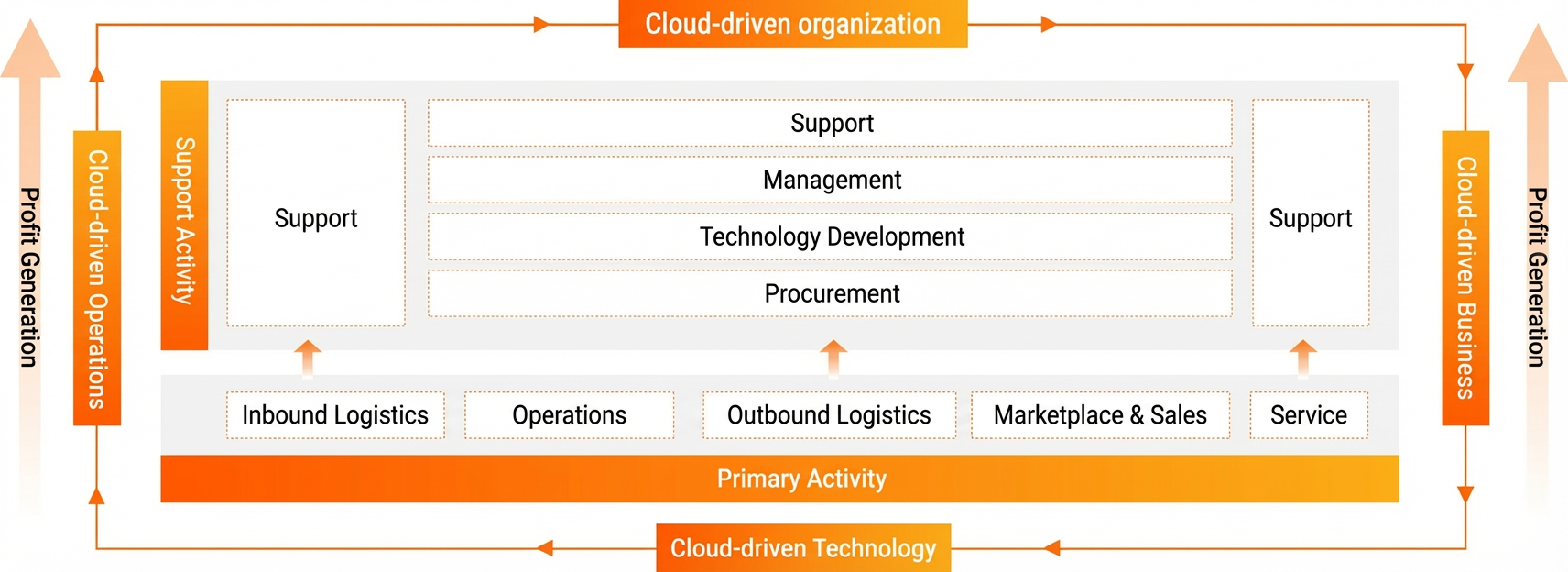
1. Value from cloud-driven technology
Enterprises that adopt a cloud strategy can solve key business problems using advanced cloud-native technologies. A cloud-native architecture enables fast, cross-region, and cross-business collaboration. It builds distributed business operations on a unified cloud and network infrastructure. Cloud-native development makes technology adoption more agile, which speeds up the migration of enterprise applications to the cloud. It also meets the technical demands for flexibility and adaptability that business innovation requires. The high reliability of cloud-native technology ensures business continuity. This provides enterprises with a platform to acquire advanced technical capabilities at a lower total cost and guarantees that high-level non-functional requirements are met.
2. Value from cloud-driven operations
After migrating to the cloud, the focus of Operations and Maintenance (O&M) shifts away from maintaining the stability and reliability of data center hardware. Operations transition from multi-platform, manual work to a single-platform, automated approach. This helps standardize IT service management activities, such as defining IT service level agreements (SLAs), refining metering, billing, and financial accounting, and aligning IT operational metrics with business operational metrics.
3. Value from a cloud-driven business
When business innovation and the cloud become deeply integrated, every part of the enterprise changes dramatically. These changes are driven by two new elements: data and online capabilities. Many current business innovations transform traditional, stable business models using data as the raw material and growing natively on the cloud. Migrating business and data to the cloud creates more connections and establishes data feedback loops. This, in turn, creates new digital services and fundamentally improves competitiveness.
4. Value from a cloud-driven organization
By migrating to the cloud, an enterprise builds the foundational infrastructure for its overall digitalization. The cloud-driven concept introduces new ideas and provides momentum for an enterprise's digital transformation. Building a cloud-driven organization improves collaboration efficiency and digitalizes management. It also encourages employees to value data and fosters a data-centric culture, which helps build a digital mindset. This enhances digital thinking in management and innovation and develops the ability to apply digital solutions.