Add a PolarDB for Oracle data source
Add a PolarDB for Oracle data source in DataV to visualize data from PolarDB, a next-generation cloud-native relational database that is fully compatible with Oracle syntax.
Prerequisites
A PolarDB for Oracle data source is available.
Add the IP addresses of the corresponding region to your data source whitelist to ensure that DataV can access your database. For more information, see Configure a database whitelist.
Limits
This feature is available only in DataV Enterprise Edition and later versions.
Add a data source over an internal network
Access the DataV console.
-
On the Workbench page, click in the navigation pane on the left. On the Data Source page, click New Data Source.
-
From the Type list, select PolarDB for Oracle.
-
For Network, select Private Network and the region where the PolarDB instance is located.
-
Enter the database information.
Parameter
Description
Name
A custom display name for the data source.
VPC ID
The ID of the VPC that contains your PolarDB for Oracle instance. Find this ID on the instance details page in the PolarDB console. To view the VPC ID and VPC Instance ID, add the private IP address of the DataV VPC in the instance's region to the whitelist.
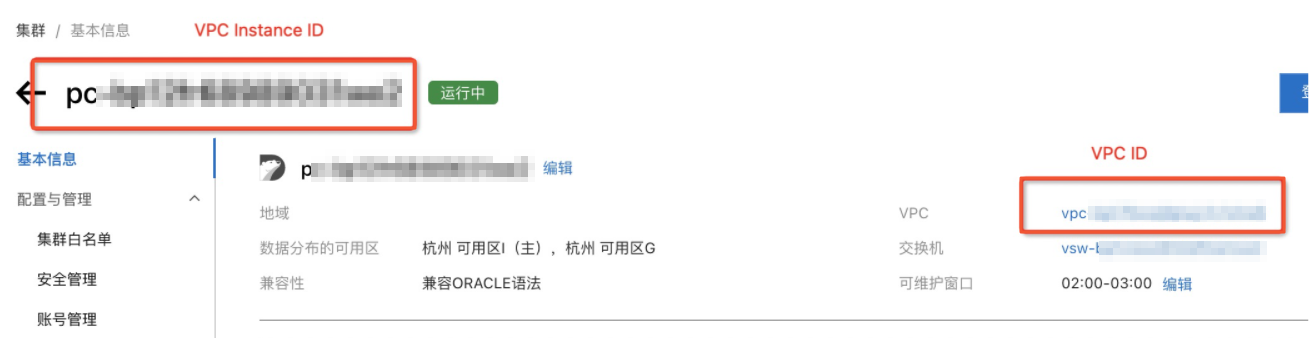
VPC Instance ID
The ID of the database instance in the VPC. Find this ID on the instance details page in the PolarDB console.
Domain Name
The internal endpoint of the database.
ImportantThis is the domain name or IP address that the DataV server uses to access your database over the public network or an Alibaba Cloud internal network in some regions.
For example, for an Alibaba Cloud PolarDB for Oracle instance on an internal network, the domain name looks like `xxxxxxxx.o.polardb.rds.aliyuncs.com`. To use this domain name, go to the instance details page in the PolarDB console and add the private IP address of the DataV VPC in the instance's region to the whitelist. You can use the internal endpoint after the configuration takes effect.
Port
The port number of the database.
Username
The username to log on to the database.
Password
The password to log on to the database.
Database
The name of the database.
-
After you enter the database information, the system automatically tests the connection to verify that the database is reachable.
-
After the connection test is successful, click OK to add the data source.
The new data source appears in the data source list.
Add a data source over the public network
Access the DataV console.
-
On the Workbench page, click in the navigation pane on the left. On the Data Source page, click New Data Source.
-
From the Type list, select PolarDB for Oracle.
-
For Network, select Public Network.
-
Enter the information for the PolarDB for Oracle data source.
Parameter
Description
Name
A custom display name for the data source.
Domain Name
The public endpoint of the database.
ImportantThis is the domain name or IP address that the DataV server uses to access your database over the public network or an Alibaba Cloud internal network in some regions.
For example, for an Alibaba Cloud PolarDB for Oracle instance on the public network, the domain name looks like `xxxxxxxx.o.polardb.rds.aliyuncs.com`. To use this domain name, go to the instance details page in the PolarDB console, request a public endpoint, and add the public IP addresses of DataV to the whitelist. You can use the public endpoint after the configuration takes effect.
Port
The port number of the database.
Username
The username to log on to the database.
Password
The password to log on to the database.
Database
The name of the database.
-
After you enter the information, click OK to add the data source.
The new data source appears in the data source list.
What to do next
To use the data source in your widgets, see Configure a widget data source.
FAQ
For more information, see FAQ about data source configuration and usage.