One-click JDBC for logical data warehouse
The one-click JDBC access feature in Data Management Service (DMS) lets you securely access a logical data warehouse from your applications. By using the proxy endpoint generated by this feature, you can connect directly through standard MySQL and HTTPS protocols. This topic describes the use cases for one-click JDBC access and explains how to enable or disable it.
Use cases
-
Run federated queries across multiple databases from your application.
-
Query data archived by DMS to dedicated storage space or Object Storage Service (OSS) from your application.
-
Create reports that support federated queries in your business intelligence (BI) tools.
Prerequisites
This feature requires the administrator system role. For more information, see System roles.
How to enable
The one-click JDBC access feature for a logical data warehouse is currently available only to users on an allowlist. To use this feature, join the DingTalk group (Group ID: 44962304) and provide your tenant ID to technical support for access. To learn how to obtain your tenant ID, see View tenant information.
Features
-
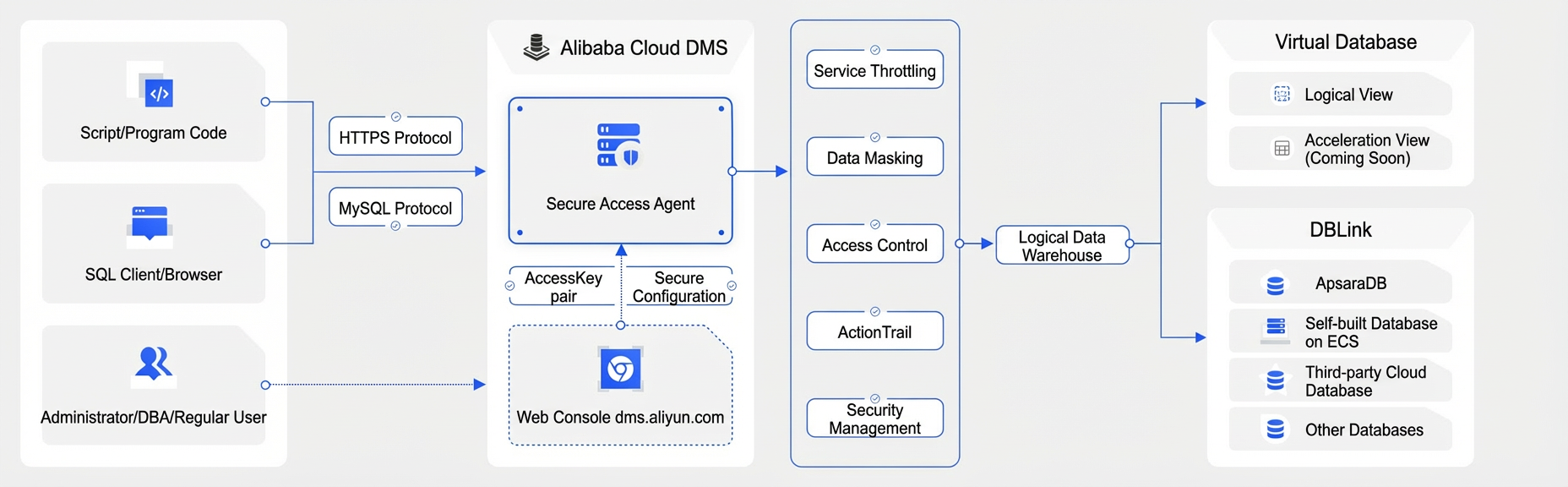
One-click JDBC access provides security capabilities, such as security governance, access control, data masking, and operation auditing, for enterprise applications that access a logical data warehouse.
-
One-click JDBC access is built on the secure access proxy feature of DMS and provides access proxies for the MySQL and HTTPS protocols.
Limitations
-
A single query can return a maximum of 3,000 rows.
-
The client-side SQL query timeout cannot exceed 15 minutes.
Procedure
Step 1: Enable or disable one-click JDBC
Log in to DMS 5.0.
-
In the left-side navigation pane, click Logical Data Warehouse.
NoteIf you are using the console in simple mode, click Database Instance on the left side of the homepage, and then click Logical Data Warehouse in the instance list.
-
On the logical data warehouse page, click one-click JDBC access in the SQL Console toolbar.
-
In the one-click JDBC access dialog box, enable or disable the feature.
ImportantAfter you disable this feature, the system automatically releases physical resources, such as the access proxy and authorized accounts. These resources cannot be recovered. Proceed with caution.
In the one-click JDBC access dialog box, set Access Proxy to Enable or Disable. After you enable it, you can view the Internal endpoint (MySQL and HTTP(S) endpoints) and Public endpoint (MySQL and HTTP(S) endpoints), and the Default Account and Default Password. The Copy Sample Code section at the bottom lets you quickly copy the JDBC connection string, MySQL command, and HTTPS request.
Step 2: Create an authorized account
-
An authorized account is a security credential that contains user information for securely accessing the destination database.
-
A single DMS user can create multiple authorized accounts. Each account has the same database permissions.
You can create an authorized account in one of the following ways:
-
Automatic creation: If you enable one-click JDBC access or open the one-click JDBC access dialog box, the system automatically creates an authorized account.
-
Manual creation: In the one-click JDBC access dialog box, click View Details. On the secure access proxy details page, click Authorize in the Authorization Information section to create an authorized account. For more information, see Grant permissions for a secure access proxy.
NoteIf you are a regular user, contact an administrator to create an authorized account.
Step 3: Connect using one-click JDBC
After enabling one-click JDBC access, the logical data warehouse acts as the destination instance for the access proxy and provides secure access through the MySQL and HTTPS protocols.
-
For information about commonly used drivers and tools, see Commonly used drivers and tools.
-
For detailed steps, see Connect to an instance by using the MySQL protocol and Connect to a destination instance over HTTPS.
Related operations
Manage the public endpoint: The public endpoint is enabled by default, which allows you to connect to the logical data warehouse from your local applications. You can click View Details in the one-click JDBC access dialog box to navigate to the secure access proxy details page, where you can enable or disable the public endpoint.
Use the internal endpoint if your Alibaba Cloud service is deployed in a VPC in the China (Hangzhou) region. Otherwise, use the public endpoint.