Application containerization service details
1. Overview
1.1 Service description
As cloud computing continues to develop and gain popularity, more enterprises are deepening their understanding of the cloud and actively pursuing cloud-based transformations. The focus has shifted from simply migrating to the cloud to using the cloud effectively. Cloud-native technology, which embodies the benefits of cloud computing, is becoming the de facto standard and the future of the industry. As a key component of cloud-native technology, containerization is the foundation of cloud-native and the first step for enterprises in their cloud-native transformation. In recent years, Kubernetes from the Cloud Native Computing Foundation (CNCF) has become the de facto standard for container orchestration. As a member of and contributor to the CNCF, Alibaba Cloud has invested heavily in cloud-native and containerization technologies and provides customers with application containerization delivery services. By implementing key cloud-native technologies, such as containerization and automation, and leveraging Alibaba Cloud's complete cloud-native ecosystem, we work with customers to build more flexible, modern, and standard cloud-native applications that support more efficient and rapid business development.
In a broad sense, cloud-native generally refers to four core technologies: containerization, microservices, DevOps, and continuous delivery. As cloud computing evolves, the scope of these four concepts can be expanded. Containerization specifically refers to the application running environment, which enables unified management and orchestration. Microservices emphasize a distributed, decoupled, and highly cohesive application architecture. This architecture is a stateless aggregation built for elasticity. DevOps emphasizes automation and observability, enabling capabilities such as resource utilization, performance monitoring, and service administration through popular methodologies and tools. Continuous delivery represents an application's ability to respond to business needs, including its flexibility, robustness, and elasticity. The application containerization service is not limited to encapsulating applications into containers. It also involves continuous improvements and implementations in other cloud-native areas, such as automation, DevOps, and observability. The scope of these improvements is adjusted based on the specific project and the customer's requirements.
2. Scope of service
The service is available in three editions: Standard, Advanced, and Premium. Each edition is delivered based on the specific needs of the customer.
2.1 Standard Edition scope of service
The Standard Edition includes the following services:
Infrastructure assessment
Business status and application system assessment
Cloud architecture design
Application containerization solution design
Containerization and cloud migration solution design
DevOps automation solution design
Implementation of one sample application transformation
2.2 Advanced Edition scope of service
The Advanced Edition includes all services from the Standard Edition, plus the following:
Microservice administration solution design
Observability implementation solution design
2.3 Premium Edition scope of service
The Premium Edition builds on the Advanced Edition by providing an additional month of support. This helps customers containerize their core business systems more quickly.
Service boundaries and scope:
In the consulting package, Alibaba Cloud provides only consulting and solution design within the agreed-upon scope. We will assist with the containerization transformation of one sample core business system. The customer is responsible for transforming the remaining systems.
In both the consulting and implementation support packages, Alibaba Cloud does not participate in specific code modification or implementation. These tasks must be performed by the customer or the customer's developers.
Alibaba Cloud does not provide application Operations and Maintenance (O&M) services after the containerization transformation is complete.
Alibaba Cloud provides technical solutions and support based only on the Alibaba Cloud platform. If third-party software or application systems outside the Alibaba Cloud platform are used, Alibaba Cloud provides only consultation and advice. We do not provide implementation support or guarantee the outcome.
Alibaba Cloud provides containerization technical solutions based only on Container Service for Kubernetes (ACK). We do not support self-built Kubernetes clusters or other container clusters on the cloud.
3. Prerequisites
You must request this service at least 15 calendar days in advance. This allows Alibaba Cloud to evaluate the feasibility of your business goals and timeline and to confirm whether to accept the service request.
You must promptly provide Alibaba Cloud with all necessary and reasonable documents, information, data, charts, system permissions, and remote access channels to enable service delivery. All such materials are subject to the confidentiality clauses of this agreement. You agree that all information disclosed or to be disclosed to Alibaba Cloud is true, accurate, and not misleading.
This project provides containerization consulting services. The location of Alibaba Cloud's office is not a constraint for this project. Services are delivered primarily through phone, DingTalk, and email.
You are the primary entity responsible for implementation. Alibaba Cloud primarily provides solution design and troubleshooting during the implementation process. You must perform specific application deployments and testing.
During project implementation, both parties will use mutually agreed-upon communication methods. The project managers for both parties are responsible for exchanging the written information required for the project. Communication methods may include DingTalk, the Internet, and email.
All project deliverables will be in Simplified Chinese, and the working language will be Chinese. All deliverables will be in Microsoft Office formats, such as PowerPoint, Word, Excel, and Visio, and submitted as electronic copies.
Party A and Party B must perform the project work according to the agreed-upon work plan, personnel resource plan, and the start and end dates confirmed in writing. If Party A delays the release of iterations for its business systems, the project schedule will be postponed accordingly, and Party B will not be held responsible for such delays.
Neither party is liable for any special, incidental, or indirect damages or consequential economic losses (including loss of profits or savings) under this project, even if the party has been advised of the possibility of such damages.
As the O&M entity, you must perform O&M tasks related to your own business.
4. Division of responsibilities
4.1 Customer and Alibaba Cloud
Both parties agree on and confirm the specific business objectives and scope.
The contract is signed and payment is completed.
4.1.1 Responsibilities of both parties in each phase
To ensure the project proceeds smoothly, both parties have different responsibilities in each phase, as outlined in the project plan.
Project phase | Customer | Party B |
Project preparation phase |
|
|
Current state assessment phase |
|
|
Solution design phase |
|
|
Solution implementation phase |
|
|
Cutover and support |
|
|
4.1.2 Completion criteria
After the system cutover is confirmed, Alibaba Cloud will assist you with a comprehensive functional acceptance of the system. We will assist with functional regression testing, troubleshoot and identify potential issues and abnormalities, and help you resolve them.
The completion criteria for the Standard and Advanced Editions are:
The covered deliverables are accepted, which means they are signed and confirmed by you.
The implementation of one sample core application is completed.
The completion criteria for the Premium Edition are:
The deliverables covered in the Standard and Advanced Editions are accepted, which means they are signed and confirmed by you.
The additional one-month support service is time-limited. The service is considered complete when the support period ends.
4.2 Service Catalog
Service content: Alibaba Cloud provides the following services to meet your business objectives:
Phase name | Service Catalog | Standard Edition | Advanced Edition | Premium Edition |
Project preparation phase | Pre-delivery preparation | Support | Support | Supported |
Project assessment phase | Infrastructure assessment | Support | Supported | Support |
Business status and application system assessment | Support | Support | Support | |
Containerization goal assessment | Supported | Supported | Supported | |
Solution design phase | Cloud architecture design | Supported | Support | Support |
Application containerization solution design | Support | Support | Support | |
DevOps automation solution design | Support | Supported | Supported | |
Containerization and cloud migration solution design | Support | Supported | Supported | |
Observability solution design | Support | Support | ||
Solution implementation phase (Only for one sample application) | Infrastructure and architecture implementation | Supported | Support | Support |
Containerization transformation implementation | Supported | Support | Support | |
DevOps implementation | Support | Support | Support | |
Observability integration implementation | Support | Support | ||
Containerization migration to cloud implementation | Support | Support | ||
Cutover assurance | Cutover preparation and implementation | Support | Support | Supported |
Ongoing transformation support | One-month application transformation support (extends the service period only) | Supported |
5. Service-Level Agreement (SLA)
Provide expert services for containerization delivery.
Provide an application transformation support group and on-site support as needed during the service period.
Provide deliverables, such as the Application Containerization Solution, DevOps Automation Solution, Containerization and Cloud Migration Solution, and Observability Solution, based on the service plan. The specific deliverables vary depending on the service content.
6. Service process
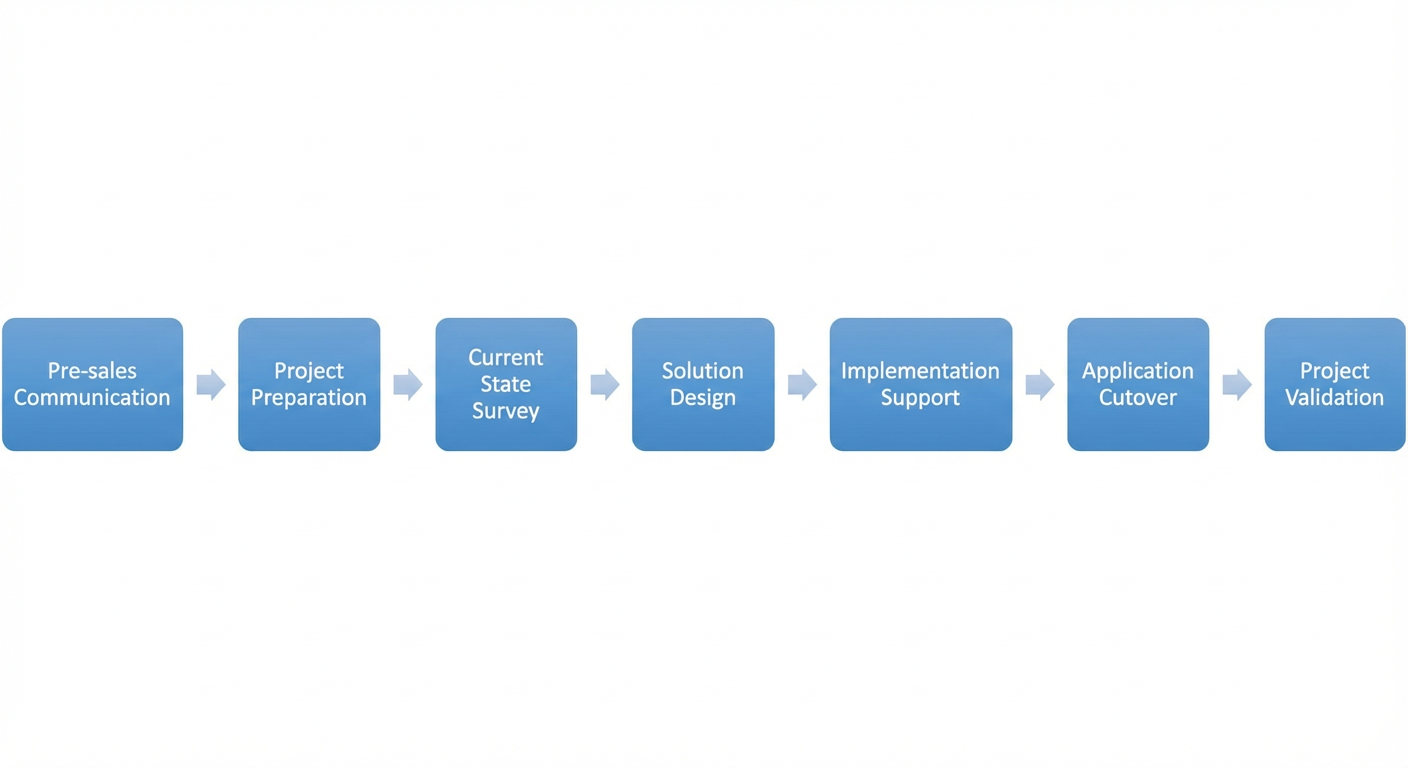
Application deadline: You must submit a purchase request for the service at least 15 days before the service start date.
Service process overview:
7. Acceptance criteria
7.1 Acceptance checklist
No. | Delivery phase | Deliverable | Deliverable type |
1 | Project assessment phase | "Project Assessment Report" | Document |
2 | Solution design phase | "Cloud Container Architecture Design Solution" | Support |
3 | "Application Containerization Solution" | Document | |
4 | "DevOps Automation Solution" | Document | |
5 | "Containerization Migration to Cloud Solution" | Document | |
7 | "Observability Solution" | Document | |
8 | Solution implementation phase | "Application Containerization Implementation Support Issue Checklist" | Document |
7.2 Acceptance criteria
During the project delivery process, Alibaba Cloud provides technical support for the containerization transformation to ensure the process goes smoothly. Key information is recorded in documents. Therefore, the acceptance of document deliverables should focus on their content to confirm that what Alibaba Cloud submits meets your requirements.
If your business processes require internal reviews before Alibaba Cloud submits deliverables, you must facilitate and complete these internal reviews and reports before the agreed-upon acceptance time.
After a review meeting, if a document requires changes, Alibaba Cloud will make the changes and resubmit it for your acceptance. Your designated representative will then confirm acceptance. Acceptance is completed when you click the Confirm Acceptance button on the public cloud service system page.
Standard and Advanced Edition acceptance criteria:
The solution design meets your requirements and is confirmed with a signature. For more information about specific solutions, see the Section 7.1 Acceptance checklist.
The project is considered to meet the acceptance requirements upon the successful containerization and implementation of one sample core system.
Premium Edition acceptance criteria:
The solution design meets your requirements and is confirmed with a signature. For more information about specific solutions, see the Section 7.1 Acceptance checklist.
The project is considered to meet the acceptance requirements upon the successful containerization and implementation of one sample core system.
The service is considered complete and meets the acceptance requirements when the 30-day support period ends after the transformation of the one sample core system.
7.3 Acceptance plan
Party A agrees to accept the project deliverables from Party B based on the following acceptance plan and the deliverables for each phase listed in the '7.1 Acceptance Checklist'.
No. | Acceptance milestone | Acceptance content | Acceptance completion flag |
1 | Containerization solution design and validation completed | All deliverables from the project preparation, containerization assessment, and containerization cloud migration design phases | You confirm the "Acceptance Report" online. |
2 | Transformation and cutover of one sample core business system | All deliverables related to containerization transformation implementation support. For more information, see the Section 7.1 Acceptance checklist. | You confirm the "Acceptance Report" online. |
8. Completion flag
The customer has completed the acceptance process.