Dianxiaomi Enterprise Agent overview
This topic describes the product positioning, value proposition, and capabilities of Dianxiaomi Enterprise Agent.
What is Dianxiaomi Enterprise Agent?
Dianxiaomi Enterprise Agent extends the official capabilities of Dianxiaomi 5.0. It allows enterprises to customize models and build agents for specific scenarios. It supports the creation of brand-exclusive customer service models and dedicated agents, significantly improving the end-to-end efficiency of e-commerce customer service.
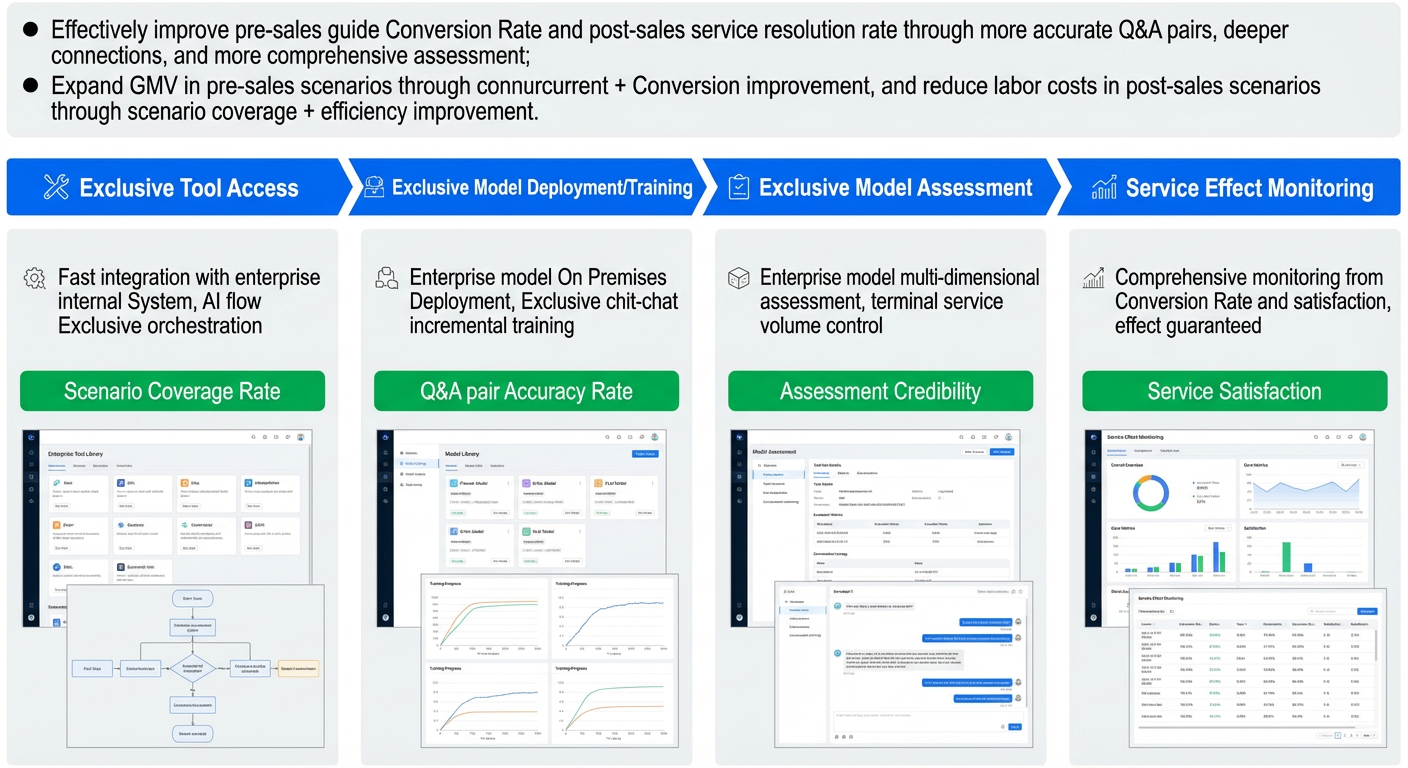
Provides access to official Dianxiaomi models, including VLM, Planner, and Critic, and supports enterprise fine-tuning.
Customized dedicated service agents deliver personalized service based on real-time user context.
Uses tools to actively solve problems, not just answer questions.
Calls platform tools: Flexibly calls platform APIs to quickly answer common logistics-related inquiries.
Calls merchant tools through ISVs, creating external collaboration tickets to streamline the end-to-end process from logistics verification to solution negotiation for complete problem resolution.
Scenario-based attribution: It establishes a closed-loop decision-making process based on specific scenarios, covering problem identification, optimization implementation, and performance tracking.
Core features
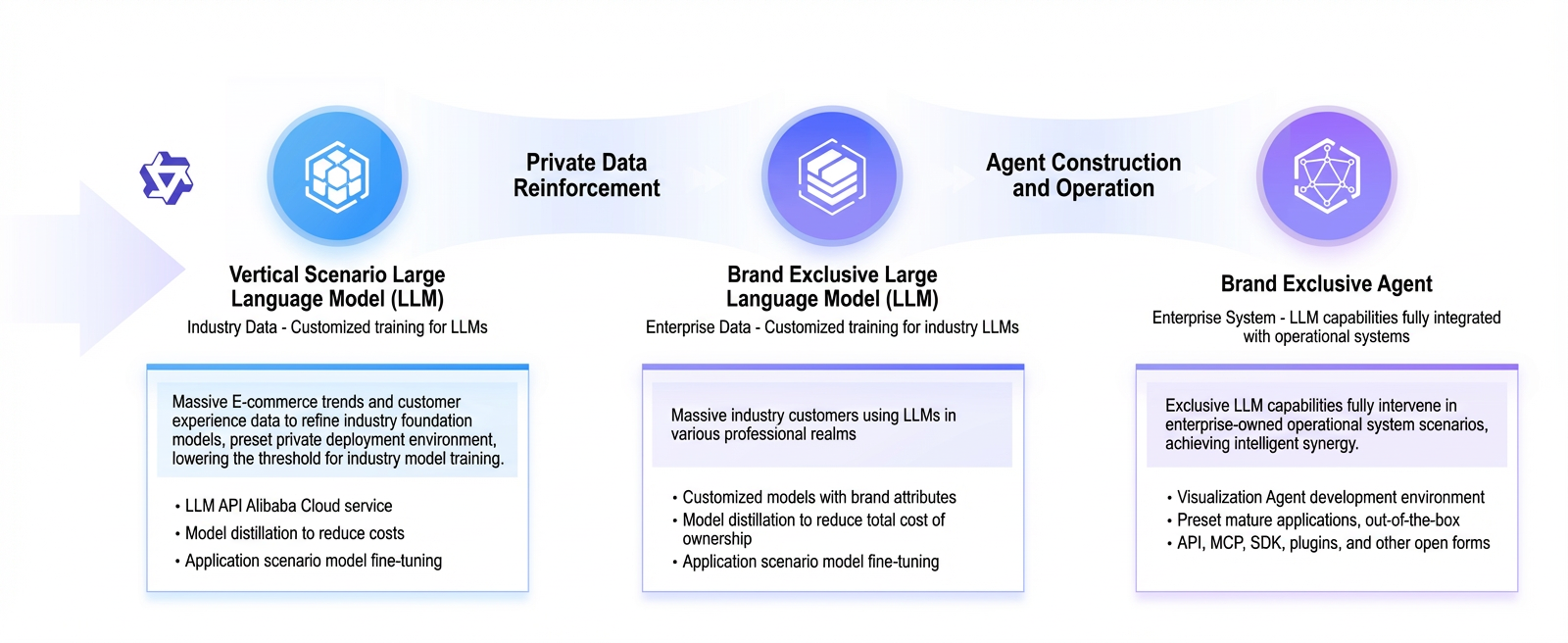
One-stop model service
Provides out-of-the-box official Dianxiaomi customer service foundation models: Planner, Critic, and VLM.
Supports rapid integration of custom-built enterprise foundation models.
Offers a one-stop service for fine-tuning, evaluation, deployment, and inference of official Dianxiaomi and open-source models to build enterprise-exclusive foundation models.
Supports model routing and service degradation strategies to enhance service flexibility and reliability.
Enterprise-exclusive agents
Lets you build various types of agents—such as knowledge-based Q&A, task-oriented, and composite—by combining prompts, a knowledge base, tools, and workflows.
Workflows orchestrate intelligent collaboration between agents with different functions to complete complex tasks.
Supports integration of multiple tool types: Enables calling interfaces and tools such as RESTful APIs, MCP, and workflows.
Enterprise-exclusive tools
Provides official pre-sales and post-sales MCP tools, such as product search and recommendation, shipping and logistics queries, campaign Q&A, and product comparison, to extend the capabilities of customer service agents.
Supports rapid integration of enterprise tools such as Enterprise Resource Planning (ERP), Customer Relationship Management (CRM), and Warehouse Management Systems (WMS) through MCP or API, enabling interoperability between internal and external systems.
Its proprietary MCP gateway provides enterprise-grade stability and security mechanisms, including authentication, authorization, rate limiting, circuit breaking, and service discovery.
Enterprise-exclusive pre-sales and post-sales workflows
Allows enterprises to customize complex pre-sales and post-sales workflows. This reduces reliance on prompt engineering and model inference, enhances the application's ability to handle complex tasks, and improves the system's explainability, stability, and fault tolerance.
Provides a rich set of workflow nodes, including foundation model calls, tool calls, document retrieval, data queries, information collection, conditional logic, memory variables, conversation replies, and intent classification.
Offers visual debugging tools to improve the efficiency of building and testing workflows.
Model performance monitoring
Configure traffic for both official and exclusive models, then gradually shift traffic after validating performance.
Compare performance metrics such as conversion rate, transfer-to-human rate, and satisfaction rate between official and exclusive models. Use this data to guide and validate model optimizations.
Core value propositions
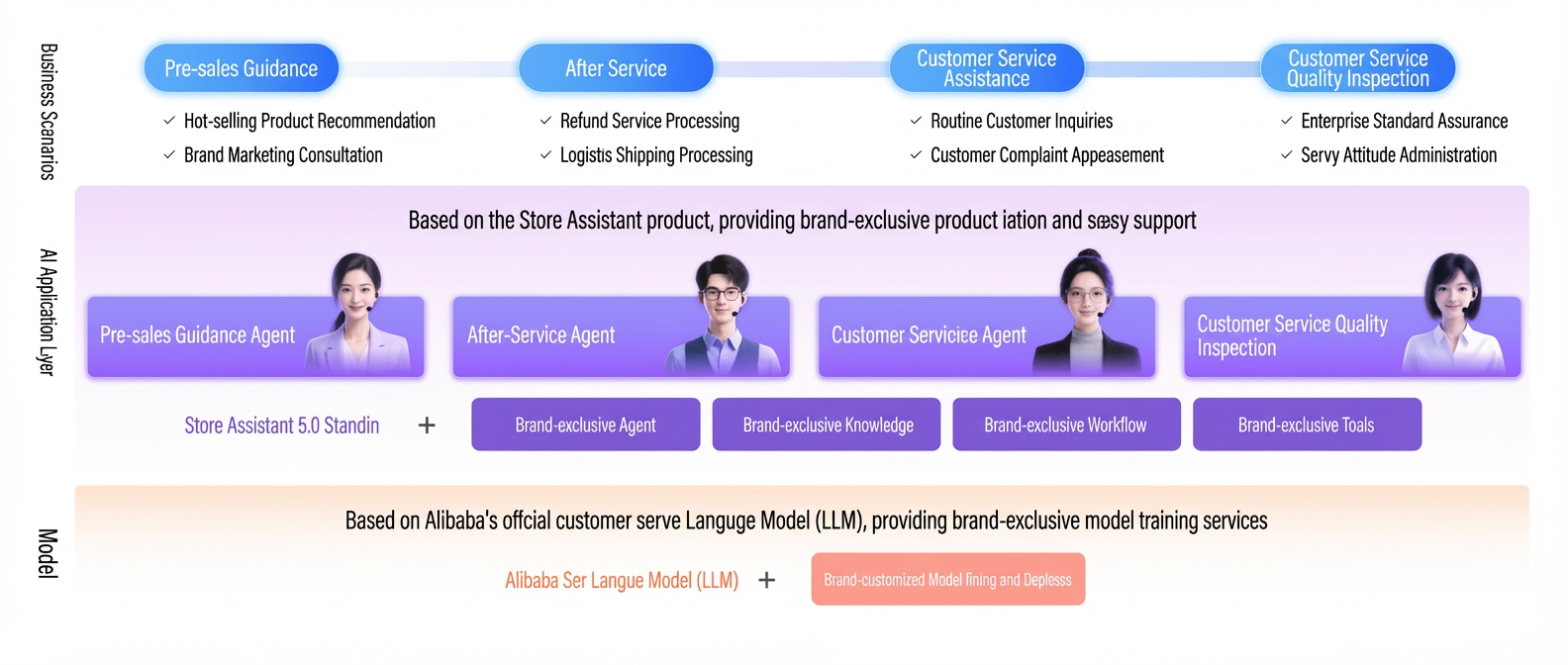
Build a brand-exclusive intelligent service brain
Brand-customized agents
Define agent personas and response styles that deeply align with your brand's tone and service philosophy.
Exclusive model training
Integrate Dianxiaomi 5.0 and platform-proprietary data within a compliance framework to build a unique and defensible competitive advantage.
Prompt-driven optimization and evaluation
Use prompts to drive and optimize decision logic, enabling agile configuration of AI service strategies and dynamic alignment with business goals.
Visual understanding
Enable multimodal image-and-text interactions, allowing the AI to understand images and explain details, reshaping the immersive shopping guide experience.
Build an evolving and sustainable growth engine
Exclusive Taobao ecosystem chat data
Deeply mine high-value conversational assets to continuously feed back into model optimization, building a dynamically evolving foundation for intelligent decision-making.
Dynamic parameter injection
Instantly integrate user profiles, product statuses, and chat histories to ensure every response is precisely tailored to the current business context.
Deep system integration
Seamlessly connect with enterprise ERP, CRM, ticketing, and logistics systems to enable automatic issue assessment, intelligent execution, and end-to-end resolution of service requests.
Agent self-iteration mechanism
Automatically optimize strategic paths based on user feedback and behavioral data, giving the AI the ability to continuously learn and grow.
Achieve omni-channel, all-scenario intelligent collaboration
Unified knowledge base
Build a cross-platform knowledge base, enabling an efficient "capture once, share everywhere" model for knowledge management.
Multi-domain SOP platform
A unified strategy configuration and process engine that supports the standardized implementation of service protocols across multiple e-commerce platforms, including the Taobao ecosystem and private domains.
Cross-scenario model reuse
Use the same intelligent foundation to power diverse applications such as pre-sales Q&A, post-sales processing, service quality inspection, and agent assist, creating economies of scale for AI.
Aggregated VOC analysis
Consolidate user feedback from the entire customer journey to inform and improve service.