Billing overview
Alibaba Cloud DCDN supports pay-as-you-go and resource plan billing methods. Fees cover basic services and optional value-added services.
Bills for Alibaba Cloud DCDN are generated 3 to 4 hours after each billing cycle ends.
Alibaba Cloud CDN and Alibaba Cloud DCDN can share outbound data transfer resource plans, static HTTPS request resource plans, and edge WAF request resource plans.
Unless otherwise specified, Alibaba Cloud DCDN is billed based on outbound data transfer.
The following figure shows the billing process: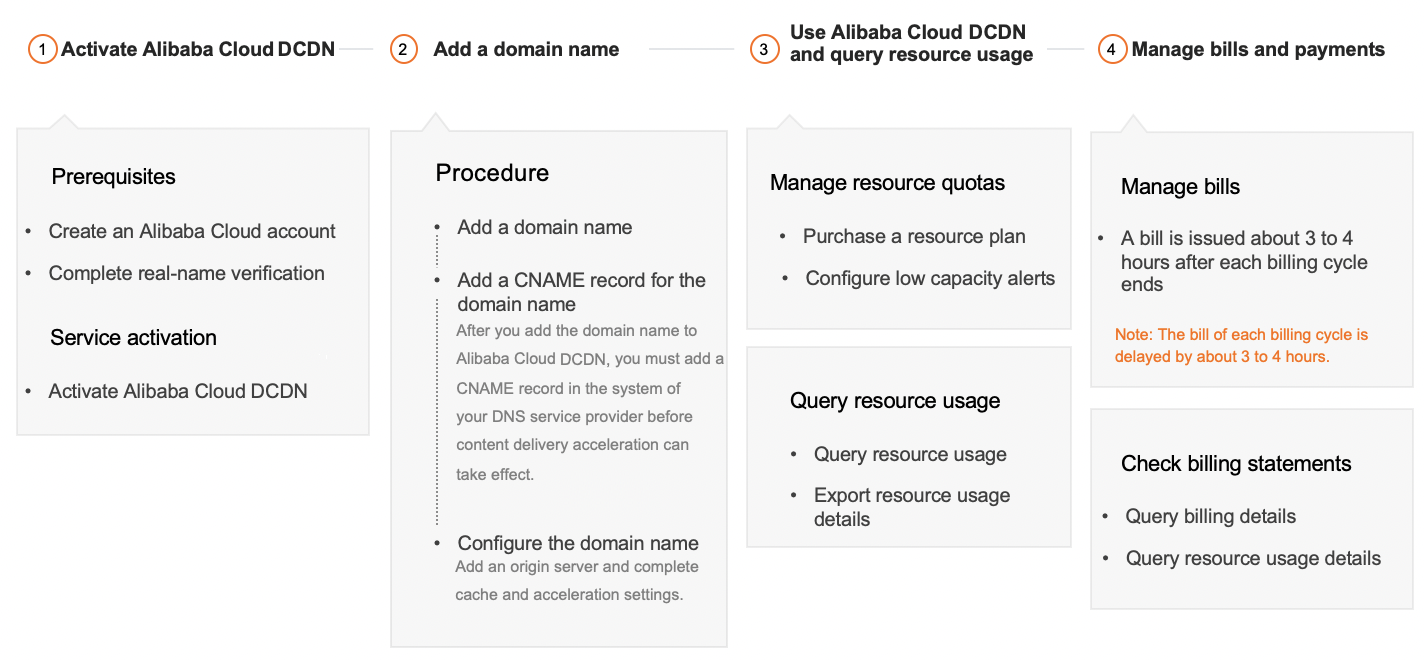
Billing methods
Alibaba Cloud DCDN supports two billing methods: pay-as-you-go (default) and resource plans.
Pay-as-you-go: You are charged based on actual usage of each billable item. This post-paid method suits businesses with fluctuating demand.
Resource plan (subscription): You purchase resource plans in advance at a discounted price. During billing, usage is first offset by these plans. This prepaid method suits businesses with stable demand.
Resource plans are discounted compared to pay-as-you-go billing.
Usage beyond your resource plan quota is billed on a pay-as-you-go basis. Purchase a plan that matches your required services and business volume. For more information, see Resource plan selection.
Billable items
Alibaba Cloud DCDN and IP Application Accelerator (IPA) are independent services. IPA is billed separately for data transfer only. You are not charged again for HTTP or HTTPS requests. For more information, see IP Application Accelerator billing.
Alibaba Cloud DCDN fees consist of basic services (required) and value-added services (optional). If you enable IP Application Accelerator (IPA), IPA pricing applies.
DCDN service:
Basic service billing (Required): Covers outbound data transfer or bandwidth charges for DCDN.
Value-added service billing (Optional, billed separately): You can enable value-added services such as static HTTPS requests and QUIC requests based on your business needs.
IP Application Accelerator service: Covers outbound data transfer or bandwidth charges for IPA.
Billing cycle
The following table describes the billing cycles.
Billing cycle | Billing and deduction | Billable items |
Hourly | Billed hourly. Bills are typically generated 3 to 4 hours after the current billing cycle ends. Actual bill generation times may vary. |
|
Daily | Billed daily. Bills for the previous day are generated and fees are deducted at approximately 04:00. Actual times may vary. |
|
Monthly | At approximately 04:00 on the first day of the following month. | Basic services (Monthly 95th percentile peak bandwidth) |
Billable regions
Data transfer is billed based on the region where the usage occurs. Alibaba Cloud DCDN has deployed sufficient redundant points of presence (POPs) in each billable region to prevent cross-region data transfer.
The following table lists the billable regions and coverage areas. For more information about POP distribution, see POP distribution.
Billable region | Abbreviation | Coverage area |
Chinese mainland | CN | All regions in the Chinese mainland share the same pricing. |
North America | NA | United States |
Europe | EU | Ukraine, United Kingdom, France, Netherlands, Italy, Sweden, Germany, Spain |
Asia Pacific 1 | AP1 | Hong Kong (China), Japan, Singapore, Thailand, Philippines, Malaysia |
Asia Pacific 2 | AP2 | Indonesia, India, South Korea, Pakistan |
Asia Pacific 3 | AP3 | Australia |
Middle East and Africa | MEAA | Türkiye, United Arab Emirates, Kuwait, Qatar, Oman, Nigeria, South Africa |
South America | SA | Brazil |
DCDN pricing
For pricing details of each billable item, see DCDN pricing details.
For resource plan pricing, see Resource plan pricing.
Outbound data transfer plans
Static HTTPS request plans
Dynamic request plans
IP Application Accelerator (TCP/UDP) plans
WebSocket data transfer plans
Edge WAF request plans
To learn more about resource plan selection and deduction rules, see Resource plans, Resource plan selection, and Resource plan rules.
Alibaba Cloud DCDN outbound data transfer resource plans, IP Application Accelerator (TCP/UDP) data transfer resource plans, and WebSocket data transfer resource plans can only offset fees when the corresponding service uses the pay-by-data-transfer billing method. If a different billing method is used, the resource plan is suspended. You can change the billing method as needed. For more information, see Change the billing method.
Related documents
Billable items and billing methods | |
Resource plans | |
More references |