What is Elasticsearch Serverless?
Elasticsearch Serverless is an Elasticsearch service built on a cloud-native serverless architecture. It is compatible with native Elasticsearch APIs and their ecosystem. Elasticsearch Serverless provides a simple, flexible, and out-of-the-box experience. You do not need to manage cluster resources or configurations. The service dynamically allocates resources based on your workload, which helps you quickly respond to business changes and optimize costs.
Background information
When you use open source Elasticsearch, you must provision resources such as CPU, memory, and disk space for your cluster based on estimated read and write traffic. This approach has the following pain points:
-
Unexpected bursts of read and write traffic during peak periods, such as sales promotions or new releases, can cause cluster breakdowns. This makes it difficult to ensure business stability.
-
Capacity planning based on peak traffic leads to underutilized resources during off-peak hours. This results in resource waste and unnecessary costs.
-
In environments focused on IT cost control and overall efficiency, you need to further optimize Elasticsearch configurations and reduce your budget.
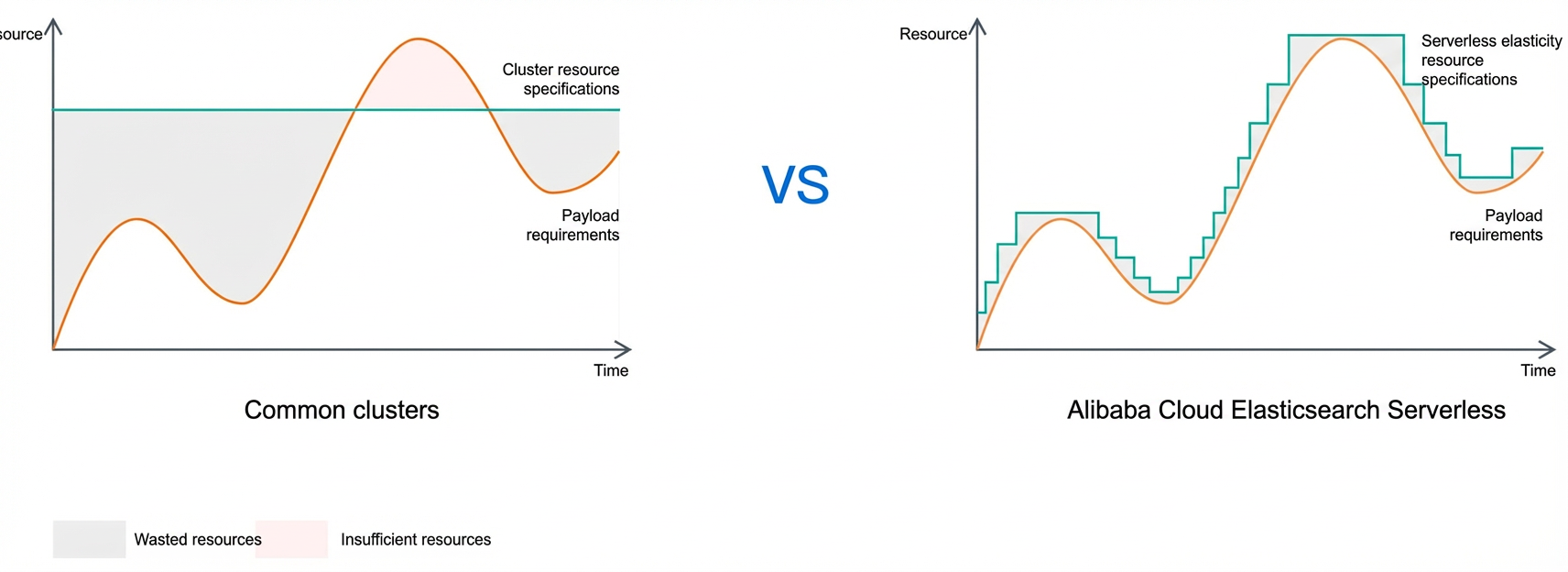
The following figure shows the resource usage and scaling differences between a self-managed open source Elasticsearch cluster and an Elasticsearch Serverless application when service traffic fluctuates. The figure shows that with open source Elasticsearch, significant resource waste occurs during off-peak periods. There may also be insufficient resources during peak periods, which affects business stability.
Benefits
-
Lower costs: You can reserve fixed resources at a lower unit price and combine them with flexible, elastic resources. This ensures stable access during peak periods and accommodates growth. This combined approach lowers your overall costs compared to a pure pay-as-you-go model.
-
Elastic scaling: The service automatically scales resources up or down based on your read and write needs. You do not need to manually scale the cluster. This reduces operations and maintenance (O&M) costs and improves business stability during traffic fluctuations.
-
Open source compatibility: The service is compatible with native Elasticsearch APIs and ecosystem components such as Kibana. This preserves your existing workflows and allows for a quick migration to the Serverless version, helping you move your business to the cloud faster.
-
Fully managed: You do not need to worry about underlying resource deployment, configuration, or cluster scaling. The service operates without affecting your business or requiring manual intervention, ensuring continuous availability.
Scenarios
-
Software as a Service (SaaS) applications, such as website building for small and medium-sized enterprises.
-
Enterprise users who want a fully managed service.
-
Scenarios with unpredictable traffic fluctuations and uncertain workloads.
-
Infrequently used environments, such as for development and testing.
-
Educational scenarios, such as for individual developers, school instruction, and student experiments.
Product selection
Elasticsearch Serverless offers the following application types for different scenarios:
-
Search-enhanced application (v8.17): Suitable for search scenarios with low to medium CU usage.
-
Log analysis application: Suitable for ingesting time series data such as logs and metrics.
-
General-purpose search application: Suitable for general scenarios such as data retrieval and multidimensional analysis.
Each application type offers different features. Select an application type based on your business needs.
FAQ
What are the feature differences between Elasticsearch Serverless and Elasticsearch clusters?
Elasticsearch Serverless simplifies resource management to provide an out-of-the-box experience. As a result, its capabilities differ from Elasticsearch clusters in the following scenarios:
-
Custom vectorization models: The Model Management page of Elasticsearch Serverless supports only initializing built-in models. It does not provide an entry point for registering custom vectorization models, such as text-embedding or text-reranker models. This capability is available only in Elasticsearch clusters. If you need to use custom vectorization models, use Elasticsearch clusters instead.
-
Multi-account access and fine-grained permission management: Elasticsearch Serverless does not support creating multiple independent accounts and does not provide a Kibana X-Pack role management interface, so you cannot configure fine-grained permissions such as index-level read-only access. Currently, only Resource Access Management (RAM) policies are supported for instance-level access control. If you need multi-account collaboration or finer-grained permission management, use Elasticsearch clusters instead.
-
Uploading custom certificate files for Logstash: The security configuration panel of a Serverless Logstash instance does not provide an entry point for uploading custom files. As a result, you cannot upload the .jks certificate file required for SASL_SSL authentication. If your business requires SASL_SSL certificate authentication, deploy Logstash on an Elastic Compute Service (ECS) instance and manually place the certificate file locally to complete the configuration.
Will I still be billed after I delete and release an Elasticsearch Serverless instance?
After you completely delete and release an Elasticsearch Serverless instance, the system no longer generates new fees. However, if the instance had unexpired reserved resources before it was released, or usage records that switched to pay-as-you-go billing after a savings plan or deduction package was exhausted, these fees may still appear in your billing history. To avoid data loss, back up your data before you release the instance.
Pricing
With Elasticsearch Serverless, you do not need to provision resources based on peak traffic. This maximizes resource utilization and reduces costs. The total fee for a single Elasticsearch Serverless application consists of resource fees and storage fees. These items are billed on a pay-as-you-go basis or through savings plans. To ensure a prompt response to increases in query and write traffic, Elasticsearch Serverless applications reserve a minimum amount of resources, which incurs a minimum fee. Billing standards vary by application type. For more information, see Serverless billing.
If you have any questions, join the Elasticsearch Serverless user group on DingTalk (Group ID: 11205017670 or 72335013004) for assistance.
Available regions
Elasticsearch Serverless is available in the following regions.
A region is a physical data center. You cannot change the region of an Elasticsearch Serverless application after it is created.
|
Region |
Region ID |
|
China (Hangzhou) |
cn-hangzhou |
|
China (Shanghai) |
cn-shanghai |
|
China (Beijing) |
cn-beijing |
|
China (Shenzhen) |
cn-shenzhen |
Quick start
For more information, see Serverless quick start.
References
Comparison between Elasticsearch clusters and Elasticsearch Serverless