What is MaxCompute?
MaxCompute, a cloud-native big data computing service formerly known as ODPS, is an enterprise-grade Software as a Service (SaaS) smart cloud data warehouse developed by Alibaba Cloud. It is cost-effective and AI-driven, and provides multi-modal computing and enterprise-grade security.
Video introduction
Product introduction
MaxCompute is an analytics-oriented enterprise-grade SaaS-based smart cloud data warehouse. It uses a serverless architecture to provide a fully managed, out-of-the-box online data warehouse service that eliminates the scalability and elasticity limits of traditional data platforms.
Its intelligent optimization for compute and storage, open data lakehouse architecture, near real-time and interactive query acceleration, and integrated Data+AI capabilities enable you to analyze massive datasets economically and efficiently with minimal operations overhead.
Tens of thousands of enterprises use MaxCompute for data computing and analysis to efficiently turn data into business insights.
Service architecture
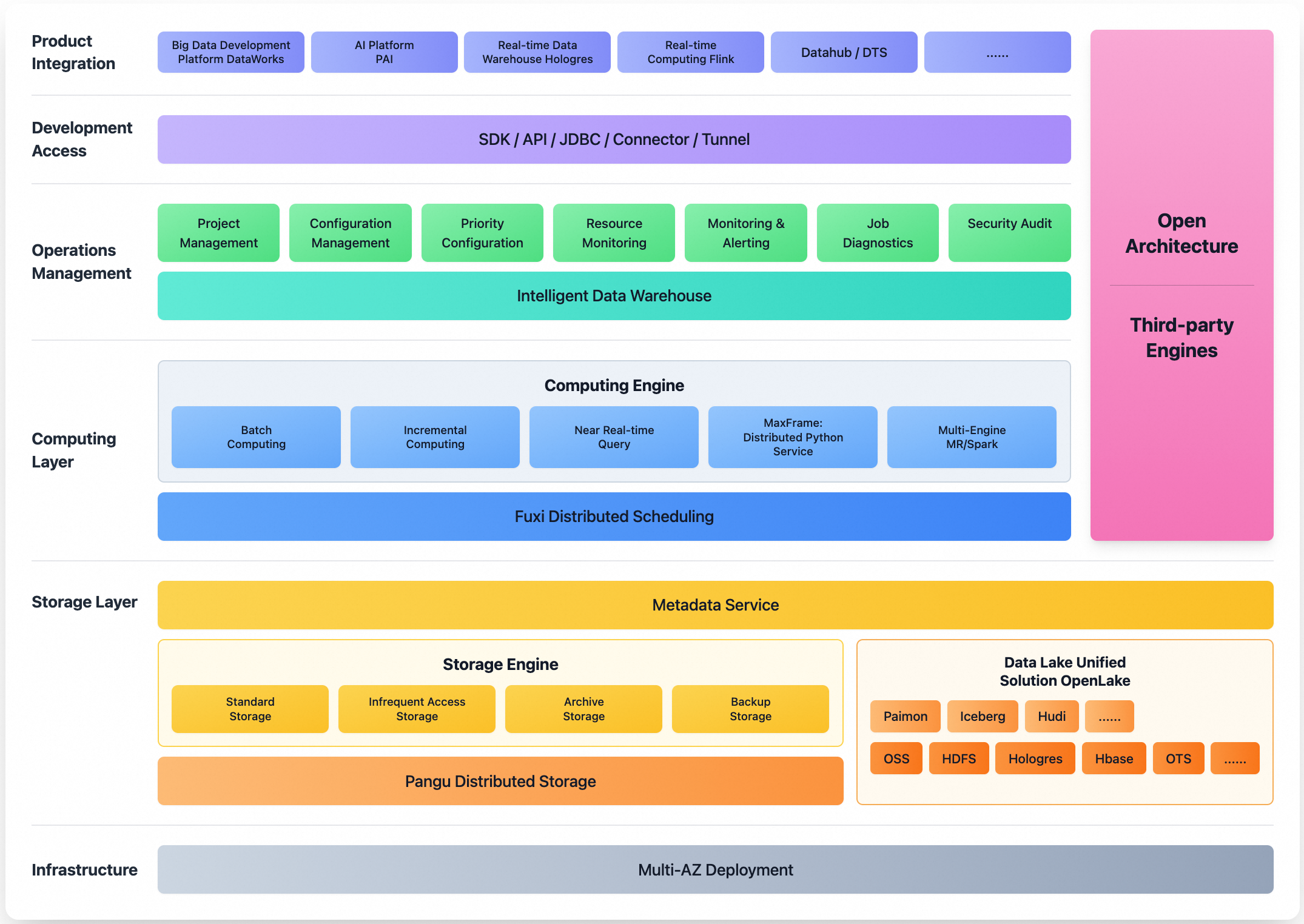
The MaxCompute architecture consists of a storage layer, a compute layer, and a unified operations and management platform. These components are built on a stable infrastructure with a multi-zone deployment.
The storage layer uses its storage engine to integrate a native storage system with Standard, Infrequent Access, and Archive storage classes. It also supports an open data lakehouse (OpenLake) architecture.
The compute layer uses multiple engines to support various computing tasks, such as offline, near real-time, and Data+AI tasks.
The operations and management layer is the management and control core of the platform. It provides resource administration for projects, quotas, and priorities. It also offers comprehensive monitoring, including resource observation, alert monitoring, and job diagnostics, along with full security audit capabilities.
The entire platform integrates with upper-layer products such as DataWorks and PAI through standard development access interfaces such as software development kits (SDKs), APIs, and Java Database Connectivity (JDBC).
Benefits
Cost-effective enterprise data warehouse
Easy to use: Pre-integrated with multiple services and supports standard SQL for out-of-the-box development.
Scalability: The serverless architecture decouples storage and compute. It provides flexible scalability without upfront planning and uses a pay-as-you-go billing method. This accommodates sudden business growth and supports real-time resource allocation for business peaks and troughs.
Secure and stable: Built-in access control, security, and disaster recovery capabilities. It also provides resource observation and job diagnostics capabilities.
Cost-effective: Provides intelligent analytics solutions for continuous optimization of performance and cost.
Optimized computing for both incremental and full data across multiple scenarios
Supports streaming writes and near real-time incremental computation: MaxCompute incremental computation decouples computation from storage, providing unified incremental and full data processing and unified stream and batch processing capabilities on a unified SQL engine. Through Delta Live MV, it automatically detects upstream data changes and continuously refreshes, simplifying the construction of incremental computation pipelines. It is also compatible with various data ingestion methods such as full-database real-time synchronization and Flink streaming writes and updates.
The upgraded MaxQA query acceleration can return query results for 2.8 billion rows of data in as fast as one second.
Unified offline and real-time processing: Deeply integrates with the real-time data warehouse Hologres. It supports high-speed bidirectional direct data reads for online services and interactive analysis.
Data lakehouse with an open architecture
The MaxCompute data lakehouse supports the OpenLake solution, which allows multiple engines to access the same OpenLakehouse data.
Supports federated query analysis and is compatible with multiple mainstream open source data formats.
MaxCompute supports exposing data to third-party open source engines through the Storage API and connectors, which simplifies compute engine integration. For example, Spark is deeply integrated with MaxCompute's computing resources, data, and permission system.
Data+AI
The MaxFrame distributed computing framework provides Python programming interfaces, is compatible with Pandas operators, and seamlessly integrates with PAI.
MaxFrame has built-in third-party dependency packages and general-purpose models. It supports custom image management and provides Data+AI integration for deep learning scenarios such as large models through its cloud-native big data pre-processing capabilities.
Wide range of scenarios
MaxCompute provides data warehouse solutions and analytics modeling services for various computing scenarios. It serves as a unified platform for data warehousing, BI, near real-time analytics, data lake analysis, machine learning, and more. It has been used at a large scale within Alibaba Group.For more information about its development history, product awards, and customer use cases, see Development history and Customer use cases.
Rich product ecosystem:
MaxCompute is deeply integrated with Alibaba Cloud products such as DataWorks, the real-time data warehouse Hologres, PAI, and Quick BI for various data analytics scenarios. For more information about the Alibaba Cloud services that integrate with MaxCompute, see Supported Alibaba Cloud services.
Use DataWorks for one-stop data synchronization, business process design, data development, management, and operations and maintenance (O&M).
Use the algorithm components of the PAI machine learning platform to perform operations such as model training on MaxCompute data.
Use Hologres to accelerate queries on MaxCompute data through external tables, or export data to Hologres for interactive analysis.
Use Quick BI to create reports from MaxCompute data for visual analytics.
Features
MaxCompute provides the following core features. For a detailed list of features, see Features.
Feature category | Description |
Basic data warehouse capabilities |
|
Multi-scenario computing capabilities |
|
Open architecture |
|
Enterprise-grade capabilities |
|
Security, disaster recovery, and stability |
|
Announcements and updates
The MaxCompute SQL engine now supports AI Function capabilities
MaxCompute now supports model objects and model management capabilities
For more product updates, see MaxCompute Announcements and Updates.