Instance edition selection
Microservices Engine (MSE) offers two engine types: Nacos and ZooKeeper. Two instance types are available: Regular and Serverless. Regular instances come in Enterprise, Professional, and Developer editions, while Serverless instances provide Auto Scaling. Compare instance types, editions, and cost-effectiveness to choose the best option for your workload.
Instance types
Open Source Eureka 2.x is no longer maintained, and development on Open Source Eureka 1.x has slowed. We recommend using MSE Nacos, which is seamlessly compatible with the Eureka protocol and delivers 50% better performance. For more information, see Create a Nacos engine.
Migration between Standard Instances and Serverless instances is not supported.
Enterprise Edition
Fully compatible with the Nacos 3.0 open-source ecosystem and supports the MCP Registry.
Enterprise-grade stability and high availability (HA): 3-node deployment by default, dedicated underlying resources, and a 99.99% SLA guarantee.
Enhanced security, maximum performance, full observability, and automated O&M.
Suitable for development, test, and production environments that require high levels of security, availability, and performance.
Professional Edition
Open-source compatible with high availability, built-in security, high performance, full observability, and automated O&M.
3-node deployment by default. Suitable for development, test, and production environments.
Developer Edition
Open-source compatible with built-in security, basic observability, and automated O&M.
Single-node only. Intended for development and test environments.
Serverless
Core features:
Auto Scaling: Scales in and out automatically based on traffic, with no minimum resource commitment.
O&M-free: No manual node management required. Overall capabilities are similar to the Professional Edition.
Cost-effective: Ideal for scenarios with large daily traffic fluctuations or low traffic volumes. Costs less than a Professional Edition Standard Instance.
Use cases: Suitable for development, test, and production environments. Ideal for workloads with variable traffic or lightweight business applications.
Instance capability comparison
Nacos engine
Feature | Community edition | Developer edition | Professional edition | Enterprise edition | Serverless edition | |
Priority access to Nacos 3.0 managed capabilities | Self-hosted and self-managed | Not supported | Not supported | Supported | Not supported | |
AI capabilities | MCP registration | Not supported | Not supported | Not supported | Supported | Not supported |
Availability | Service-Level Agreement (SLA) | Not supported | No SLA guarantee | 99.95% | 99.99% | 99.9% |
Automated risk scanning and management | Not supported | Supported | Supported | Supported | Supported | |
Self-healing for unhealthy nodes | Not supported | Supported | Supported | Supported | Supported | |
Configuration canary release | Not supported | Supported | Supported | Supported | Supported | |
Multi-node disaster recovery | Not supported | Not supported | Supported | Supported | Supported | |
Multi-AZ Disaster Recovery | Not supported | Not supported | Supported | Supported | Supported | |
Empty Push Protection | Not supported | Not supported | Supported | Supported | Supported | |
Traffic protection | Not supported | Not supported | Supported | Supported | Supported | |
Quota management | Not supported | Not supported | Supported | Supported | Supported | |
Zero-downtime changes | Not supported | Not supported | Supported | Supported | Supported | |
Auto Scaling | Not supported | Not supported | Not supported | Not supported | Supported (with built-in limits to prevent cost overruns from attacks) | |
Security | RAM Authentication and Authorization | Not supported | Supported | Supported | Supported | Supported |
AccessKey-free access | Not supported | Supported | Supported | Supported | Supported | |
Allowlist-based access control (ACL) | Not supported | Supported | Supported | Supported | Supported | |
TLS encryption for data in transit (updates in real time) | Not supported | Supported | Supported | Supported | Supported | |
Storage Encryption (via KMS) with custom key rotation (updates in real time) | Not supported | Supported | Supported | Supported | Supported | |
Vulnerability hot-patching (no impact, no restarts) | Not supported | Supported | Supported | Supported | Supported | |
Data source management | Not supported | Not supported | Not supported | Supported | Not supported | |
Runtime disk encryption | Not supported | Not supported | Not supported | Supported | Not supported | |
Usability | Automated O&M | Not supported | Supported | Supported | Supported | Fully managed |
Automatic domain binding | Not supported | Supported | Supported | Supported | Supported | |
Automated recovery for faulty nodes (no manual intervention) | Not supported | Supported | Supported | Supported | Supported | |
Native integration with gateways, Service Governance, and other services | Not supported | Supported | Supported | Supported | Supported | |
Graceful migration tools | Not supported | Supported | Supported | Supported | Supported | |
Eureka protocol compatibility | Not supported | Supported | Supported | Supported | Supported | |
Event center | Not supported | Supported | Supported | Supported | Supported | |
Built-in Grafana dashboard with over 30 metrics | Not supported | Supported | Supported | Supported | Supported (limited to service metrics for Auto Scaling) | |
Pre-configured monitoring and alerts (customizable) | Not supported | Supported | Supported | Supported | Supported (limited to service metrics for Auto Scaling) | |
Advanced monitoring (traces for service and configuration pushes) | Not supported | Not supported | Supported | Supported | Supported | |
Performance | Improved push performance | Requires manual tuning | On par with open-source version | 202% | 300% | 202% |
Improved transactions per second (TPS) | Requires manual tuning | On par with open-source version | 40% | 60% | 40% | |
Improved QPS | Requires manual tuning | On par with open-source version | 55% | 82.5% | 55% | |
ZooKeeper engine
Feature | Developer edition | Professional edition | Enterprise edition | Serverless edition | |
Usability | Automated O&M | Supported | Supported | Supported | Fully managed |
Automatic domain binding | Supported | Supported | Supported | Supported | |
Automatic removal of faulty nodes | Supported | Supported | Supported | Supported | |
Deep integration with Cloud-native Gateway and Service Governance | Supported | Supported | Supported | Supported | |
Web console for managing data, services, and parameters | Supported | Supported | Supported | Supported | |
Availability | SLA | No SLA guarantee | 99.95% | 99.99% | 99.9% |
Multi-node and Multi-AZ Disaster Recovery | Not supported | Supported | Supported | Supported | |
Automated global risk identification and management | Supported | Supported | Supported | Supported | |
Auto Scaling | Not supported | Not supported | Supported | Supported (with a scaling cap to prevent cost overruns from attacks) | |
Scheduled data backup | Not supported | Not supported | Supported | Not supported | |
Anti-fragility rate limiting | Not supported | Not supported | Supported | Not supported | |
Security | ACLs | Supported | Supported | Supported | Supported |
Web console for SASL user management | Supported | Supported | Supported | Supported | |
Data encryption | Not supported | Not supported | Supported | Not supported | |
Observability | Basic monitoring and alerts (resource usage, cluster service metrics, etc.) | Supported | Supported | Supported | Supported (limited to service metrics for Auto Scaling) |
Advanced monitoring (audit logs for client read/write operations) | Not supported | Supported | Supported | Supported | |
Capacity watermark management | Not supported | Not supported | Supported | Not supported | |
Performance | Improved TPS | On par with baseline | 30% | 100% | 30% |
Improved QPS | On par with baseline | 70% | 100% | 70% | |
Cost-effectiveness analysis
Billing methods
Standard Instance: Billed by specifications and node count (Subscription or Pay-as-you-go).
Serverless Instance: Billed using Tiered Pricing based on the maximum number of connections per hour.
Example cost calculation
The Tiered Pricing for a Serverless Instance is as follows:
For the latest pricing, see the official product page.
Pricing tier | Maximum connections per hour | Price per 10 connections (CNY/hour) |
Tier 1 | 0–10 (inclusive) | 0.16 |
Tier 2 | 11–50 (inclusive) | 0.07 |
Tier 3 | 51–100 (inclusive) | 0.05 |
Tier 4 | 101 and above | 0.018 |
Example: If a workload peaks at 50 connections per hour, its hourly price is calculated as follows:
Tier 1 (First 10 connections): 1 block of 10 connections × 0.16 CNY/block = 0.16 CNY.
Tier 2 (Next 40 connections): 4 blocks of 10 connections × 0.07 CNY/block = 0.28 CNY.
Total hourly price: 0.16 + 0.28 = 0.44 CNY.
Estimated monthly price: 0.44 CNY/hour × 24 hours/day × 30 days = 316.80 CNY.
The monthly price for a Standard Instance is based on the Subscription list price for the selected specification. The following table provides an estimated monthly cost comparison:
Maximum connections per hour | Serverless hourly price (CNY) | Serverless monthly estimate (CNY) | Professional Edition spec | Professional Edition monthly price (CNY) |
10 | 0.16 | 115 | 1 vCPU, 2 GiB, 3 nodes | 498 |
50 | 0.44 | 317 | 1 vCPU, 2 GiB, 3 nodes | 498 |
100 | 0.69 | 497 | 1 vCPU, 2 GiB, 3 nodes | 498 |
200 | 0.87 | 626 | 1 vCPU, 2 GiB, 3 nodes | 498 |
600 | 1.59 | 1145 | 2 vCPU, 4 GiB, 3 nodes | 1107 |
Cost comparison: Professional Edition vs. Serverless Instance
Use case 1: Stable workloads
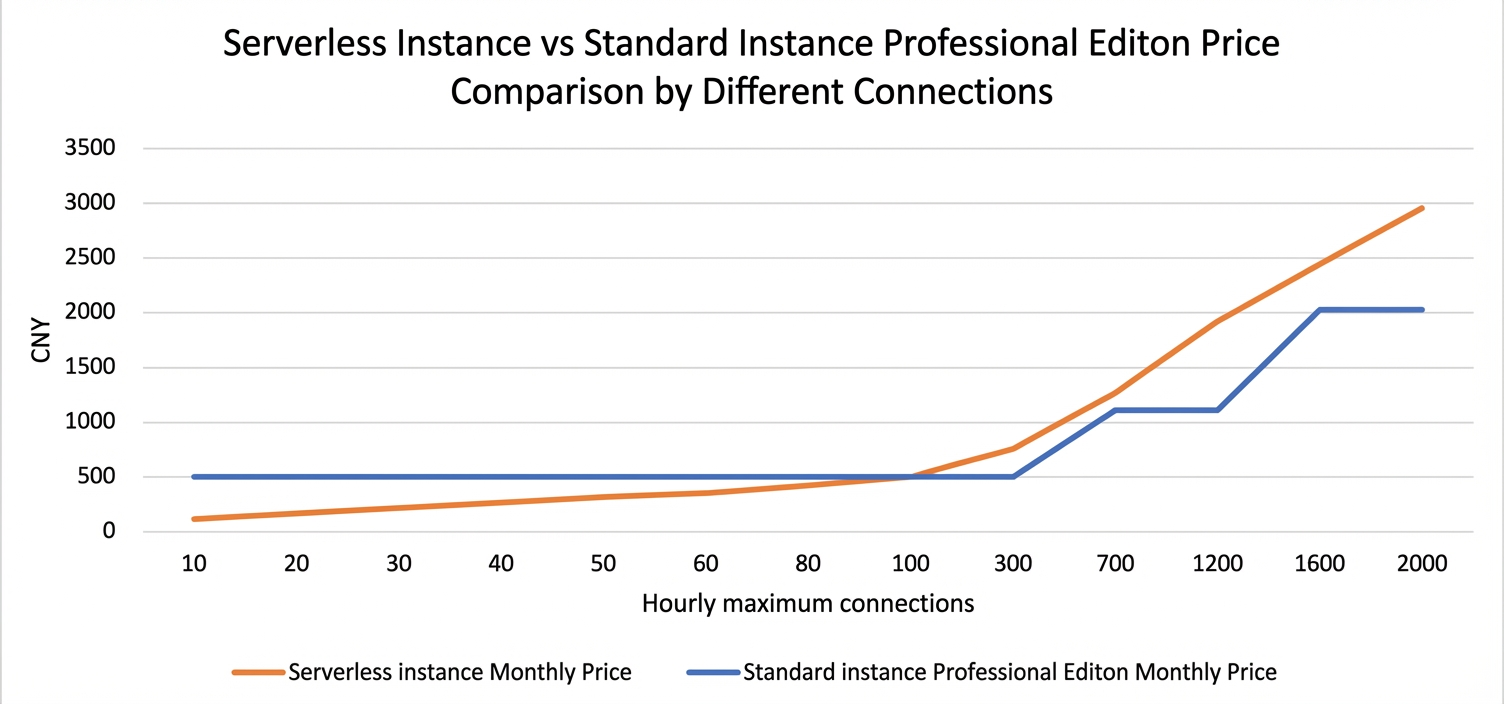
For workloads with a constant connection count, a Standard Instance has a fixed monthly rate, while a Serverless Instance is billed based on usage.
When the maximum number of connections per hour is 100 or fewer, the Serverless Instance is more cost-effective.
When the maximum number of connections per hour is more than 100, the Professional Edition becomes more cost-effective.
The following chart compares the monthly costs of a Serverless Instance and a Professional Edition instance at different connection levels:
Use case 2: Fluctuating workloads
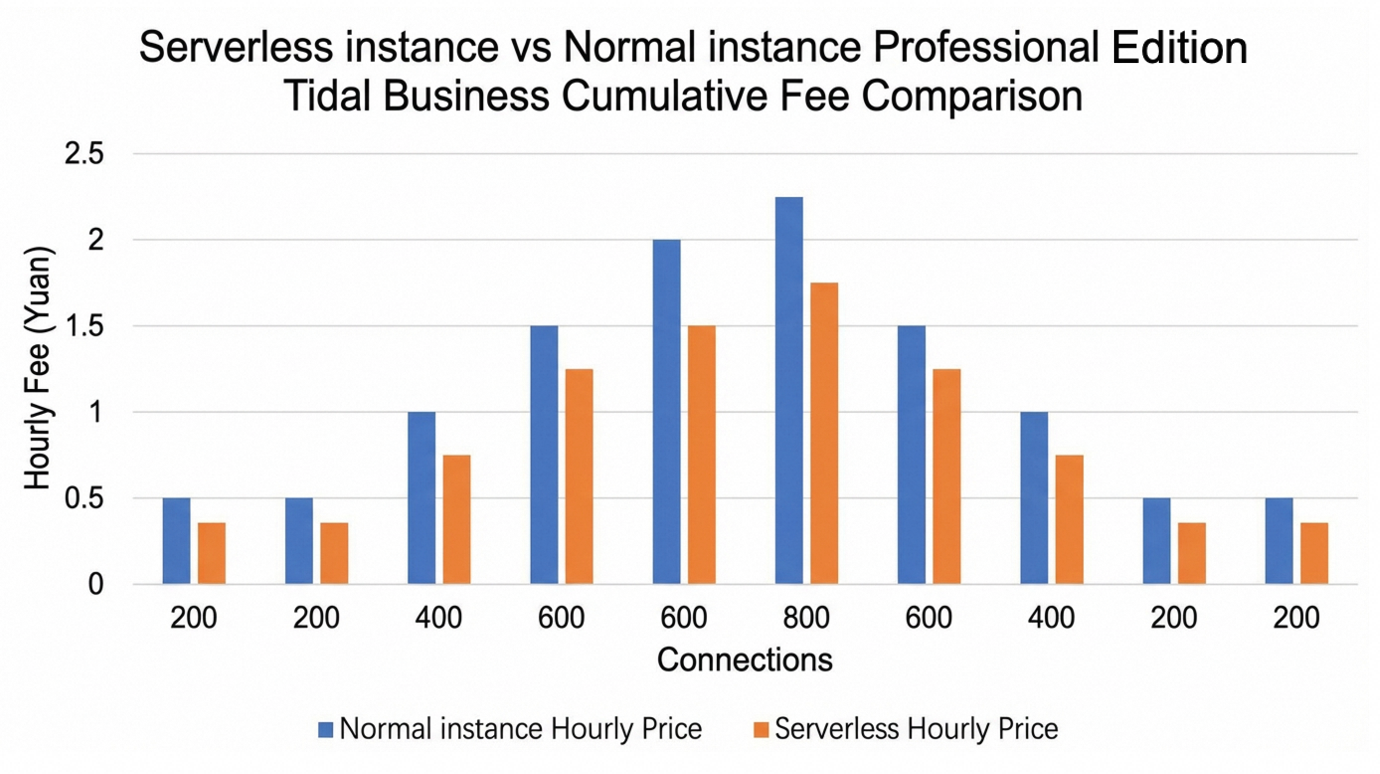
For fluctuating workloads, you must provision a Professional Edition instance for peak capacity. A Serverless Instance instead uses Elastic Scaling to match real-time demand automatically. Consider an example where client connections scale from 200 up to 800, and then back down to 200.
A Serverless Instance is therefore more cost-effective for fluctuating workloads.
The following chart compares the cumulative cost of a Professional Edition instance and a Serverless Instance for a fluctuating workload:
Selection recommendations
Before purchasing an instance, perform a capacity assessment. For more information, see Capability assessment for Professional and Developer Editions, Nacos Enterprise Edition capacity specifications, and ZooKeeper Enterprise Edition capacity specifications.
Use case | Recommended edition | Description |
Development and testing environment | Developer Edition | A single-node, low-cost option. Not recommended for production environments. |
Production environments requiring high availability | Professional Edition / Enterprise Edition |
|
Workloads with variable or low traffic | Serverless Edition | Cost-effective and fully managed with automatic scaling. |