SAP deployment architecture
The SAP systems on Alibaba Cloud described in this document refer to on-premises versions of SAP software deployed on Alibaba Cloud infrastructure. They do not refer to SAP's cloud-native products, such as SAP Cloud ERP or SAP Business Technology Platform (SAP BTP).
A typical on-premises SAP deployment uses a two-tier architecture consisting of an application server and a database server. The SAP application and database software are installed on these servers, which run on supported operating systems.
System environments are typically divided into production and non-production systems. A common setup is a three-system landscape consisting of development, testing, and production systems, often supplemented by a sandbox or staging environment.
Network architecture is another key consideration. A well-designed network topology is essential for integrating your entire SAP system and its surrounding business applications into a secure, reliable network.
This on-premises deployment methodology, combined with foundational public cloud services, represents the best practice for deploying SAP systems in the cloud. This approach involves a combination of compute, storage, network, and other cloud services.
We also recommend using the Landing Zone enterprise cloud adoption framework to plan your resource structure, access control, network architecture, and security and compliance systems. This helps you build a manageable and scalable cloud environment. This document does not cover Landing Zone in detail. For more information, see the Alibaba Cloud official website.
Cloud deployment architecture
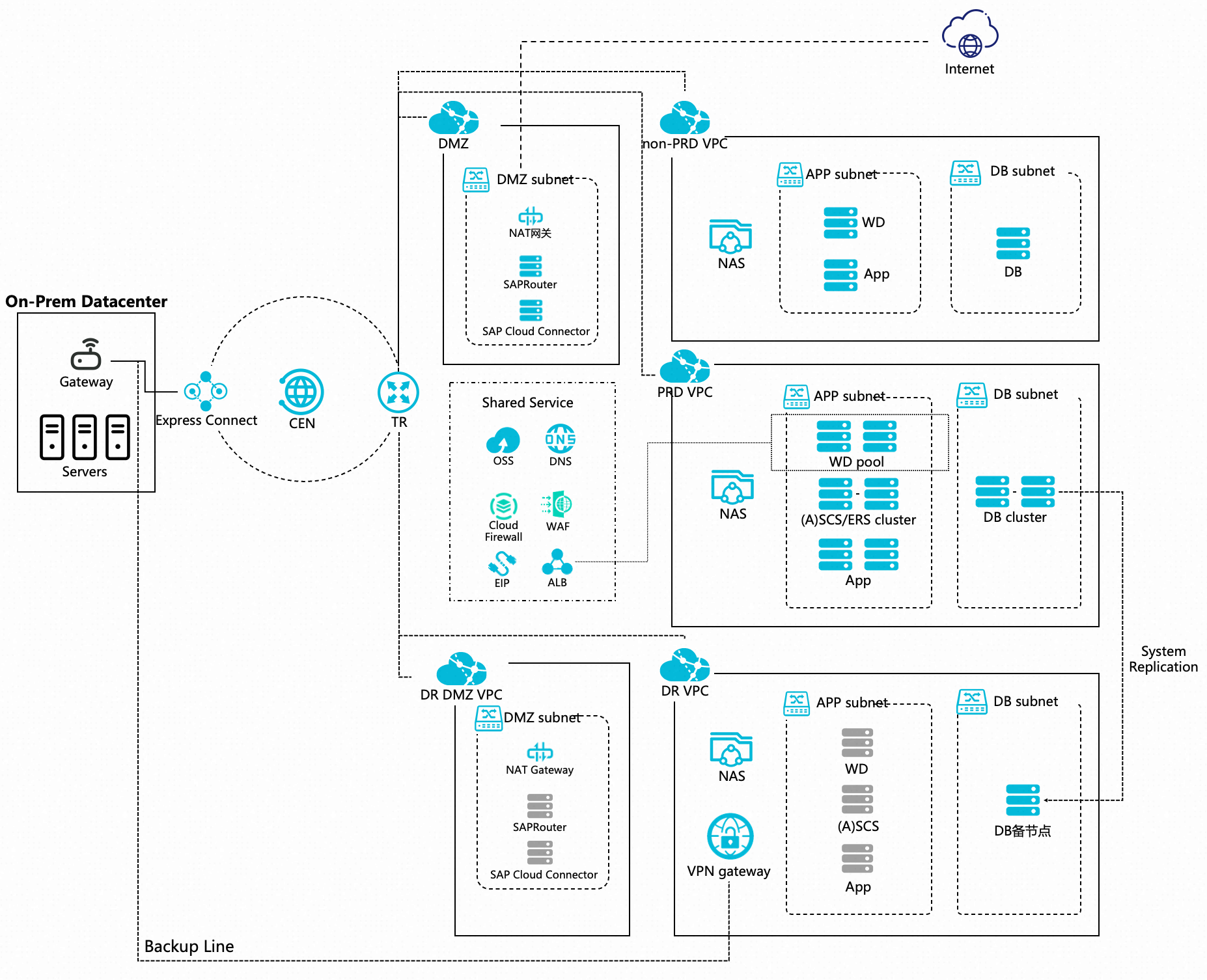
The diagram above shows an example architecture for deploying a complete SAP system in the cloud.
When designing your SAP system architecture in the cloud, consider the following key areas.
Network design: Use VPC as the core of your network. Segment your cloud network based on business requirements and use other Alibaba Cloud network products to build an interconnected and secure network architecture.
Storage selection: The storage required for an SAP system includes cloud disks attached to ECS instances, file storage for the SAP global file system, and object storage for cold data backups.
Cloud security: Alibaba Cloud provides security products at multiple layers to ensure host security, network security, access control, and more.
High availability: Design a high-availability architecture using relevant cloud services to protect the SAP system against single points of failure.
Disaster recovery: Implement a disaster recovery architecture to ensure business continuity for your production SAP system in the event of a data center or availability zone failure.
Subsequent documents will expand on these architectural design points.