Cost Details
Cost Details shows the true cost of each cloud resource by amortizing subscription costs (annual/monthly plans, resource plans, and savings plans) to the specific resources they cover.
To use Cost Details, you need to upgrade to the new billing version. Alibaba Cloud is rolling out invitational testing to users in phases, so please wait patiently. For more information about the new billing version, see New billing report fields.
Cost Details are only available for months on or after the upgrade. Data from before the upgrade cannot be viewed. For example, if you enable the new billing version on November 1, you can view bills dated November 1 and later in the new version.
Final Cost Details data for a given month is finalized after 12:00 on the 4th of the following month. Earlier results are preliminary.
Cost Details data is for analysis only, not for financial reconciliation.
Supported products and granularity
Cost Details supports pay-as-you-go and subscription-based products (annual/monthly plans, resource plans, and savings plans).
Pay-as-you-go products: available at billing cycle granularity (hourly or daily).
Subscription-based annual/monthly plans: available at daily granularity.
Subscription-based resource plans and savings plans: covered usage at billing cycle granularity; unused portions at the plan's deduction cycle granularity.
Unsupported products and scenarios:
ECS reserved instances, Alibaba Cloud Communication resource plans, resource plans for monthly cumulative billing products (such as public network traffic), and products resold by virtual operators.
For annual/monthly plan upgrades or downgrades, billing-item-level costs may fluctuate because discount amounts are not shown. Alibaba Cloud is optimizing these rules and will release updates soon.
View and export cost details
Log on to the Expenses and Costs console and go to Cost > Cost Allocation > Cost Details. Set the filters to view your data:
Bill Generation Date: The month for which costs are amortized. For example, if you purchased an annual/monthly plan on January 1, 2025 (service period: January 1 to December 31, 2025), select 2025-02 to view the amortized cost for February.
Line Item Type: Filter by the following line item types:
Line Item Type
Description
Pay-as-you-go Fee for Cloud Resources
Cost of pay-as-you-go cloud resource usage.
Subscription Covered Usage
Subscription cost allocated to a cloud resource for its pay-as-you-go usage.
Subscription Refund Covered Usage
One-time amortized cost of a refunded subscription, charged against the subscription after covering pay-as-you-go usage.
Subscription Unused Usage
Cost of a subscription's unused portion.
You can also customize columns and export cost details:
Customize bill columns: Click the
 icon to select which columns to display.
Customize column order: Drag and drop column groups in the custom columns section to reorder them. This order applies only to the console view.

Export cost details: Click the
 icon to export. Download the file from the Export Details page.
Cost allocation examples
Example 1: Annual/monthly plan
Date | Transaction details |
December 31, 2024 09:00:00 | A user purchases an annual/monthly plan. The service period is from December 31, 2024 09:00:00 to January 1, 2026 00:00:00, with an amount payable of 365 CNY. (Because the purchase occurred partway through December 31, 2024, amortization begins on January 1, 2025 00:00:00.) |
January 15, 2025 10:00:00 | The user initiates an upgrade. The unit price of the product becomes 2 CNY per day. A refund of 349 CNY is issued for the original purchase order, and a new sub-order for the upgrade is generated with an amount payable of 700 CNY. The service period is from January 15, 2025 10:00:00 to January 1, 2026 00:00:00. |
December 20, 2025 09:00:00 | The user receives a refund of 11 CNY for unsubscribing. |
Cost amortization process:
From January 1, 2025 00:00:00 to January 15, 2025 00:00:00:
The daily amortized cost is 365 / 365 = 1 CNY. One cost detail record is generated each day.
On January 15, 2025 10:00:00:
For the original purchase order, the remaining cost of (365 - 14) × 1 = 351 CNY is amortized as a one-time charge. The line item type is Subscription Unused Usage.
The upgrade sub-order has a total amount of 350 × 2 = 700 CNY. This cost is amortized over the term. Because the upgrade occurred partway through the day, amortization begins on January 16, 2025.
For the refund sub-order, a cost amount of -349 CNY is amortized as a one-time charge. The line item type is Subscription Refund Covered Usage.
From January 16, 2025 00:00:00 to December 20, 2025 00:00:00: The daily amortized cost amount is 2 CNY.
For the upgrade sub-order, the cost is amortized over the term. The line item type is Subscription Covered Usage. The daily cost amount = 700 / 350 = 2 CNY.
On December 20, 2025 09:00:00:
When a refund occurs, the line item type is Subscription Refund Covered Usage, with a cost amount of -11CNY.
For the unused portion of the upgraded order, a cost amount of 700 - (338 × 2) = 24 CNY is recorded. The line item type is Subscription Unused Usage.
Example 2: Savings plan (Fixed)
Date | Transaction details |
January 1, 2025 00:00:00 | A user purchases a savings plan, instance SPN1, with an hourly commitment of 10 CNY. The subscription provides a 60% discount (equivalent to a 0.4 pay-ratio). The service period is from January 1, 2025 00:00:00 to January 1, 2026 00:00:00. The plan is fully prepaid, with a total amount payable of 87,600 CNY. |
January 1, 2025 12:00:00 | The user purchases another savings plan, instance SPN2, with an hourly commitment of 20 CNY and an 80% discount (equivalent to a 0.2 pay-ratio). The service period is from January 1, 2025 00:00:00 to January 1, 2026 00:00:00. The plan is fully prepaid, with a total amount payable of 175,200 CNY. |
January 3, 2025 00:00:00–01:00:00 | The user consumes an ECS product for 50 CNY (instance ECS1). The cost is covered by savings plans SPN1 and SPN2. |
January 4, 2025 00:00:00–01:00:00 | The user consumes an ECS product for 150 CNY (instance ECS2). The cost is covered by savings plans SPN1 and SPN2. |
January 5, 2025 00:00:00 | The user initiates a refund for SPN1 and receives 80,000 CNY. |
Cost amortization process:
From January 1, 2025 00:00:00 to January 1, 2025 12:00:00:
SPN1 is not used to cover any resource consumption. An hourly amortized cost amount of 10 CNY is recorded. The line item type is Subscription Unused Usage.
From January 1, 2025 12:00:00 to January 3, 2025 00:00:00:
SPN1 is not used. An hourly amortized cost amount of 10 CNY is recorded as Subscription Unused Usage.
SPN2 is not used. An hourly amortized cost amount of 20 CNY is recorded as Subscription Unused Usage.
From January 3, 2025 00:00:00 to 01:00:00:
SPN1 covers 25 CNY of ECS1 usage (10 / 0.4 = 25 CNY). The line item type is Subscription Covered Usage, and the cost amount is 10 CNY. This cost is allocated to the ECS instance ECS1.
SPN2 covers the remaining 25 CNY of usage for ECS1 (5 / 0.2 = 25 CNY). The line item type is Subscription Covered Usage, and the cost amount is 5 CNY. This cost is allocated to the ECS instance ECS1.
The unused portion of SPN2 is recorded as Subscription Unused Usage. The cost amount is 20 - 5 = 15 CNY. This cost is recorded against SPN2 itself.
NoteSPN2 can cover up to 20/0.2 = 100 CNY.
From January 3, 2025 01:00:00 to January 4, 2025 00:00:00:
SPN1 is not used. An hourly amortized cost amount of 10 CNY is recorded as Subscription Unused Usage.
SPN2 is not used. An hourly amortized cost amount of 20 CNY is recorded as Subscription Unused Usage.
From January 4, 2025 00:00:00 to 01:00:00:
SPN1 covers 25 CNY of ECS2 usage (10 / 0.4 = 25 CNY). The line item type is Subscription Covered Usage, and the cost amount is 10 CNY. This cost is allocated to the ECS instance ECS2.
SPN2 covers 100 CNY of ECS2 usage (20 / 0.2 = 100 CNY). The line item type is Subscription Covered Usage, and the cost amount is 20 CNY. This cost is allocated to the ECS instance ECS2.
The remaining 25CNY for ECS2 is not covered by a deduction, and a bill is still generated for the ECS instance: The line item type is Pay-as-you-go Fee for Cloud Resources, and the cost amount = 25CNY. This bill is for the pay-as-you-go ECS product and the instance ECS2.
From January 4, 2025 01:00:00 to January 5, 2025 00:00:00:
SPN1 is not used. An hourly amortized cost amount of 10 CNY is recorded as Subscription Unused Usage.
SPN2 is not used. An hourly amortized cost amount of 20 CNY is recorded as Subscription Unused Usage.
On January 5, 2025 00:00:00:
The refund order for SPN1 generates a record with a cost amount of -80,000 CNY. The line item type is Subscription Refund Covered Usage. This cost is recorded against SPN1.
The remaining prepaid value of the original SPN1 order is recorded as a one-time cost. The cost amount is 87,600 - (4 × 24 × 10) = 86,640 CNY. The line item type is Subscription Unused Usage. This cost is recorded against SPN1.
From January 5, 2025 00:00:00 to January 1, 2026 00:00:00:
SPN2 continues to be amortized until the end of its service period. If unused, an hourly amortized cost of 20 CNY is recorded as Subscription Unused Usage.
Example 3: Savings plan (Decreasing)
Date | Transaction details |
January 1, 2025 00:00:00 | A user purchases a savings plan (Decreasing), instance SPN1, with a 60% discount (equivalent to a 0.4 pay-ratio). The service period is from January 1, 2025 00:00:00 to January 1, 2026 00:00:00. The plan is fully prepaid with a total committed spend of 365 CNY. The amount payable for the order is 365 CNY. |
July 1, 2025 00:00:00 | The user consumes an ECS product for 50 CNY (instance ECS1). The cost is covered by SPN1. |
Cost amortization process:
On July 1, 2025 00:00:00:
SPN1 covers 50 CNY of usage for ECS1. The cost to cover this usage is 20 CNY, based on the plan's 0.4 pay-ratio (20 / 0.4 = 50 CNY). The line item type is Subscription Covered Usage, and the cost amount is 20 CNY. This cost is allocated to the ECS instance ECS1.
On January 1, 2026 00:00:00:
The unused portion of SPN1 expires. The line item type is Subscription Unused Usage. The remaining cost amount is 365 - 20 = 345 CNY. This cost is recorded against SPN1.
Example 4: Resource plan (Fixed)
Date | Transaction details |
January 1, 2025 00:00:00 | A user purchases a standard storage resource plan (ossbag), instance ossbag1. The plan is a Fixed type that provides 1 GB of capacity, which refreshes hourly. The service period is from January 1, 2025 00:00:00 to April 1, 2025 00:00:00. The amount payable for the order is 1,080 CNY. |
January 1, 2025 01:00:00–02:00:00 | The user consumes an OSS product, instance OSS1, with a total usage of 3 GB. Resource plan ossbag1 covers 1 GB. The remaining 2 GB is billed at 1 CNY/GB. |
Cost amortization process:
From January 1, 2025 00:00:00 to 01:00:00:
Resource plan ossbag1 is not used. The hourly unused cost amount is 0.5 CNY. The line item type is Subscription Unused Usage. This cost is recorded against the resource plan ossbag1.
From January 1, 2025 01:00:00 to 02:00:00:
Resource plan ossbag1 covers 1 GB of OSS usage. The cost amount is 1,080 / (24 × 90) = 0.5 CNY. The line item type is Subscription Covered Usage. This cost is allocated to the OSS instance OSS1.
The remaining 2 GB of OSS1 usage is not covered. The cost amount is 2 CNY. The line item type is Pay-as-you-go Fee for Cloud Resources. This cost is recorded against the OSS product.
From January 1, 2025 02:00:00 to April 1, 2025 00:00:00:
Resource plan ossbag1 is not used. The hourly cost amount is 0.5 CNY. The line item type is Subscription Unused Usage. This cost is recorded against the resource plan ossbag1.
Example 5: Resource plan (Decreasing)
Date | Transaction details |
January 1, 2025 00:00:00 | A user purchases an OSS resource plan, instance ossbag1, with a total capacity of 500 GB (declining-balance type). The service period is from January 1, 2025 00:00:00 to April 1, 2025 00:00:00. The amount payable for the order is 500 CNY. |
January 3, 2025 10:00:00 | The user consumes an OSS product, instance OSS1, with a usage of 400 GB. The usage is covered by ossbag1. |
Cost amortization process:
On January 3, 2025 10:00:00:
Resource plan ossbag1 covers the OSS usage. The cost amount is (400 / 500) × 500 = 400 CNY. The line item type is Subscription Covered Usage. This cost is allocated to OSS1.
On April 1, 2025 00:00:00:
The unused portion of the resource plan expires. The cost amount is 500 - 400 = 100 CNY. The line item type is Subscription Unused Usage. This cost is recorded against ossbag1.
Example 6: Pay-as-you-go billing
Date | Transaction details |
January 1, 2025 09:00:00 | A user has a pay-as-you-go OSS product, instance OSS1, billed hourly at 1 CNY/GB. The user consumes 300 GB at 09:00:00. The amount payable is 300 CNY. |
January 3, 2025 09:00:00 | The user consumes 200 GB at 09:00:00. The amount payable is 200 CNY. |
Cost allocation process:
On January 1, 2025 09:00:00: The cost for OSS instance OSS1 is recorded as a one-time charge. The cost amount is 300 CNY.
On January 3, 2025 09:00:00: The cost for OSS instance OSS1 is recorded as a one-time charge. The cost amount is 200 CNY.
Cost Details vs. Amortized Cost
Amortized cost: Shows cost data from a time-based perspective, distributing pay-as-you-go and subscription bills across time periods.
Cost Details: Shows cost data from a resource-centric perspective, amortizing subscription costs (annual/monthly plans, resource plans, and savings plans) to the specific cloud resources that consumed them.
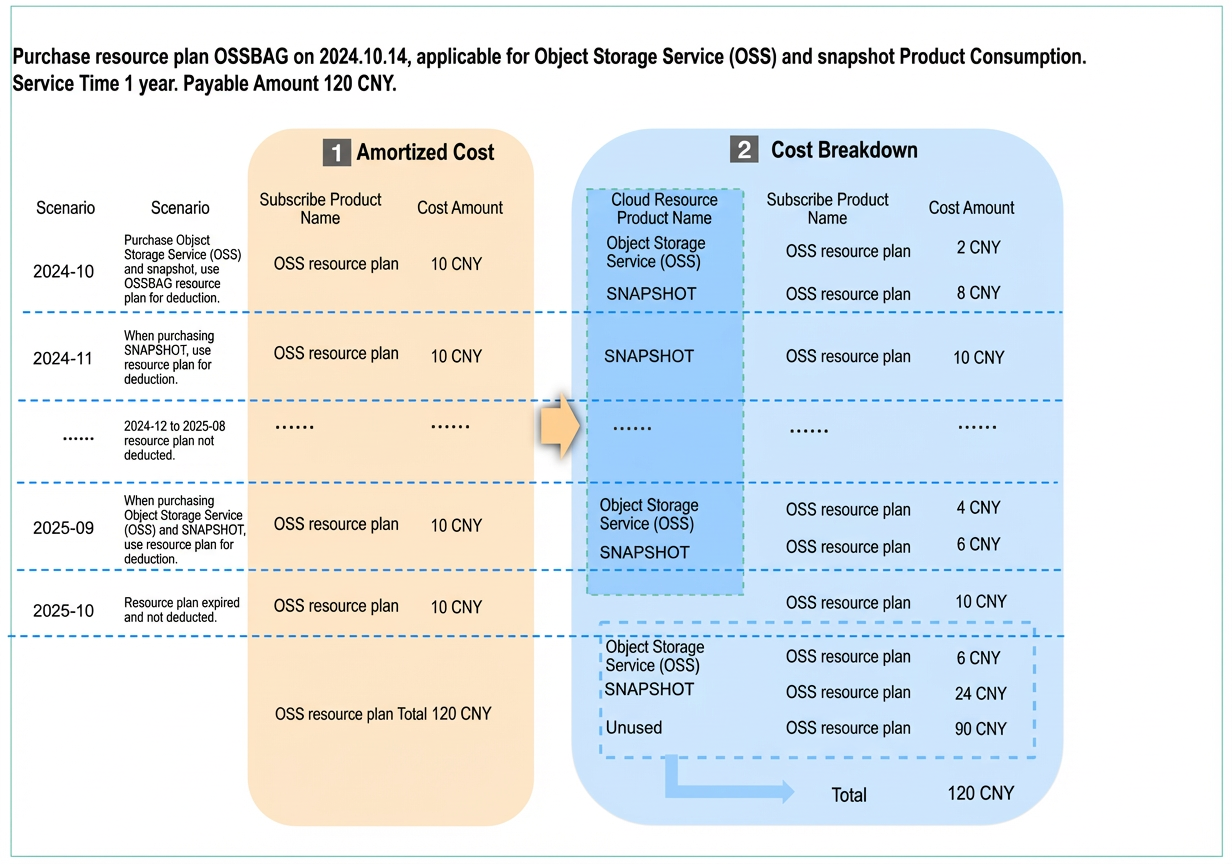
The following table compares amortized cost and Cost Details:
Reason for difference | Scenario | Amortized cost | Cost Details |
Feature purpose | - | Shows cost distribution over time but does not allocate subscription costs to specific resources. | Allocates subscription costs to the resources that consumed them, providing a complete per-resource cost breakdown. |
Data availability | - | Finalized monthly data is available after 12:00 on the 6th of the following month. | Finalized monthly data is available after 12:00 on the 4th of the following month. |
Data granularity | - | Instance + monthly | Billing item + granularity based on the line item type:
|
Data output method | - | Supports API access. |
|
Rule differences | Upgrade or downgrade of an annual/monthly plan, resource plan, or savings plan | When an upgrade or downgrade occurs:
| When an upgrade or downgrade occurs, subscription value transfers:
Because of this rule, if the refund amount differs from the remaining value of the original purchase, amortized cost and Cost Details will show different results. |
Purchasing fixed-fee installment products |
| The total order amount is amortized over the term. | |
Purchasing a prepaid card | The prepaid card purchase bill is amortized over the term. | Prepaid card purchases are excluded from cost data. Costs appear in Cost Details only when you use the prepaid card to pay for cloud resources. |
FAQ
Are prepaid card purchases included in Cost Details?
No. The initial purchase of a prepaid card is excluded from Cost Details. This report tracks the cost of consumed cloud resources, not payment instruments. Costs appear only when you use the prepaid card balance to pay for a cloud product.