Continuous delivery
1 Background
Small businesses often have fewer than 30 developers. These companies can be in a startup or growth phase. They must release products quickly to keep up with the market. They usually do not have dedicated managers for the development process. They want to adopt a mature solution to organize their teams. A small, skilled technical team can then drive major business and market growth. This leads to growth for both the company and the team.
Alibaba Cloud DevOps provides solutions to help small and medium-sized enterprises (SMEs) grow. A common challenge is solving the core problems of code management and product releases efficiently, without adding complex processes or extra staff. With Alibaba Cloud DevOps, you can establish a mature continuous delivery capability in just ten minutes and two steps:
First, use a code platform to host and review code.
Second, use a pipeline for continuous integration and delivery.
2 Challenges in continuous delivery for small businesses
Without mature tools and methods, development processes often face the following challenges:
Teams lack a unified development management process, and tool usage is not enforced. Adherence to process standards depends on individual discipline.
Daily release processes involve too much manual work and lack automated deployment capabilities.
To meet daily development needs and deploy smoothly to a production environment, you need:
Unified code hosting and review.
Consistent build and run environments.
A standardized, automated release process.
3 Solution based on Alibaba Cloud DevOps
3.1 Continuous delivery capabilities of Alibaba Cloud DevOps
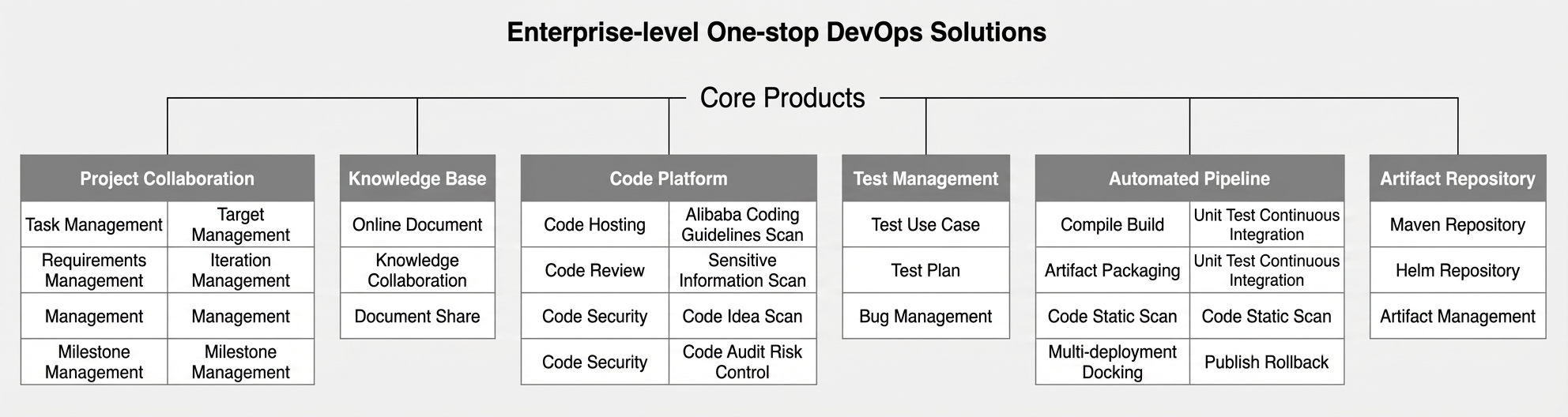
Alibaba Cloud DevOps is an enterprise-level, one-stop DevOps solution built on Alibaba's advanced management concepts and engineering practices. It is designed to be the research and development (R&D) efficiency engine for digital enterprises. Alibaba Cloud DevOps provides end-to-end collaboration services and development tools that cover the entire lifecycle, from requirements to operations. It supports public cloud, Apsara Stack, and hybrid cloud deployments. It uses artificial intelligence (AI) and automation to help developers improve efficiency and continuously deliver value. For more information, see Two simple steps for small and micro enterprises to achieve continuous delivery and How to quickly achieve continuous delivery.
3.2 Our advantages
3.2.1 Code management
Automated code detection. Security scans quickly identify code security issues, and checks based on Alibaba Coding Guidelines ensure code quality.
Developed by Alibaba for enterprise repositories. This solution provides data isolation between enterprises and offers three levels of permission control: enterprise, repository, and member.
Secure and stable repositories. Features such as log auditing and IP whitelists provide access control to help keep your code secure.
Flexible code reviews. You can configure various code review scenarios, and automated code scans improve review efficiency.
Try it now: Alibaba Cloud Codeup.
3.2.2 Pipelines
DingTalk notifications. Receive instant and accurate pipeline results in your DingTalk group. This reduces communication costs and improves team collaboration.
Quick pipeline generation for multiple scenarios. You can use templates to create pipelines quickly. This feature includes visual orchestration and a What You See Is What You Get (WYSIWYG) results display.
Automated quality assurance. You can use quality gates such as code scans, security scans, and manual test approvals to ensure delivery quality.
Multi-language support. You can generate code frameworks for languages such as Java, Node.js, Python, PHP, and Golang, and connect to major code repositories.
Release support. You can ensure stable delivery using strategies such as canary and phased releases. For more information, see How to choose the right Kubernetes application release model.
Try it now: Alibaba Cloud Flow.
3.3 Solution architecture
Combining a code management platform with a continuous delivery pipeline provides a solid foundation for small businesses. It enables continuous integration and daily delivery. This helps you continuously and rapidly deliver value.
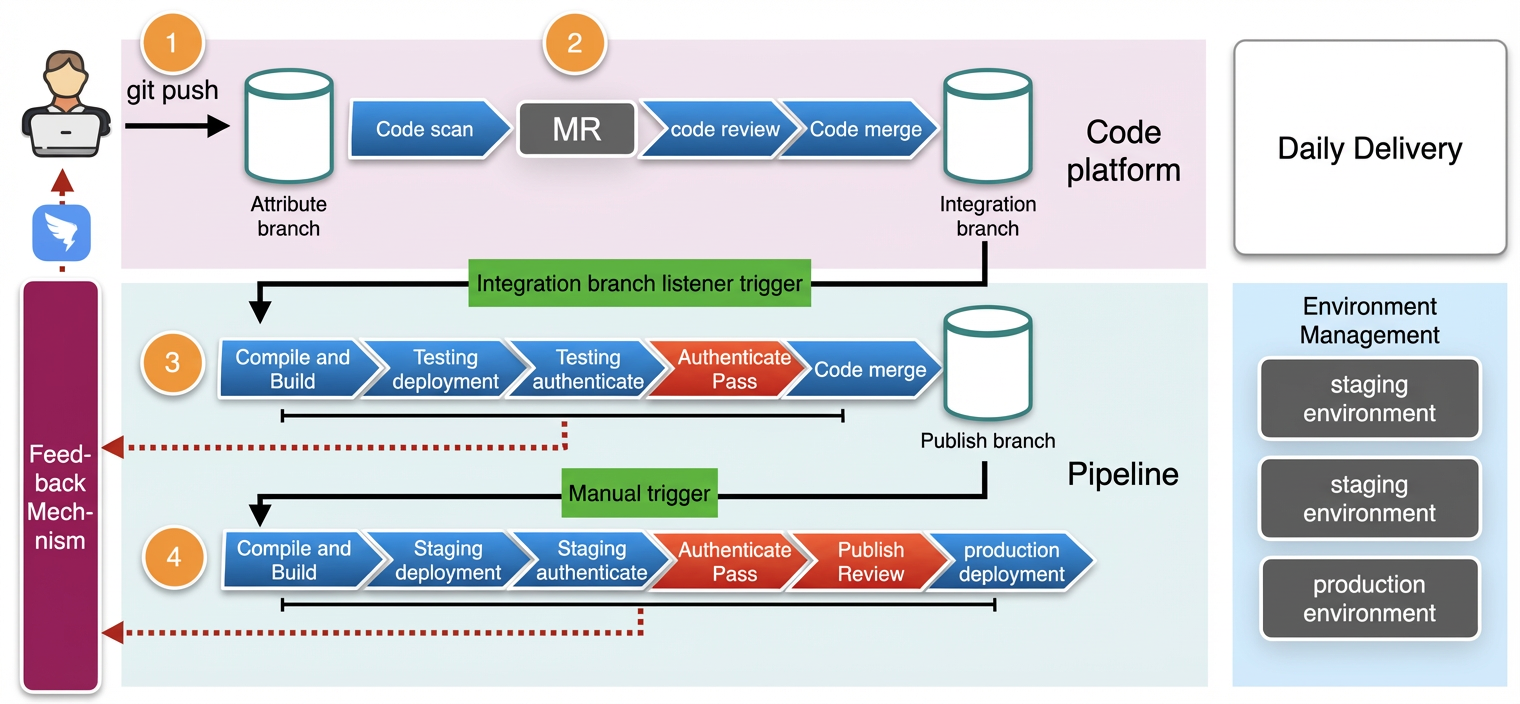
During the process, any issues are automatically reported to the designated owner through DingTalk. This ensures accurate feedback, prompt responses, and fast recovery.
Developers create feature branches for their tasks. They compile and test the code locally before committing it. For more information, see Implementing branch models with Alibaba Cloud Flow.
A code commit automatically triggers a code scan. If the scan passes, a merge request is created. The request is sent to designated reviewers based on repository settings.
After the code review is complete, the code is merged into the integration branch. This action automatically triggers the integration pipeline, which builds, deploys, and verifies the code in the staging environment. After verification is successful, the code is merged into the release branch. For more information, see How to perform host deployments with Alibaba Cloud, How to achieve continuous deployment to K8s with Alibaba Cloud, and Using Alibaba Cloud Flow tags to release to multiple Alibaba Cloud ECS environments.
Based on the release schedule, you can manually trigger the release pipeline. The pipeline completes the build, pre-production verification, and release approval steps. After the release is approved, the application is deployed to the production environment.
For more best practices, see: