Continuous extension and introduction
Continuous extension
Building a landing zone completes the initial implementation of the eight modules. During continuous cloud adoption, you can build on the foundation of the landing zone. You can continue the previous planning and implementation to migrate or deploy new systems to the cloud. This involves horizontally extending the business and deployment architecture without introducing new products or technologies. This approach allows more business systems to move to the cloud and use more cloud computing resources.
Most horizontal extension work is similar to a new cloud adoption process. This process is similar to traditional IT processes. During continuous horizontal extension, custom system requirements often arise. As a result, it is impossible to fully reuse existing technologies and processes. To maintain a sound enterprise architecture, the Cloud Center of Excellence (CCoE) must focus on three areas:
Review the Architecture During Extension
After a period of time and growth, the architecture will differ from the initial landing zone. The CCoE must regularly review the architecture to assess the current state of the cloud strategy and plan the next phase.
Specific technologies can provide information for architecture reviews. For example, the application discovery service can non-intrusively collect and analyze host and process information, resource usage levels, and dependencies between applications and components. This information helps validate the actual state of the extended architecture.
Use Cloud Features to Reduce Extension Costs and Risks
Using cloud computing features correctly can reduce stability risks, lower management complexity, and increase agility during extension. During horizontal extension, you can use the elasticity of cloud resources to easily create rollback and backup policies to reduce risk, quickly scale out or scale in based on business needs to match resources with capacity and lower costs, and preserve the state of a single point of failure to improve troubleshooting efficiency.
Address Compromises and Technical Debt
Sometimes, a technical compromise is made because the chosen technology does not fully meet the requirements of the cloud strategy. Other times, technical debt occurs. This can happen when cloud adoption standards are not followed, or when acquired or legacy cloud businesses do not conform to the enterprise cloud architecture. These issues are often the result of management problems. You should annotate these issues in the architecture diagram, plan them, and set resolution goals. Cloud computing features make this resolution process easier. Continuous updates to cloud products can offer solutions for technical compromises. A smooth migration after refactoring lets you resolve technical debt without significantly affecting business operations.
Continuous introduction
Continuous architecture extension and continuous technology introduction are complementary. Architecture extension usually does not change the technical architecture. Technology introduction, however, significantly changes it. The need for new technology often arises during extension. The new technology then helps with future extensions.
The CCoE evaluates continuous introduction in two situations:
Demand-driven: A clear need requires new technologies and products to support business or technical growth.
Technology-driven: New technologies and products are identified that could create new business or technical value.
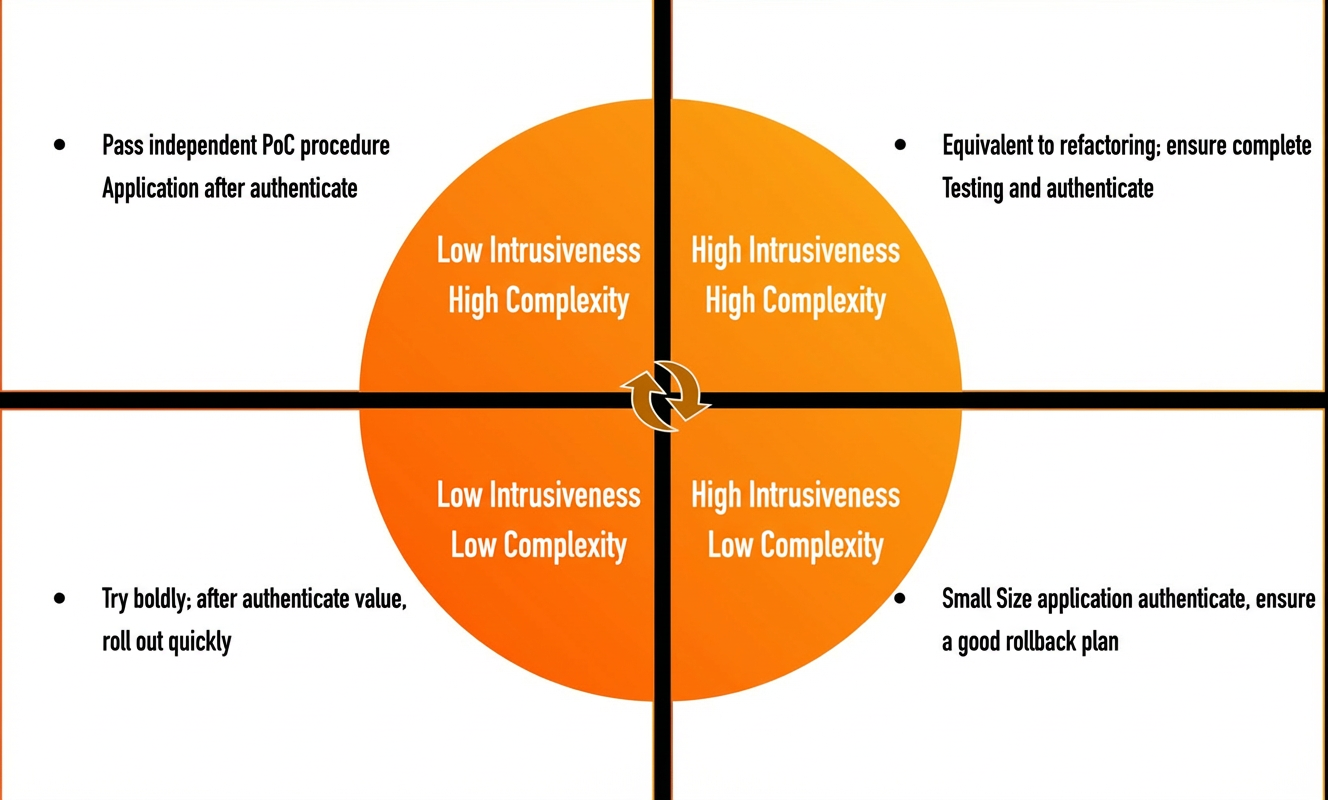
When you introduce new cloud technologies, you can create different policies based on four types. These types are defined by two dimensions:
Invasiveness: This dimension considers whether the new technology requires changes to existing cloud applications. It also considers whether a problem with the technology in the production environment would affect application operations.
Complexity: This dimension considers whether the new technology requires significant new capabilities or costs. It also considers whether a failure of the technology would cause a loss of resources.
The policies for these four types are as follows:
Low invasiveness and low complexity: You can adopt these technologies readily once they meet a need or create value. For example, you can introduce a database read-only instance to handle high volumes of read requests.
Low invasiveness and high complexity: Because the technology is complex, you can use a Proof of Concept (PoC) process to verify its value. This process helps introduce and develop new capabilities. For example, you can introduce Application Real-Time Monitoring Service (ARMS) for full-stack monitoring and trace diagnostics.
High invasiveness and low complexity: Because of the high invasiveness, you should first run a small-scale trial and create a rollback plan. After validation, you can extend its use. For example, you can use Object Storage Service (OSS) to store unstructured enterprise data in the cloud.
High invasiveness and high complexity: You should evaluate these technologies based on the significant business or technical value they can provide. You must perform complete testing and validation, and ensure you have the necessary resources. For example, you can introduce a message queue to support scenarios such as asynchronous decoupling, stream data processing, and event-driven architectures.
Introducing new technology can help you achieve specific goals for using the cloud. The following examples show how to match technology introduction with your goals:
Pursue new opportunities
During rapid business expansion, a failure to keep up with technology can result in lost business opportunities. You can introduce new technologies at the right time. This approach can lower the overall IT cost per business unit as the business grows.
Mitigate risks
Meeting compliance requirements is a major challenge for enterprise IT at the application, technology, and infrastructure layers. For example, meeting the requirements of the Classified Protection of Cybersecurity standard involves introducing many new technologies.
Improve efficiency
When an enterprise's IT infrastructure grows to a certain size, manual methods are no longer efficient. You can extend CI/CD to the infrastructure level. This helps achieve an automated and maintainable deployment process.
Control costs
As an enterprise's Internet business grows, network access scenarios become more complex and feature-rich. This increases IT infrastructure costs. Alibaba Cloud networking services can quickly connect enterprise resources without changing the existing architecture. This reduces costs for hardware investment, operations and maintenance (O&M), bandwidth procurement, and disaster recovery and backup.