Cost management and optimization
One of the biggest advantages of cloud computing is the shift from Capital Expenditure (CAPEX) to Operational Expenditure (OPEX). You no longer need to provision numerous underutilized resources in advance for potential business peaks. The cloud also provides various technologies and products to help you achieve elasticity. This ensures that resource usage matches the business payload while maintaining business stability and reliability. However, some companies do not fully understand the cloud. They continue to use traditional Internet Data Center (IDC) operations and maintenance (O&M) standards. During or after migration to the cloud, they still provision numerous resources in advance to meet elastic demand. This dilutes the advantages of the cloud and leads to unnecessary cost increases.
During cloud migration, companies usually provision more resources to ensure business stability and reliability. Some companies lack optimization measures and may over-purchase resources by 50% during a direct migration. After migrating to the cloud, resource waste can occur as business needs change and the system architecture evolves.
Therefore, cloud users must continuously focus on cost optimization. This is also one of the responsibilities of a Cloud Center of Excellence (CCoE).
The overall cost optimization framework is as follows:
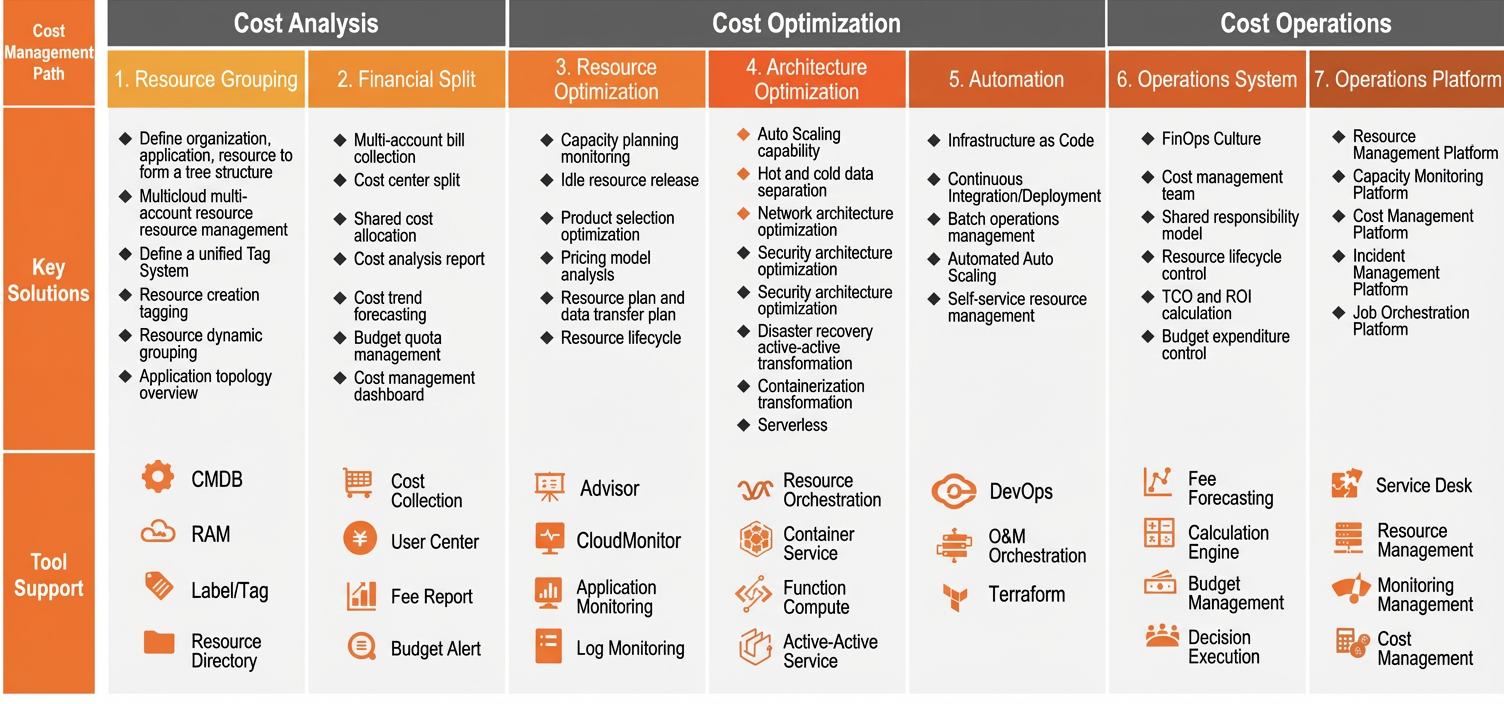
Cost optimization in the cloud is not a one-time job. You cannot expect to completely eliminate cost waste after one or a few optimizations. Cost optimization should be treated as a routine task. Continuously monitor and take action to maximize cost savings in the cloud. The entire cost optimization procedure can follow the Identify, Plan, Implement, and Evaluate (IPIE) principle. This creates a closed loop for continuous optimization and improvement.

Identify: Identify areas of resource waste and find potential cost optimization targets. There are many potential points for cost optimization in the cloud. However, you do not need to act on all of them immediately. Analyze the return on investment (ROI) based on your current team resources and business situation to find suitable optimization points for the current stage. Typically, you should start with the easiest measures and gradually move to more complex ones.
Plan: After selecting an optimization target, set an optimization goal. Estimate the workload, prepare the necessary resources, and communicate with any coordinating teams. Assess the potential impact on current online services and create a contingency or rollback plan in case the business is affected.
Implement: Carry out the optimization plan. Perform the optimization procedure during off-peak business hours. Rehearse all related operations, scripts, and code in advance. Automate the entire procedure as much as possible to minimize manual operations. During implementation, monitor the impact on your business systems. This step requires a comprehensive monitoring facility. If you find any abnormal metrics, you must adjust or roll back the changes promptly to prevent the optimization from affecting the business.
Evaluate: After implementation, evaluate the results. Compare the cost savings against the baseline to determine if the goal was met. You can evaluate the effect from two perspectives: whether resource usage has decreased and whether costs have been reduced. When you evaluate the effect, first rule out the influence of business factors, such as promotions or business changes that occurred during the optimization period. Second, consider the potential impact of the cost optimization on the current business team and system. For example, determine if it adds extra O&M complexity or reduces the team's investment in technical resources.
The cloud offers a rich set of tools to help you analyze resource usage, find wasted resources, and identify optimization points. These tools include Intelligent Advisor, Cloud Governance Center, Cost Management, CADT, and Cloud Monitor. You can use these tools to analyze current resource usage, find optimization points, and evaluate the effects of optimization.
You can approach cost optimization from the following aspects:
Optimization of financial payment patterns: Flexibly use the various financial payment or resource purchase patterns in the cloud to achieve significant cost optimization.
Optimization of product usage dimensions: For products such as compute, storage, network, database, big data, and middleware, you can optimize costs by selecting different product types and using appropriate configurations to meet business needs.
Optimization of technical architecture: The cloud provides more than just elastic resources. It is also a repository of advanced technologies and concepts. By combining the technologies, products, and related solutions available in the cloud, you can further optimize costs from an overall architectural perspective, not just for individual components. For example, you can use co-location technology or adopt a serverless architecture.
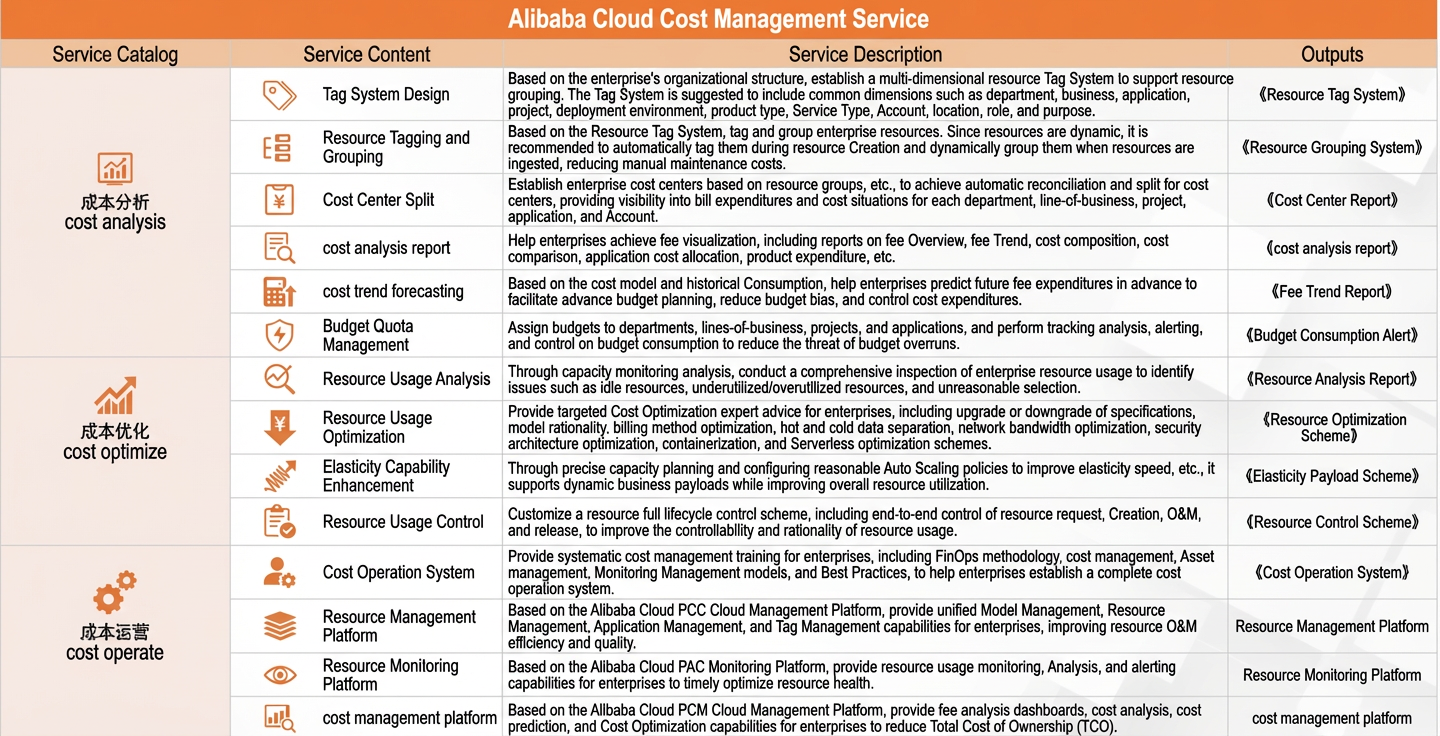
Cost management service: You can use the cost management service provided by the cloud service provider. Service consultants can help you analyze costs and provide cost optimization plans.