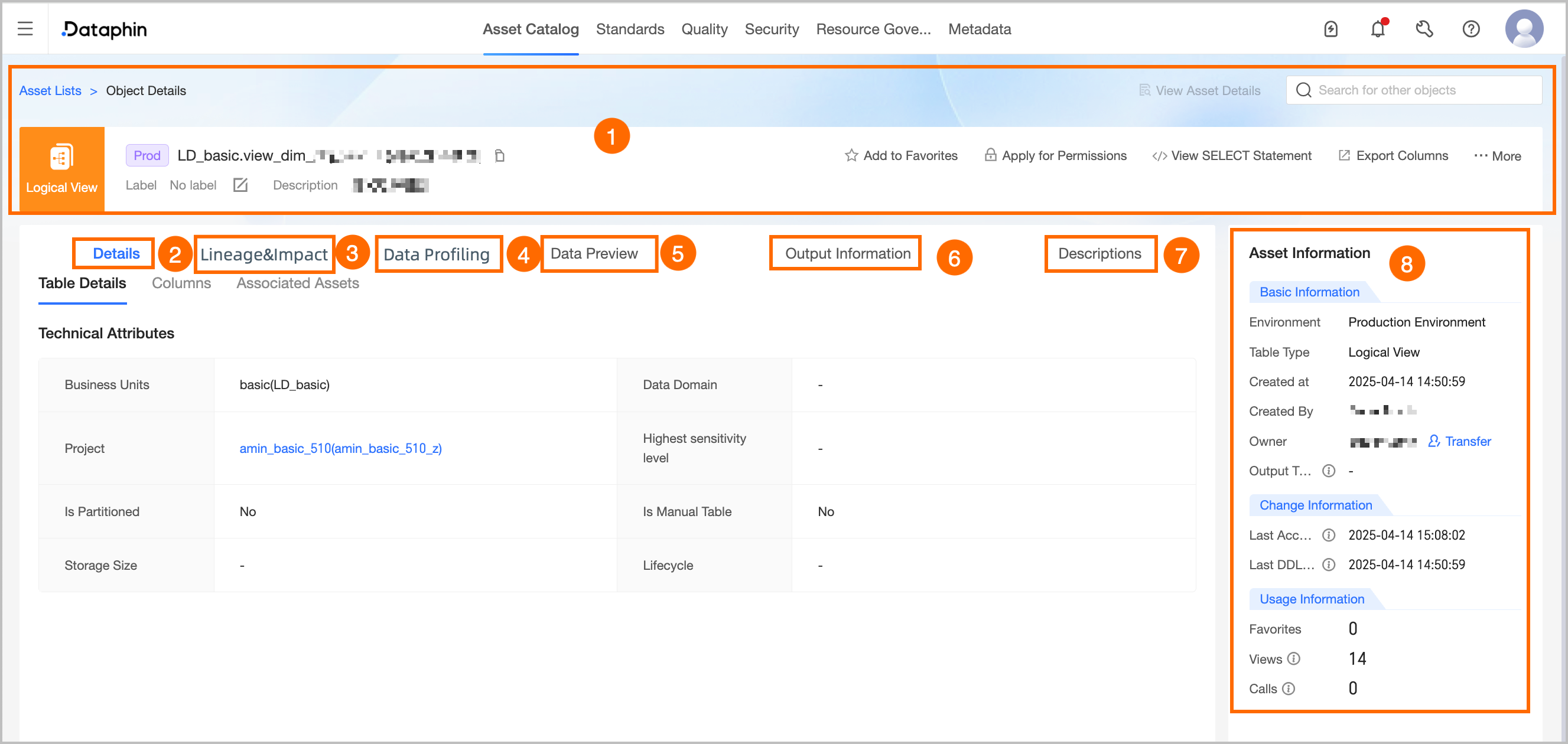
Section | Description |
① Overview | This section displays information about the table, such as its type, environment, name, tags, and description. You can also: Search for other assets: Lets you search for other assets and view their details. View asset details: If the current object is listed in the Asset Catalog, you can go to its catalog details page to view the listing information. View production/development object: Quickly switch to the object details in the corresponding production or development environment. Tags: Displays the tag values configured for the current asset. To modify tags, click Edit: Each tag value can be up to 128 characters long. Each asset can have up to 20 tag values. Super administrators can modify asset tags for all table types. The current table owner can modify asset tags for tables they own. Data architects can modify asset tags for logical views in the data domains they manage.
Favorite: Click to add or remove the asset from your favorites. After you add an asset to your favorites, you can find the 30 most recently favorited assets under My History in the Asset List for quick access. You can also view all your favorited assets in the Personal Data Center. For more information, see View and Manage My Favorites. Request permissions: Go to the permission request page for the current table. For more information, see Apply for, Renew, and Return Table Permissions. Generate SELECT statement: Generates a query statement for the current table. You can choose whether to add escape characters. You can copy the statement and run it on the ad hoc query or analysis page. Export fields: Exports the field information of the table in CSV format. This allows other developers or business users to quickly analyze and use the data. View transfer history: In the upper-right corner, click More and select View Transfer History to view the last 100 owner transfer records for the current data table. View permission list: In the upper-right corner, click More and select View Permission List to view the permission information for the data table.
Note Tables in the analytics platform do not support requesting permissions, viewing transfer history, or viewing permission lists. |
② Details | This section displays the detailed information of the table and its fields. Table details: Displays the table's technical properties, including Data Domain, Subject Domain, Project, Max Confidentiality Level, Is Partitioned Table, Is Manual Table in Analytics Platform, Storage Size, lifecycle, and Location. Project: The project to which the table belongs. You can click the project name to go to the asset details page of the project. Max Confidentiality Level: The highest sensitivity level among the fields in the table. This helps you quickly understand the data confidentiality of the table. Data Classification levels, from low to high, are L1, L2, L3, and L4 (public to top secret), and custom data classification levels. Storage Size: The table's actual storage size. This value is updated on a T+1 basis. Lifecycle: The retention period of the table in days.
Field information: Includes field details, description, data type, associated standard (requires the Data Standards module), data category (requires the Security module), sample data (displayed only when data sampling is enabled), data classification (requires the Security module), and popularity information. You can also search for, filter, and view the lineage of fields. View lineage: In the Actions column, click the lineage  icon to view the field-level lineage centered on the specified field. icon to view the field-level lineage centered on the specified field. Search and filter: You can search for fields by name or description. You can also filter for specific fields by data category or data classification (requires Data Security to be enabled).
Associated assets: Displays the dimension information associated with the current table. Click a table name to go to the details page of that table.
|
③ Lineage & impact | |
④ Data profiling | If you have enabled the data quality feature, you can configure data profiling tasks for the data table to quickly understand the data profile and assess its usability and potential risks in advance. If you need to enable automatic profiling, you can go to Governance > Metadata Center > Profiling and Analysis to configure it. For more information, see Create a data profiling task. |
⑤ Data preview | If sample data exists for the table, it is displayed by default. You can also manually trigger a query to get the latest data. If no sample data exists, a data preview query is automatically triggered. Sample Data: Displayed when data sampling is enabled and the data preview switch in the settings is enabled. The system queries only the sample data for fields for which you have column-level permissions and that do not require masking. The sample data for each field is stored and sorted independently; however, the integrity and existence of complete row records are not guaranteed. Data Preview: If you have permission to query data from the current table, you can use the data preview feature. This feature queries results for only the fields for which you have SELECT permissions (including field and row-level permissions). You can preview up to 50 rows. To learn how to request permissions, see Apply for, Renew, and Return Table Permissions.
After filtering the data, you can search or filter by field, view the details of a single row, auto-fit column widths, expand or collapse field display names, and transpose rows and columns. You can also click the sort icon next to a field to perform Unsorted, Ascending, or Descending sorting. Double-click a field value to copy it.
Note If a field's data type is HLL (HyperLogLog), a preview for that field cannot be displayed. |
⑥ Output information | Output tasks include tasks that write data to this object, tasks where this table is an output in parsed or custom lineage, and tasks whose node output name matches Project Name.Table Name. The output task list is updated in near real-time. The output details are updated on a T+1 basis. 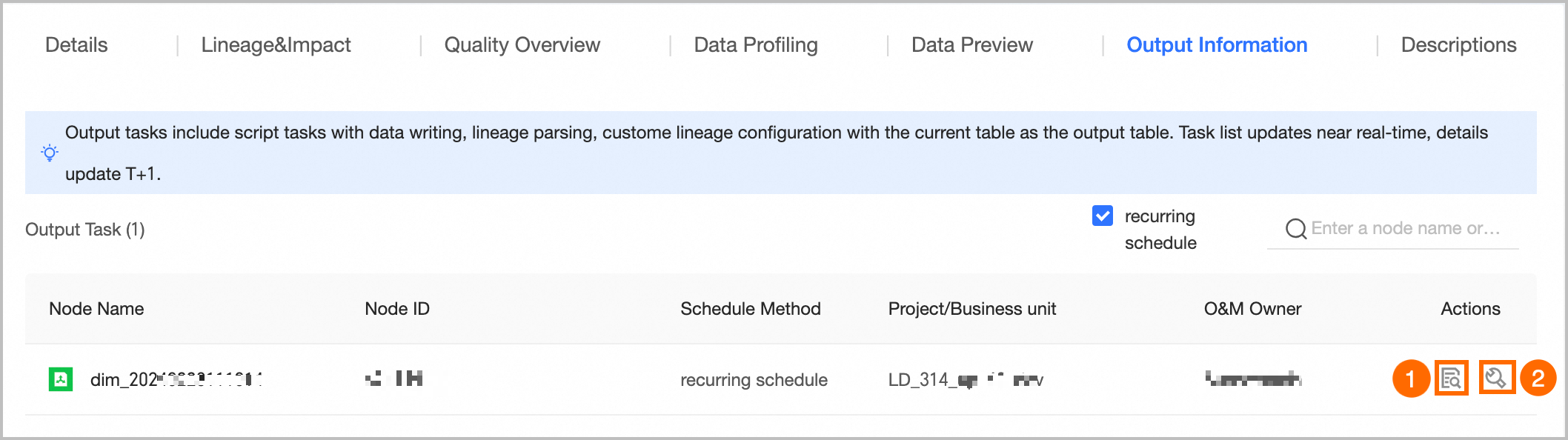
① View Output Details: You can view output details for periodic tasks only. For more information, see Output details. ② Go to O&M: Click the Go to O&M button to go to the task list page in the O&M center, where the current task is filtered for you to view more information.
|
⑦ Instructions | You can add instructions to the data table for viewers and consumers. To do so, click Add Instructions and enter a title and content.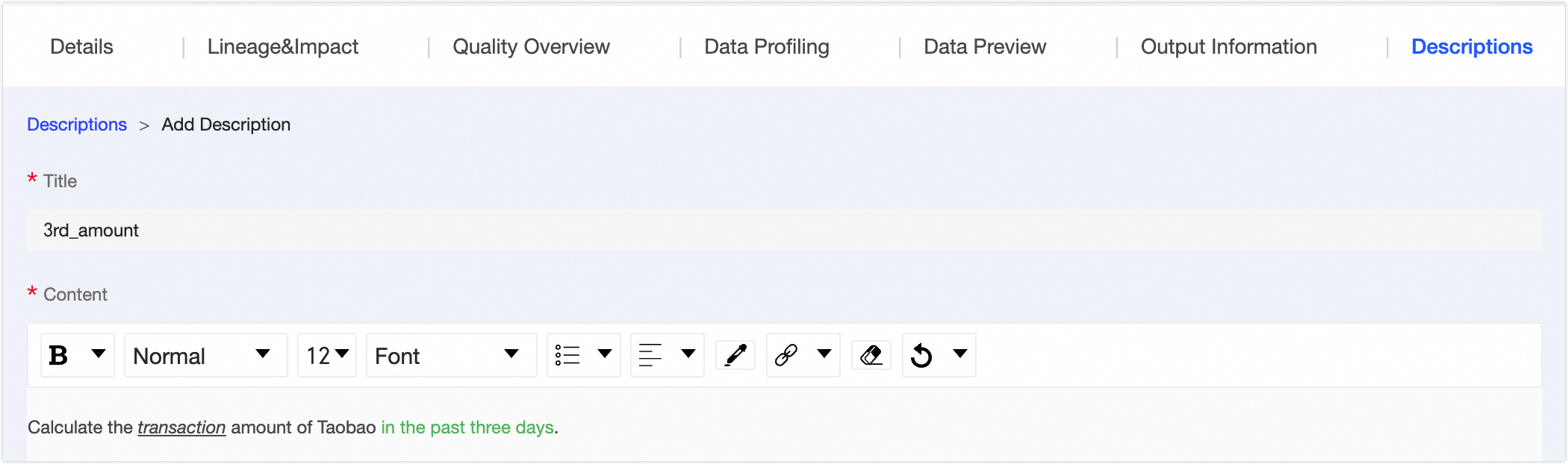 |
⑧ Asset information | This section displays detailed information about the physical table, including Basic information, Change information, and Usage information. Basic information: Includes Environment, Table Type, Creation Time, Creator, Owner, and Output Task. Owner: The owner of the current table. You can transfer the ownership of the current table to another user. In the Transfer Owner dialog box, you can choose whether to synchronously transfer ownership of the corresponding development/production environment table. After selecting a New Owner, click OK to complete the transfer immediately. We recommend that you notify the new owner after the transfer. You can view transfer information on the transfer history page. For more information, see View Transfer History.
Note Super administrators can transfer the ownership of all table types. A table owner can transfer the ownership of tables they own. Data architects can transfer the ownership of logical views in the data domains they are responsible for.
Output Tasks: You can view the output tasks for the table. These tasks include data write tasks, tasks used for data lineage parsing or configured with the current table as the output table, and tasks where the node output name is ProjectName.TableName. Click the name of an output task to go to the O&M details page for the data table.
Note You can view output details for periodic tasks only.
Change information: Includes Last Accessed and DDL change. Last Accessed: The time of the last select operation (a DQL operation) parsed by Dataphin from SQL. Access triggered by external systems is not counted. This value is updated in real time. DDL Change: The time of the most recent table structure change (DDL operation) that Dataphin parses from SQL. This value is updated in real time and does not include changes triggered by external systems.
Usage information: Includes Number of Favorites, Page Views (PV), and Access Count. Favorites: Displays the number of users who have favorited the current table. This value is updated in real time. Page Views: The real-time count of page views (PV) for the current data table, which increases by 1 with each page refresh. Access Count: Based on SQL parsing, one access is counted each time the table is selected in a Dataphin task (which corresponds to a DQL operation). The data is updated on a T+1 basis and displays the total number of accesses in the last 30 days.
|
 icon in the Actions column to open the details page.