progress-donut-chart-exploded
Each configuration item of the progress donut chart (exploded) widget in Full Select mode.
Chart style
A progress donut chart (exploded) is a type of pie chart that displays either the percentage of a current metric relative to its target or the actual metric value. It does not support displaying both the metric value and the target value simultaneously, and does not support multi-series data configuration. 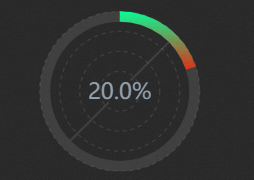
Style Panel 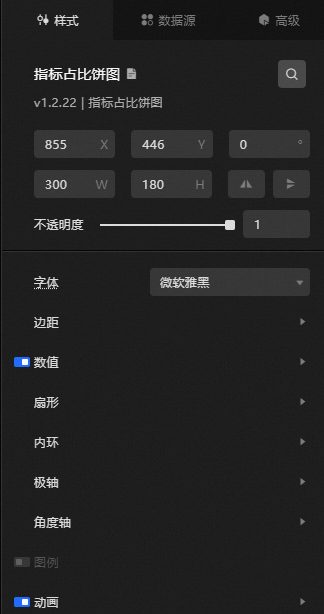
-
Search Configuration: Click the Search configuration items icon
 in the upper-right corner of the Style panel to search for a configuration item by name. Fuzzy match is supported. For more information, see Search configuration items.
-
Size: the width and height of the widget. Unit: pixels.
-
Positioning: the x-axis and y-axis coordinates of the widget. Unit: pixels. X-coordinate is the pixel distance between the upper-left corner of the widget and the left edge of the canvas. Y-coordinate is the pixel distance between the upper-left corner of the widget and the top edge of the canvas.
-
Rotate: the rotation angle of the widget in degrees.
-
Enter the degrees in the Rotation Angle spin box, or click the plus sign (+) or minus sign (-) to adjust the value.
-
Click the
 icon to flip the widget horizontally.
 -
Click the
 icon to flip the widget vertically.
-
-
Opacity: Valid values: 0 to 1. A value of 0 hides the widget. A value of 1 makes the widget fully visible. Default value: 1.
-
-
Font: the font family for all text in the pie chart. Default value: Microsoft Yahei.
-
Margin
Parameter
Description
Top
The distance between the pie chart and the upper boundary of the widget.
Bottom
The distance between the pie chart and the lower boundary of the widget.
Left-side navigation pane
The distance between the pie chart and the left boundary of the widget.
Right-side tabs
The distance between the pie chart and the right boundary of the widget.
-
Value: the style of the displayed value in the pie chart. Click the
 icon to show or hide the value.
Parameter
Description
Font size
The size of the value.
Color
The color of the value.
Font weight
The thickness of the numeric text.
Number of decimal places
The number of decimal places to display for the value.
Real Value
Turn on the switch to display the actual data value. Turn off the switch to display the percentage value.
-
Fan: the fan-shaped sector style in the pie chart.
Parameter
Description
title
The text title displayed below the pie chart.
Color
The color of the title. See color picker to modify.
Background color
The color of the background ring beneath the fan.
out-of-bounds color
The color of the out-of-bounds ring, which appears when the progress exceeds the target.
Inner radius
The inner radius ratio of the sector. Valid values: 0 to 1. A value that is too small may cause the inner ring to be covered.
-
Inner Ring: the style of the inner ring, which typically forms a complete circle.
Parameter
Description
Color
The color of the inner ring.
Inner radius
The inner radius ratio of the inner ring. Valid values: 0 to 1.
Outer radius
The outer radius ratio of the inner ring. Valid values: 0 to 1.
-
Polar Axis: the style of the polar axis.
Network Line: the style of the polar axis network line. Click the
icon to show or hide the network line.Color: the color of the polar axis line.
-
Angle Axis
Angle Offset: the starting offset angle of the sector. Default value: auto (offset is 0).
-
Legend: the legend style of the chart. Click the
icon to show or hide the legend.-
Text: the text style of the legend.
Parameter
Description
Font size
The size of the legend text.
Color
The color of the legend text.
Font weight
The font weight of the legend text.
-
Layout
-
Spacing: the spacing style of the legend.
Parameter
Description
Left and Right Spacing
The horizontal distance between adjacent legends. This parameter takes effect only when multiple series exist.
Upper and lower interval
The vertical distance between the legend and the upper and lower boundaries of the widget.
-
Position: the position of the legend relative to the start coordinates of the widget. You can select Top Center, Top Left, Top Right, Bottom Center, Bottom Left, or Bottom Right.
-
-
-
Animation: the animation effect of the pie chart. Click the
icon to enable or disable the animation effect.Parameter
Description
Initial Animation Duration
The duration of the initial rendering animation. Unit: ms.
Easing Effect
The easing effect of the animation. Multiple common easing effects are available.
Update the animation duration
The animation duration when widget data is updated. Unit: ms.
Whether to update from previous position
If turned on, the animation starts from the previous data position. If turned off, the animation starts from 0.
 icon to show or hide the value.
 icon to show or hide the legend.
Data Sources panel
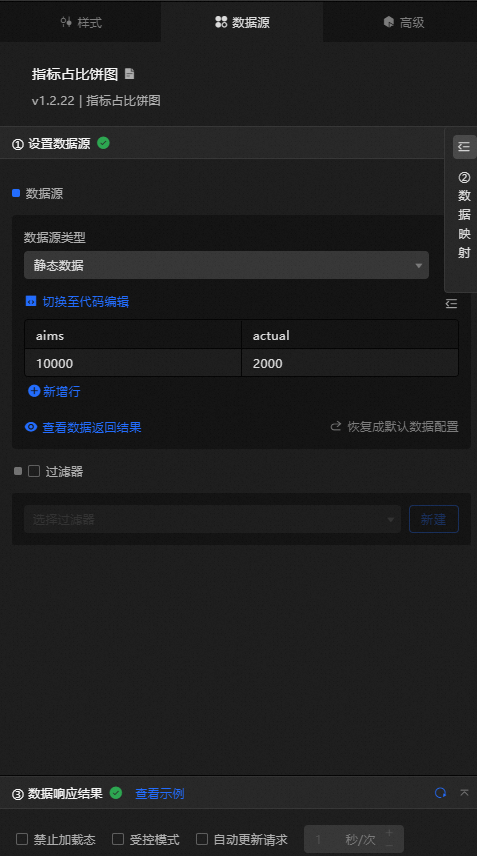
|
Column |
Description |
|
|
The expected target value. |
|
|
The actual progress value, displayed as a percentage in the pie chart. |
|
Configure data items |
Description |
|
DataSource |
Use the code editor or visual editor to view and edit the data fields of the widget. You can also change the Data Type parameter to configure data sources flexibly. |
|
Data Mapping |
To customize chart field configurations, set field mappings in the Data Mapping module to map your data to the corresponding widget fields without modifying the data source. Click the |
|
Configure a filter |
Turn on Filter, select an existing data filter or create a data filter, and configure a data filter script to filter data. For more information, see Manage data filters. |
|
Data Response Result |
Displays the widget data response in real time. If the data source changes, the latest data is shown here. Click the |
|
Forbid Loading |
Select this check box to prevent loading animations during component initialization when you update the widget or preview the data dashboard. By default, this check box is cleared. |
|
Controlled Mode |
Select this check box to prevent the widget from requesting data on initialization. Data is requested only through global variables or methods configured in Blueprint Editor. If cleared, data is requested automatically. By default, this check box is cleared. |
|
Auto Data Request |
Select this check box and specify a polling interval to enable automatic data refresh. If cleared, data is not refreshed automatically. You must manually refresh the page or use Blueprint Editor and global variable events to trigger data updates. |
 icon to configure field styles.
 icon to view the data response result, or click the
  icon to fetch the latest data. You can also click View Example to see a sample response.
Advanced Panel
This widget does not support interaction events.
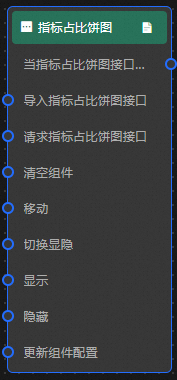
Blueprint Interaction
-
Click the
icon in the upper-left corner to go to the Blueprint page. -
On the Layer Nodes tab, add the widget to the main canvas.
-
View blueprint configuration parameters.
-
Event
Event
Description
When the progress donut chart (exploded) interface request is completed
Triggered after a data interface request is completed and processed by a filter, with the processed JSON data as output. For data examples, see the Data Response Result section of the Data Source tab in the right-side configuration panel.
-
Action
Action
Description
Import progress donut chart (exploded) Interface
After widget data is formatted for rendering, it is imported for redrawing without re-requesting server data. For data examples, see the Data Response Result section of the Data Source tab in the right-side configuration panel.
Request progress donut chart (exploded) Interface
Requests server data again, using data from an upstream processing node or layer node as parameters. For example, if the API data source is configured as
https://api.testand the data passed to request progress donut chart (exploded) interface is{ id: '1'}, the final request URL ishttps://api.test?id=1.Clear components
Clears the widget data. No parameters are required.
Move
Moves the widget to a specified location. See the data example below.
    {
      // The positioning type. to indicates absolute positioning, whereas by indicates relative positioning. The default value is to.
        "positionType": "to",
      // The location, which is indicated by the x and y coordinates.
      "attr": {
        "x": 0,
        "y": 0
      },
      // The animation type.
      "animation": {
        "enable": false,
        // The animation delay. Unit: milliseconds.
        "animationDuration": 1000,
        // The animation curve, which can be set to linear|easeInOutQuad|easeInOutExpo.
        "animationEasing": "linear"
      }
    }
Toggle Display
Toggles whether the widget is displayed or hidden. No parameters are required.
Display
Displays the widget. See the data example below.
{
  "animationType": "",// The animation method. Valid value: fade. If you do not set this parameter, no animation is available.
  "animationDuration": 1000,// The animation delay. Unit: ms.
  "animationEasing": ""// animation curve
}
Hide
Hides the widget. See the data example below.
{
  "animationType": "",// The animation method. Valid value: fade. If you do not set this parameter, no animation is available.
  "animationDuration": 1000,// The animation delay. Unit: ms.
  "animationEasing": ""// animation curve
}
Update component configurations
Dynamically updates widget style configurations. In the Style panel, click Copy Configuration to Clipboard to obtain the widget configuration data, then modify the style field in the data processing node of Blueprint Editor.
-
 icon in the upper-left corner to go to the Blueprint page.