This topic describes how camera devices connect to the LinkVisual video service.
The LinkVisual device software development kit (SDK) relies on the basic Internet of Things (IoT) capabilities provided by the IoT Platform SDK. To enable features for an Internet Protocol camera (IPC), you must integrate both the IoT Platform SDK and the LinkVisual device SDK. First, connect the device to the IoT Platform to make it an IoT device. Then, integrate the LinkVisual SDK to add video capabilities.
For more information about connecting to the IoT Platform and registering your device as an IoT device, see Develop based on a certified module.
Features
The LinkVisual device SDK is available for Linux and Android. It provides basic APIs to connect audio and video streams from IPCs to the Alibaba Cloud IoT Platform. The main features are as follows.
- Live audio and video streaming service
- On-demand video and audio streaming service for device recordings
- Image upload service
- Voice intercom service
- Built-in data encryption for audio and video streams and images, which can be enabled or disabled
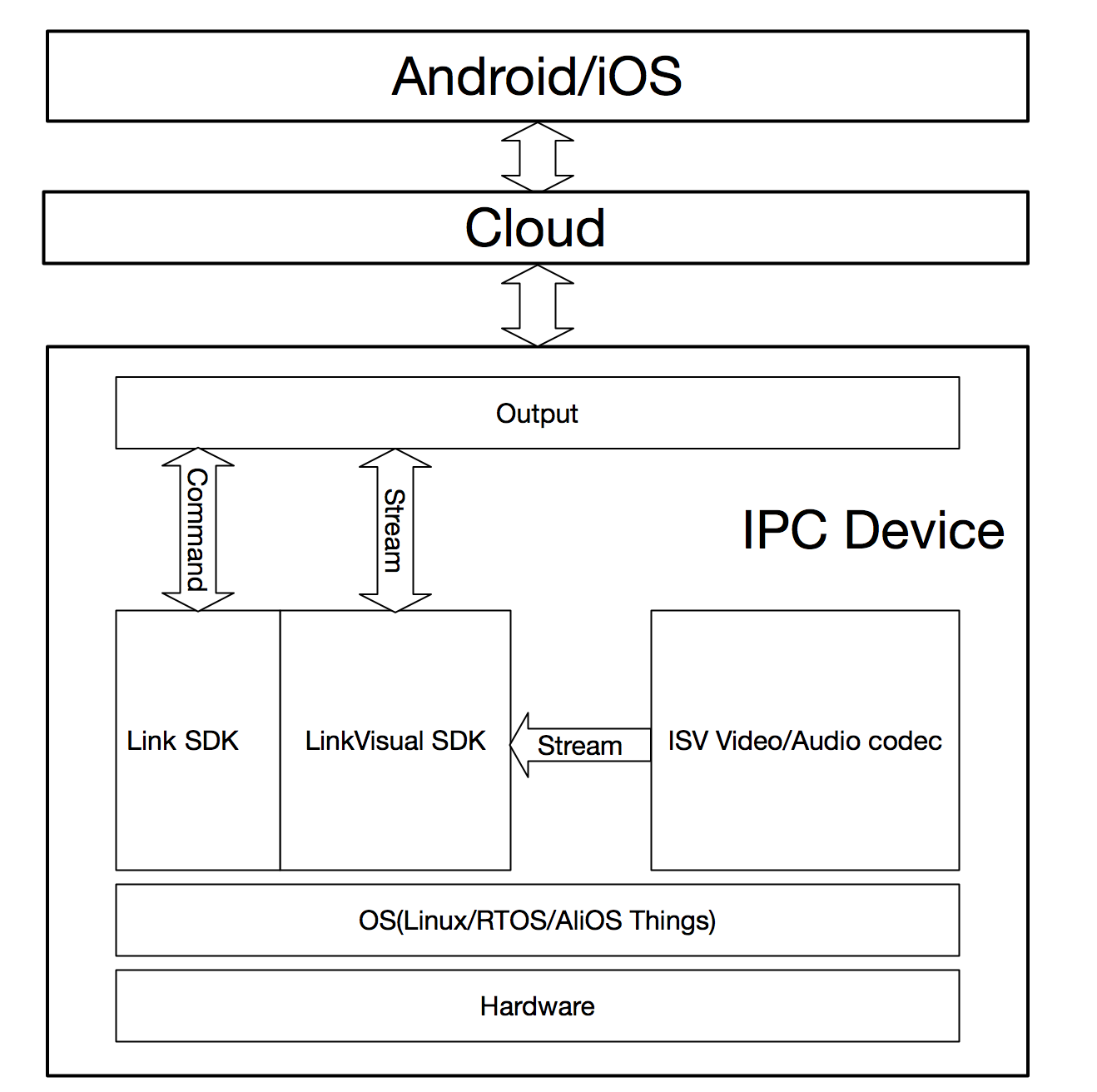
The IoT Platform SDK provides IoT channels between devices, the cloud, and apps. The LinkVisual SDK provides audio and video transmission capabilities between devices, the cloud, and apps. Device manufacturers provide the audio and video stream data and the runtime environment. The following figure shows the service architecture.
Obtain the SDK
- LinkVisual device SDK (available for Linux and Android):
For more information, see What is LinkVisual?.
- Linux device SDK: For more information, see Develop a LinkVisual video device based on the Linux device SDK.
- Android device SDK: For more information, see Develop a LinkVisual video device based on the Android device SDK.
Copyright information
LinkVisual uses the third-party librtmp library. The copyright information is as follows.
Copyright (C) 2005-2008 Team XBMC
     http://www.xbmc.org
     Copyright (C) 2008-2009 Andrej Stepanchuk
     Copyright (C) 2009-2010 Howard Chu
 librtmp is free software; you can redistribute it and/or modify
 it under the terms of the GNU Lesser General Public License as
 published by the Free Software Foundation; either version 2.1,
 or (at your option) any later version.
 librtmp is distributed in the hope that it will be useful,
 but WITHOUT ANY WARRANTY; without even the implied warranty of
 MERCHANTABILITY or FITNESS FOR A PARTICULAR PURPOSE. See the
 GNU General Public License for more details.
 You should have received a copy of the GNU Lesser General Public License
 along with librtmp see the file COPYING.  If not, write to
 the Free Software Foundation, Inc., 51 Franklin Street, Fifth Floor,
 Boston, MA  02110-1301, USA.
 http://www.gnu.org/copyleft/lgpl.html