Pay-as-you-go
Pay-as-you-go EIPs incur a data transfer fee and a configuration fee (public IP retention fee), with two metering methods for data transfer:
Pay-by-traffic: Best for bursty or unpredictable traffic (gaming, video). The peak bandwidth serves as an upper limit, not a guarantee — it may be throttled during resource contention.
Pay-by-bandwidth: Best for stable traffic peaks. The peak bandwidth is guaranteed even during resource contention.
Billing
A pay-as-you-go EIP is billed for two components: a data transfer fee and a configuration fee (public IP address retention fee).
Internet data transfer fee: Charged for data transferred over the internet through an EIP. Depending on the metering method, this is either a data transfer fee or a bandwidth fee.
Data transfer fee: Billed per GB of actual outbound data transfer (pay-by-data-transfer method).
Bandwidth fee: Billed per Mbps of specified peak bandwidth, regardless of actual data transfer (pay-by-bandwidth method).
EIP configuration fee (public IP address retention fee): The fee for retaining a public IP address.

Pay-by-data-transfer
Pay-by-data-transfer EIPs are billed hourly for outbound internet traffic. You can release the EIP at any time.
Billable items and pricing
Data transfer fee
Effective 00:00 (UTC+8) on December 17, 2024, if you create a pay-by-data-transfer EIP for the first time, Cloud Data Transfer (CDT) bills the data transfer fees for these EIPs. CDT uses tiered pricing — the unit price decreases as your data transfer volume increases. Internet data transfer.
If you have created pay-by-data-transfer EIPs before 00:00 (UTC+8) on December 17, 2024, the data transfer fees are still billed based on the rules in this topic. You can choose to upgrade to CDT billing. After the upgrade, CDT bills the data transfer fees for all your existing and new pay-by-data-transfer EIPs.
The billing cycle is one hour. Usage under one hour is rounded up to one full hour.
Data transfer fee per billing cycle = Data transfer unit price (CNY/GB) × Data transfer (GB)Data transfer: Charged for outbound traffic (from Alibaba Cloud to the internet). Inbound traffic is free.
Set the peak bandwidth based on your actual needs to prevent unexpected fees caused by programming errors or malicious requests.
Data transfer unit price: Varies by line type — BGP (Multi-ISP), BGP (Multi-ISP) Pro, or Local ISP. Local ISP is currently available only in the US (Virginia) region.
The following tables show the pricing for public cloud services. The regions and prices are for reference only. For current pricing, see the buy page.
Table 1. Data transfer unit prices for BGP (Multi-ISP) EIPs
Area | Region | Unit price (CNY/GB) |
Chinese mainland | China (Beijing), China (Zhangjiakou), China (Hohhot), China (Ulanqab), China (Hangzhou), China (Shanghai), China (Shenzhen), China (Heyuan), China (Guangzhou), China (Chengdu), China (Nanjing - Local Region), China (Fuzhou - Local Region), China (Wuhan - Local Region), China (Zhongwei) | 0.80 |
China (Qingdao) | 0.72 | |
China (Hong Kong) | 1.00 | |
Asia Pacific | Philippines (Manila), Singapore, Indonesia (Jakarta), Thailand (Bangkok), Malaysia (Johor) | 0.75 |
Malaysia (Kuala Lumpur), South Korea (Seoul) | 0.80 | |
Japan (Tokyo) | 0.60 | |
Europe & Americas | US (Virginia), US (Silicon Valley), Germany (Frankfurt), UK (London), Mexico, France (Paris), Netherlands(Amsterdam) | 0.50 |
Brazil (São Paulo) | 0.78 | |
Middle East | UAE (Dubai), Saudi Arabia (Riyadh) - Partner-operated | 1.00 |
Table 2. Data transfer unit prices for BGP (Multi-ISP) Pro EIPs
Area | Region | Unit price (CNY/GB) |
Chinese mainland | China (Hong Kong) | 3.0 |
Asia Pacific | Philippines (Manila), Japan (Tokyo), Malaysia (Kuala Lumpur), Indonesia (Jakarta), Thailand (Bangkok) | 3.0 |
Singapore | 5.16 |
Table 3. Data transfer unit prices for Local ISP EIPs
Area | Region | Unit price (CNY/GB) |
Europe & Americas | US (Virginia) | 0.33 |
Configuration fee (public IP retention fee)
The configuration fee (public IP address retention fee) is based on the public IP unit price and billing duration. Charging rules vary by line type.
For EIPs that use a BGP line type, such as BGP (Multi-ISP) or BGP (Multi-ISP) Pro:
The configuration fee (public IP address retention fee) is waived in the following scenarios:
BGP (Multi-ISP) and BGP (Multi-ISP) Pro EIPs can be directly bound to VPC-type ECS instances or ECI instances, and the EIP quota for an Alibaba Cloud account (primary account) is 2,000 or less.
The configuration fee does not apply to EIPs allocated from an IP address pool. Instead, you are charged based on the public IP address fees for IP address pools.
You bring your own IP address (BYOIP) to Alibaba Cloud.
A configuration fee is charged for all scenarios not otherwise specified. For example, when you bind an EIP to an elastic network interface, if you select an elastic network interface that is bound to a primary network interface, the configuration fee (public IP retention fee) is still charged.
For EIPs that use the Local ISP line type, the EIP configuration fee is charged regardless of whether the EIP is bound to a cloud resource.
For the pay-by-data-transfer billing method, the EIP configuration fee (public IP address retention fee) is billed hourly.
EIP configuration fee (public IP address retention fee) = Public IP unit price (CNY/hour/IP) × Billing duration (hours) × Number of EIPsThe following tables show the pricing for public cloud services. The regions and prices are for reference only. For current pricing, see the buy page.
Table 4. Public IP unit prices for pay-by-data-transfer EIPs
The public IP unit price is the same for both BGP (Multi-ISP) and BGP (Multi-ISP) Pro line types.
Area | Region | Unit price (CNY/hour/IP) |
Chinese mainland | China (Qingdao), China (Beijing), China (Zhangjiakou), China (Hohhot), China (Ulanqab), China (Hangzhou), China (Shanghai), China (Shenzhen), China (Heyuan), China (Guangzhou), China (Chengdu), China (Nanjing - Local Region), China (Fuzhou - Local Region), China (Wuhan - Local Region), China (Zhongwei) | 0.02 |
China (Hong Kong) | 0.04 | |
Asia Pacific | Philippines (Manila), Singapore, Indonesia (Jakarta), Thailand (Bangkok), Malaysia (Johor), Malaysia (Kuala Lumpur) | 0.04 |
South Korea (Seoul), Japan (Tokyo) | 0.03 | |
Europe & Americas | US (Virginia), US (Silicon Valley), Germany (Frankfurt), France (Paris), UK (London), Mexico, Brazil (São Paulo), Netherlands(Amsterdam) | 0.03 |
Middle East | UAE (Dubai) | 0.04 |
Public IP unit prices for pay-by-data-transfer Local ISP EIPs
Area | Region | Unit price (CNY/hour/IP) |
Europe & Americas | US (Virginia) | 0.06 |
Public IP retention fee billing example
Scenario 1: Requesting a pay-as-you-go EIP
Account A has an EIP quota of 500. In the China (Beijing) region, Account A creates 450 pay-as-you-go (pay-by-data-transfer) EIPs. Of these EIPs, 400 are associated with Classic Load Balancer (CLB) instances (the configuration fee applies), and 50 are associated with ECS instances (the configuration fee is waived). The EIP configuration fee (public IP address retention fee) for one billing cycle is calculated as follows: 400 IPs × CNY 0.02/hour/IP × 1 hour + 50 IPs × CNY 0/hour/IP × 1 hour = CNY 8.
Account A expects business growth and requests to increase the EIP quota to 3,000. In addition to the existing 450 EIPs, Account A creates 2,000 more EIPs and associates them with ECS instances. Because the EIP quota (3,000) is greater than 2,000, the EIP configuration fee (public IP address retention fee) applies to all 2,450 EIPs. The EIP configuration fee (public IP address retention fee) for one billing cycle is calculated as follows: 2,450 IPs × CNY 0.02/hour/IP × 1 hour = CNY 49.
Scenario 2: Allocating a pay-as-you-go EIP from an IP address pool
Account B creates an IP address pool in the China (Beijing) region and adds a CIDR block that contains 256 public IP addresses. Of these addresses, 50 are allocated as EIPs and associated with ECS instances. In this case, both the 50 allocated EIPs and the 206 unallocated public IP addresses are charged based on the rates for public IP address fees for IP address pools. The public IP address retention fee for one billing cycle is calculated as follows: 256 IPs × CNY 0.05/hour/IP × 1 hour = CNY 12.8.
Billing cycle and bill generation time
The billing cycle is one hour (rounded up). Each cycle starts at the top of the hour (UTC+8).
Bills are typically generated within one hour after a billing cycle ends. Actual generation times may vary.
Billing example
Assume that at 09:30:00 on a specific day, you create a pay-by-data-transfer EIP of the BGP (Multi-ISP) line type in the China (Hangzhou) region and set its peak bandwidth to 10 Mbps. You immediately associate the EIP with a NAT Gateway and your business starts to generate traffic.
The total data transfer for the day is 60 GB and you change the peak bandwidth twice:
At 17:00:00, the peak bandwidth is changed from 10 Mbps to 20 Mbps.
At 23:00:00, the peak bandwidth is changed from 20 Mbps to 15 Mbps.
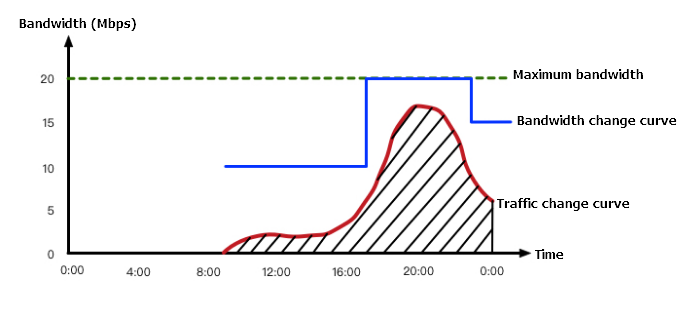
The prices in this example are for reference only. For current prices, refer to the buy page in the console.
Changes to the peak bandwidth do not affect the total fees for a pay-by-data-transfer EIP.
Total fee = Data transfer fee + Configuration fee (public IP address retention fee) = CNY 48 + CNY 0.3 = CNY 48.3
Data transfer fee:
Data transfer unit price: The unit price in the China (Hangzhou) region is CNY 0.8/GB.
Data transfer: 60 GB for the day.
Data transfer fee for the day: Data transfer unit price × Data transfer = CNY 0.8/GB × 60 GB = CNY 48.
Configuration fee:
Public IP unit price: The unit price in the China (Hangzhou) region is CNY 0.02/hour/IP.
Billing duration: You used the EIP for 14.5 hours on that day. The usage is rounded up to 15 hours for billing.
Configuration fee (public IP address retention fee) for the day: Public IP unit price × Billing duration = CNY 0.02/hour/IP × 15 hours × 1 IP = CNY 0.3.
Pay-by-bandwidth
Pay-by-bandwidth EIPs are billed based on peak bandwidth and duration. You can release the EIP at any time.
Billable items and pricing
Bandwidth fee
The bandwidth fee is based on peak bandwidth and billing duration. Charges accrue hourly and settle daily.
Bandwidth fee = Bandwidth unit price (CNY/Mbps/day) × [Billing duration (hours)/24] (days) × peak bandwidth (Mbps)Billing duration: The period you hold the EIP, rounded up to full hours. For example, if you create an EIP at 09:00:00 and release it at 12:30:00, the billing duration is 4 hours = (4/24) days.
Bandwidth unit price:
Three line types are supported: BGP (Multi-ISP), BGP (Multi-ISP) Pro, and Local ISP. Prices vary by line type. Local ISP is currently available only in the US (Virginia) region.
BGP (Multi-ISP) uses tiered pricing with a 5 Mbps threshold. Rates differ for 1–5 Mbps and above 5 Mbps.
If the peak bandwidth is greater than 5 Mbps, the bandwidth fee is calculated using the following formula, where n is the peak bandwidth:
Bandwidth fee = [Unit price for 1–5 Mbps (CNY/Mbps/day) × 5 + Unit price for >5 Mbps (CNY/Mbps/day) × (n - 5)] × [Billing duration (hours)/24] (days)
Peak bandwidth: Adjustable at any time. If changed during a day, the highest value set that day is used for billing.
The following tables show public cloud pricing for reference only. For the latest pricing, see the buy page.
Table 5. Bandwidth unit price for BGP (Multi-ISP) EIPs
Area | Region | Bandwidth unit price (CNY/Mbps/day) | |
1–5 Mbps | >5 Mbps | ||
Asia Pacific - China | China (Beijing), China (Zhangjiakou), China (Hohhot), China (Ulanqab), China (Hangzhou), China (Shanghai), China (Shenzhen), China (Heyuan), China (Guangzhou), China (Chengdu), China (Nanjing), China (Fuzhou), China (Wuhan), China (Zhongwei) | 0.96 | 3.36 |
China (Qingdao) | 0.72 | 3.12 | |
China (Hong Kong) | 0.96 | 3.36 | |
Asia Pacific - Other Regions | Philippines (Manila), Singapore, Indonesia (Jakarta), Thailand (Bangkok), Malaysia (Johor) | 0.96 | 3.36 |
Malaysia (Kuala Lumpur), South Korea (Seoul) | 0.96 | 3.36 | |
Japan (Tokyo) | 1.152 | 3.84 | |
Europe & Americas | US (Virginia), US (Silicon Valley), Germany (Frankfurt), France (Paris), UK (London), Mexico, Brazil (São Paulo), Netherlands(Amsterdam) | 0.96 | 3.36 |
Middle East | UAE (Dubai) | 3.36 | |
Table 6. Bandwidth unit price for BGP (Multi-ISP) Pro EIPs
Area | Region | Bandwidth unit price (CNY/Mbps/day) |
Asia Pacific - China | China (Hong Kong) | 9.667 |
Asia Pacific - Other Regions | Philippines (Manila), Japan (Tokyo), Malaysia (Kuala Lumpur), Indonesia (Jakarta), Thailand (Bangkok) | 9.667 |
Singapore | 16.634 |
Table 7. Bandwidth unit price for Local ISP EIPs
Area | Region | Bandwidth unit price (CNY/Mbps/day) |
Europe & Americas | US (Virginia) | 2 |
EIP retention fee
The configuration fee (public IP address retention fee) is based on the public IP unit price and billing duration.
For EIPs that use a BGP line type, such as BGP (Multi-ISP) or BGP (Multi-ISP) Pro:
The configuration fee (public IP address retention fee) is waived in the following scenarios:
BGP (Multi-ISP) and BGP (Multi-ISP) Pro EIPs can be directly bound to VPC-type ECS instances or ECI instances, and the EIP quota for an Alibaba Cloud account (primary account) is 2,000 or less.
The configuration fee does not apply to EIPs allocated from an IP address pool. Instead, you are charged based on the public IP address fees for IP address pools.
You bring your own IP address (BYOIP) to Alibaba Cloud.
A configuration fee is charged for all scenarios not otherwise specified. For example, when you bind an EIP to an elastic network interface, if you select an elastic network interface that is bound to a primary network interface, the configuration fee (public IP retention fee) is still charged.
For EIPs that use the Local ISP line type, the EIP configuration fee is charged regardless of whether the EIP is bound to a cloud resource.
For the pay-by-bandwidth method, the EIP configuration fee (public IP address retention fee) is calculated hourly and billed daily. The unit is CNY/day/IP.
EIP configuration fee (public IP address retention fee) = Public IP address unit price (CNY/day/IP) × Billing duration (days) × Number of EIPsThe following tables show public cloud pricing for reference only. For the latest pricing, see the buy page.
Table 8. Public IP address unit price for pay-by-bandwidth EIPs
The public IP address unit price is the same for both BGP (Multi-ISP) and BGP (Multi-ISP) Pro line types.
Area | Region | Public IP unit price (CNY/day/IP) |
Asia Pacific - China | China (Qingdao), China (Beijing), China (Zhangjiakou), China (Hohhot), China (Ulanqab), China (Hangzhou), China (Shanghai), China (Shenzhen), China (Heyuan), China (Guangzhou), China (Chengdu), China (Nanjing), China (Fuzhou), China (Wuhan), China (Zhongwei) | 0.48 |
China (Hong Kong) | 0.96 | |
Asia Pacific - Other Regions | Philippines (Manila), Singapore, Indonesia (Jakarta), Thailand (Bangkok), Malaysia (Johor), Malaysia (Kuala Lumpur) | 0.96 |
South Korea (Seoul), Japan (Tokyo) | 0.72 | |
Europe & Americas | US (Virginia), US (Silicon Valley), Germany (Frankfurt), France (Paris), UK (London), Mexico, Brazil (São Paulo), Netherlands(Amsterdam) | 0.72 |
Middle East | UAE (Dubai) | 0.96 |
Public IP address unit price for pay-by-bandwidth Local ISP EIPs
Area | Region | Public IP unit price (CNY/day/IP) |
Europe & Americas | US (Virginia) | 1.44 |
Billing cycle and bill generation time
Pay-by-bandwidth EIPs are billed daily, settled at 00:00:00 (UTC+8) the following day. Bills are typically generated in the early morning. Actual times may vary.
Billing example
Suppose at 09:30:00, you create a pay-by-bandwidth EIP with the BGP (Multi-ISP) line type in the China (Hangzhou) region and set its peak bandwidth to 10 Mbps. You immediately associate the EIP with a NAT Gateway and begin generating network traffic.
During that day, you change the peak bandwidth twice:
At 17:00:00, the peak bandwidth is changed from 10 Mbps to 20 Mbps.
At 23:00:00, the peak bandwidth is changed from 20 Mbps to 15 Mbps.
The prices in this example are for reference only. For actual pricing, see the buy page.
Total cost = Bandwidth fee + EIP configuration fee (public IP address retention fee) = CNY 34.5 + CNY 0.3 = CNY 34.8
Bandwidth fee:
Peak bandwidth: Billing is based on the highest peak bandwidth set during the day. In this example, the billable peak bandwidth is 20 Mbps.
Bandwidth unit price: In the China (Hangzhou) region, the unit price is CNY 0.96/Mbps/day for bandwidths of 1–5 Mbps, and CNY 3.36/Mbps/day for bandwidths greater than 5 Mbps.
Billing duration: The EIP was active for 14.5 hours. For billing, this duration is rounded up to 15 hours.
Bandwidth fee for that day = [0.96 × 5 + 3.36 × (20 - 5)] × (15 hours / 24 hours) = CNY 34.5.
EIP configuration fee:
Public IP address unit price: The unit price for a public IP address in the China (Hangzhou) region is CNY 0.48/day/IP.
Billing duration: The EIP was active for 14.5 hours. For billing, this duration is rounded up to 15 hours.
EIP configuration fee (public IP address retention fee) for that day = CNY 0.48/day/IP × (15 hours / 24 hours) × 1 IP = CNY 0.3.
Modify configuration
You can modify the peak bandwidth and metering method of a pay-as-you-go EIP to meet changing business requirements.
Go to the EIP console. In the Bandwidth column of the target EIP, click Modify Configuration. Set a new Maximum Bandwidth, or switch the billing method by modifying Data Transfer.
Limitation: While a billing method change is pending, you cannot submit another request to modify the peak bandwidth.
To adjust the peak bandwidth before a billing method change takes effect, first cancel the pending billing method change order, then submit a request to modify the peak bandwidth.
When the changes take effect:
Changes to the peak bandwidth take effect immediately.
Changes to the billing method take effect at 00:00 the next day (UTC+8).
Billing: After the changes take effect, you will be billed based on the new configuration.
Change billing method
You can switch between the pay-by-traffic and pay-by-bandwidth billing methods. The change takes effect at 00:00:00 (UTC+8) on the next day.
Switch from pay-as-you-go to subscription:
You can switch a pay-as-you-go (pay-by-bandwidth) EIP to a subscription. The change takes effect immediately.
You cannot switch EIPs protected by Anti-DDoS Origin Enterprise to the subscription billing method.
Procedure: In the Actions column for the target EIP, choose
 > Modify Instance > Switch to Subscription.
Billing impact: You must pay the subscription bandwidth fee for the selected subscription duration.
Effective time: The change takes effect immediately upon payment.
You cannot directly switch a pay-as-you-go (pay-by-traffic) EIP to a subscription. You must first switch the EIP to the pay-by-bandwidth method, and then switch it to a subscription.
While a billing method change is pending, you cannot submit another request to modify the bandwidth limit.
Procedure: In the Actions column for the target EIP, choose
> Modify Instance > Modify, and change Metering Method to Pay-By-Bandwidth. Then, in the Actions column for the same EIP, choose  > Modify Instance > Switch to Subscription.
Effective time: The switch from pay-as-you-go (pay-by-traffic) to pay-as-you-go (pay-by-bandwidth) takes effect at 00:00:00 (UTC+8) on the next day.
To cancel a pending billing method change for a pay-as-you-go EIP, in the Actions column for the EIP, choose
> Modify Instance > Cancel Pending Order. You cannot cancel effective orders. This action cannot be undone. Proceed with caution.
Bills and usage
Log in to the Expenses and Costs console to view the spending summary.
To view bills for this product, go to the Bill Details page. In the product filter, select Elastic IP Address. Select a time range to view the details for your EIPs.
To view usage, go to the EIP console, click the target EIP, and select the Monitoring and O&M tab to see its real-time bandwidth and traffic. For more detailed monitoring data, go to CloudMonitor.
Request an invoice after paying for an order or settling a bill. Invoicing entities and tax rates.
Stop billing
A pay-as-you-go EIP still incurs a public IP retention fee when not associated with any resource. If you no longer need the EIP, release the EIP to stop billing.
You cannot release an EIP that is locked for security reasons.
After you release an EIP, billing stops. However, you may still receive a bill for the EIP.
This can happen for the following reasons:
An EIP that uses the pay-by-data-transfer billing method is billed hourly.
For example, if you release an EIP at 10:30:00, you will receive a bill after 11:00:00 for the data transfer fees incurred from 10:00:00 to 11:00:00.
An EIP that uses the pay-by-bandwidth billing method is billed daily.
For example, if you release an EIP on January 1, 2025, you will receive a bill after 00:00:00 on January 2, 2025 for the bandwidth fees incurred on January 1, 2025.
Overdue payments and top-ups
When a pay-as-you-go EIP has an overdue payment, you receive email and SMS notifications. Top up your account to resolve the issue.
Your EIP service is unaffected by an overdue payment as long as your account remains within its grace period limit. Top up your account during this period to prevent service suspension.
Alibaba Cloud provides a grace period for overdue payments. A grace period allows you to use a cloud service for a set period or up to a specific limit after a payment for a pay-as-you-go resource becomes overdue. Billing continues as usual during the grace period.
If the overdue payment exceeds your grace period limit, the EIP enters service suspension.
EIPs not added to an Internet Shared Bandwidth instance: The bandwidth is limited to 1 Kbps.
EIPs added to a pay-as-you-go Internet Shared Bandwidth instance: The bandwidth of the Internet Shared Bandwidth instance is limited to 1 Kbps. The EIP is not automatically removed from the Internet Shared Bandwidth instance, and remains associated with it.
EIPs added to a subscription Internet Shared Bandwidth instance (if the instance has not expired): The Internet Shared Bandwidth instance is not affected. The EIP is not automatically removed from the Internet Shared Bandwidth instance, and remains associated with it.
If you top up your account within 7 days of an EIP entering service suspension, the system settles the overdue payment and immediately restores the service.
If an EIP remains in service suspension for 7 days, it is automatically released. After the EIP is released, its configuration and data are permanently deleted and cannot be recovered.