Introduction to MSE Serverless instances
MSE Serverless instances use a pay-as-you-go billing model to reduce resource waste. Compared to regular instances, they are low-cost, adaptively elastic, and fully managed. If you run services in a staging environment or a small to medium-sized production environment, MSE Serverless instances can significantly reduce your costs.
Notes
ZooKeeper Serverless instances automatically scale nodes based on the number of connections. A client connection may be rejected by a node that has reached its connection limit. Ensure that your client has a proper reconnection logic. After multiple retries, the client can connect to a node that is not throttled.
Advantages of MSE Serverless instances
-
Lower cost: MSE Serverless instances are available on demand and are billed on a pay-as-you-go basis.
Cloud-native gateways are billed based on the total number of requests per hour. Configuration centers are billed based on the maximum number of client connections per hour. This billing model can save significant costs for staging environments or small to medium-sized production environments.
-
Adaptive elasticity: MSE Serverless instances ensure service stability and high performance by automatically scaling underlying resources based on service traffic. This eliminates the need for complex capacity planning and manual scaling.
For businesses with tidal traffic patterns or unexpected traffic surges, this feature ensures sufficient system resources, enhances stability, and greatly reduces Operations and Maintenance (O&M) costs and system threats.
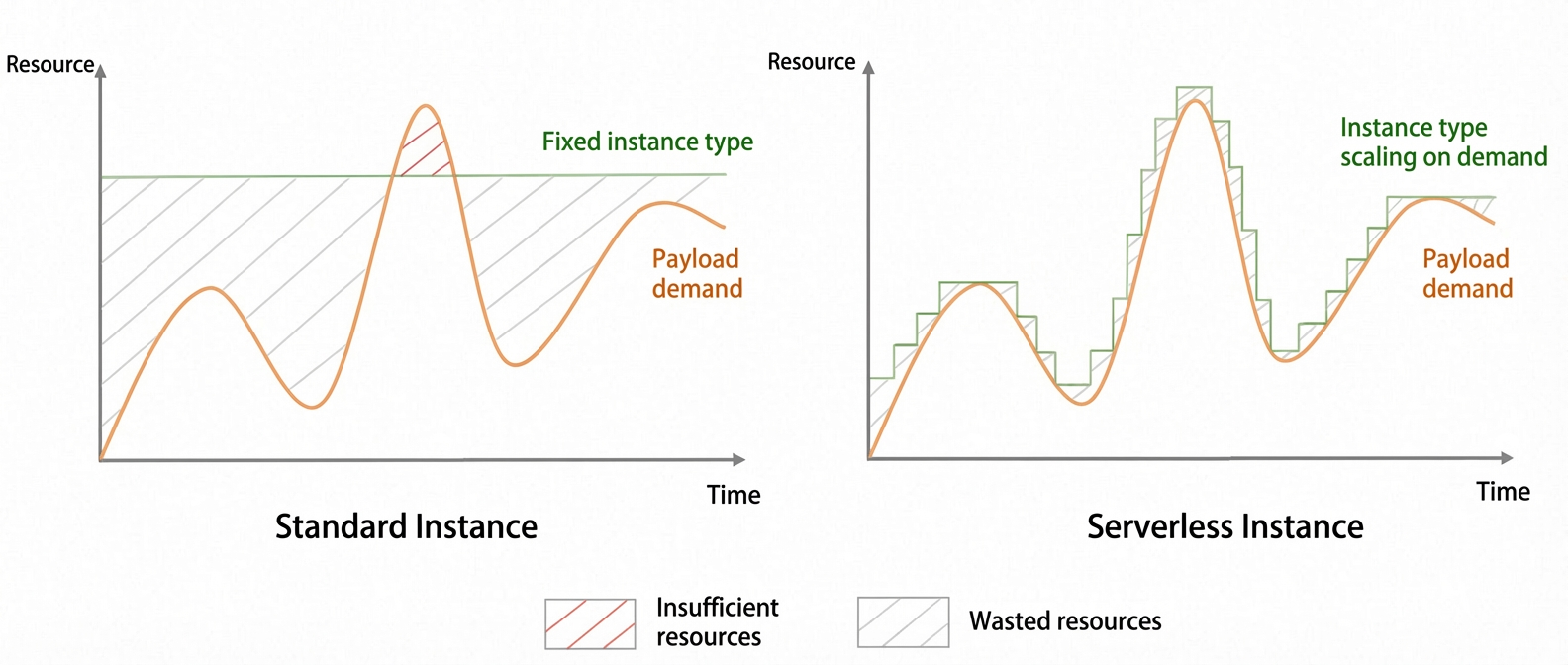
For example, in a scenario with highly fluctuating traffic, the resource usage and specification changes for regular and Serverless instances are shown in the following figure:
-
Regular instances: In this fixed-resource payment model, you must purchase specifications based on peak service loads. This leads to more wasted resources during off-peak periods and higher overall costs. If an unexpected traffic surge occurs, insufficient resources can disrupt your services.
-
Serverless instances: Because their underlying resources adjust dynamically with service traffic, resource utilization is improved and waste is reduced. This dynamic matching of load and resources, combined with pay-as-you-go billing, can result in significant cost savings. During peak periods, they can meet business demands, ensure service continuity, and improve system stability.
-
-
Out-of-the-box and fully managed: Automatic database engine version upgrades and default alert configurations reduce your O&M workload.
When you create an instance, default alert metrics are configured automatically. Database engine version upgrades are automatically scheduled and run during the maintenance window. This provides a fully managed experience with no impact on your business and ensures continuous service availability.
Instance billing
For more information about the billing of MSE Serverless instances, see Billing overview of Serverless configuration center instances and Billing overview of Serverless instances.
You can subscribe to the MSE Serverless savings plan to receive discounts. For more information, see MSE Serverless savings plan.
Limits
Although MSE Serverless instances are adaptively elastic, they have the following limits in extreme scenarios:
-
Scaling limit:
-
The automatic scaling of Serverless instances has an upper limit. Therefore, they are not suitable for scenarios with many connections.
-
-
ZooKeeper connection limits:
-
Maximum connections: 3,150 (350 × 9).
-
In scenarios where connections are frequently established, connection failures may occur. The client must implement a retry mechanism.
-
-
Nacos connection limits:
-
Maximum connections: 4,500 (500 × 9).
-
-
Nacos Serverless usage limits:
Nacos Serverless instances scale elastically based on the number of client connections and do not automatically scale based on the QPS/TPS of operations such as configuration queries, configuration publishing, service registration, and service subscription. To ensure instance stability, the system imposes protection thresholds on certain operations. Requests that exceed these thresholds may be throttled or fail.
The following table describes the request-type limits. These limits scale proportionally with the number of client connections. The values in the table represent the system protection upper limits at the maximum number of connections.
Limit
Reference ratio to client connections
System protection upper limit
Client connections
-
4,500
Configuration publishing
Approximately 0.4 times/second/connection
1,800 times/second
Configuration queries
Approximately 0.4 times/second/connection
1,800 times/second
Service registration/deregistration
Approximately 0.4 times/second/connection
1,800 times/second
Service subscription/unsubscription
Approximately 0.4 times/second/connection
1,800 times/second
Service queries
Approximately 0.2 times/second/connection
900 times/second
The following table describes the resource-type limits. These limits do not change with the elastic scale of the instance.
Limit
System protection upper limit
Services
1,000
Service instances
2,000
Service subscribers
3,000
NoteThe thresholds listed above are system protection upper limits for Nacos Serverless instances and do not represent fixed specification commitments. Actual protection thresholds depend on the current elastic scale of the instance and are subject to real-time server-side protection policies. If your business involves high-frequency configuration reads/writes, high-frequency service registration/deregistration, or large-scale subscription scenarios, we recommend that you use Professional Edition or Enterprise Edition.
Scenarios
-
Low-frequency use cases, such as developer and staging environments.
-
Small to medium-sized production environments. For microservice configuration centers, the number of client connections is fewer than 100. For cloud-native gateways, the total number of requests per hour is fewer than 200,000.
-
Scenarios that require a fully managed service.
-
Scenarios with unpredictable service loads.
-
Business scenarios with tidal or intermittent traffic patterns.
-
Educational scenarios, such as school teaching and student experiments.
To select the instance type that you need, see Feature and billing comparison between Serverless and regular configuration center instances and Feature and billing comparison between Serverless and regular cloud-native gateway instances.
References
-
To create a Serverless configuration center instance, see Create a Serverless configuration center instance.
-
To create a Serverless cloud-native gateway instance, see Create a Serverless cloud-native gateway instance.