Create a Xiao-Q report
Xiao-Q Report, a tool that combines intelligent data analysis and document editing, lets you create data reports in two ways: by generating reports intelligently or by creating a blank report. This topic describes how to create a data report.
Entry points
Log on to the Quick BI console. In the top navigation bar, click Intelligent Xiao-Q to open the Intelligent Xiao-Q page. From here, select the appropriate entry point to create your Xiao-Q Report.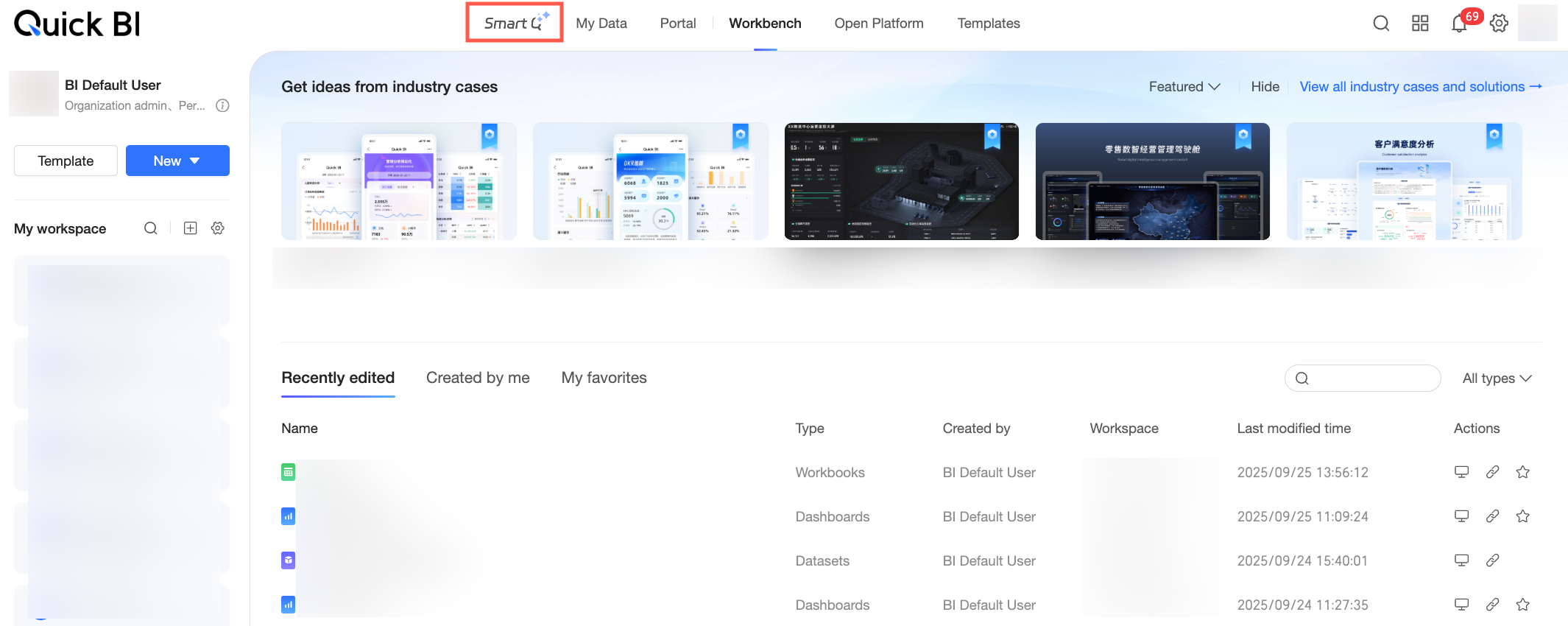
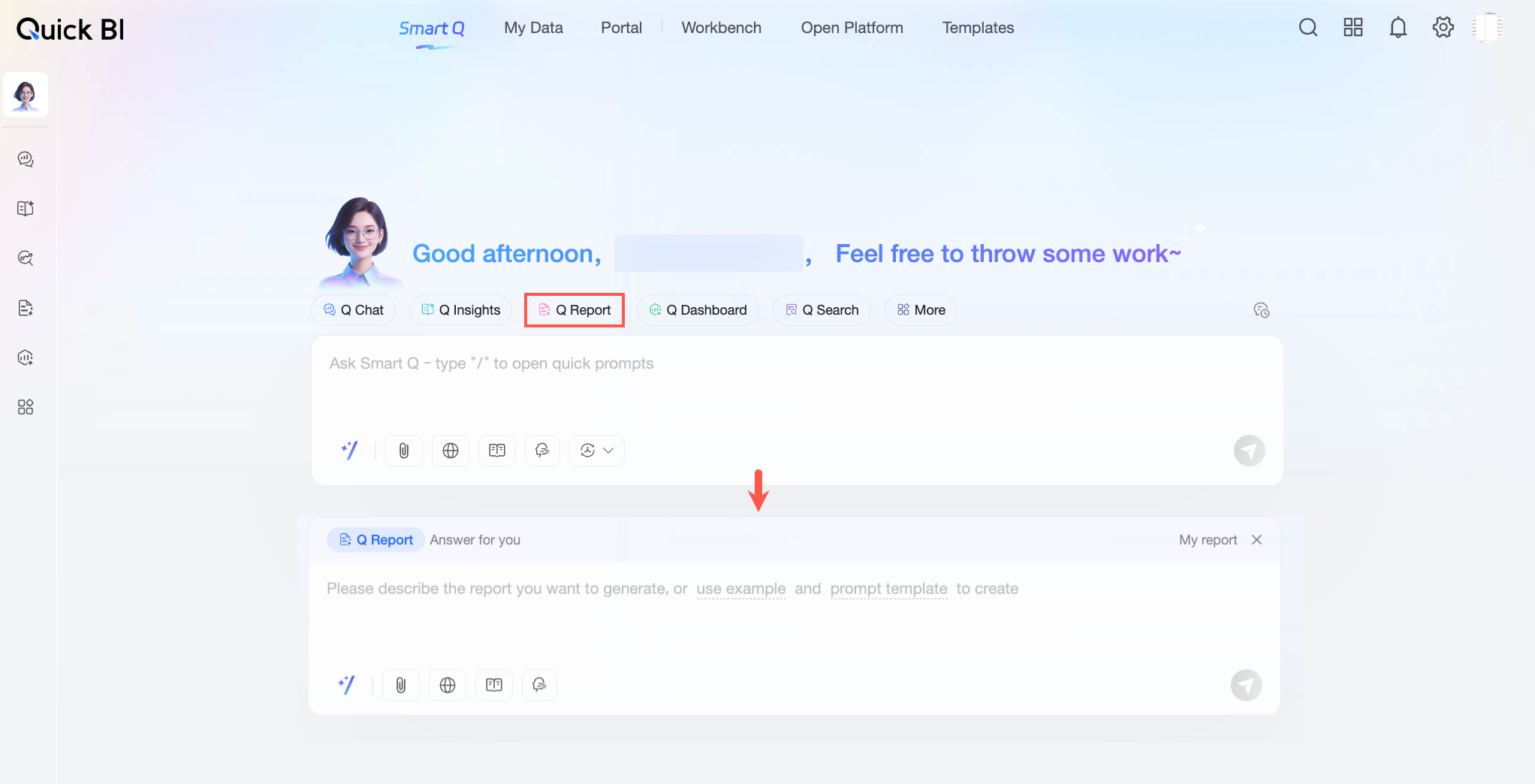
Entry points for intelligent report creation: If you need to generate an intelligent data report by entering a prompt or asking questions in natural language, use one of the following entry points.
Entry point 1: On the Intelligent Xiao-Q page, click the Xiao-Q Report button above the chat box. The chat box then switches to Xiao-Q Report mode.
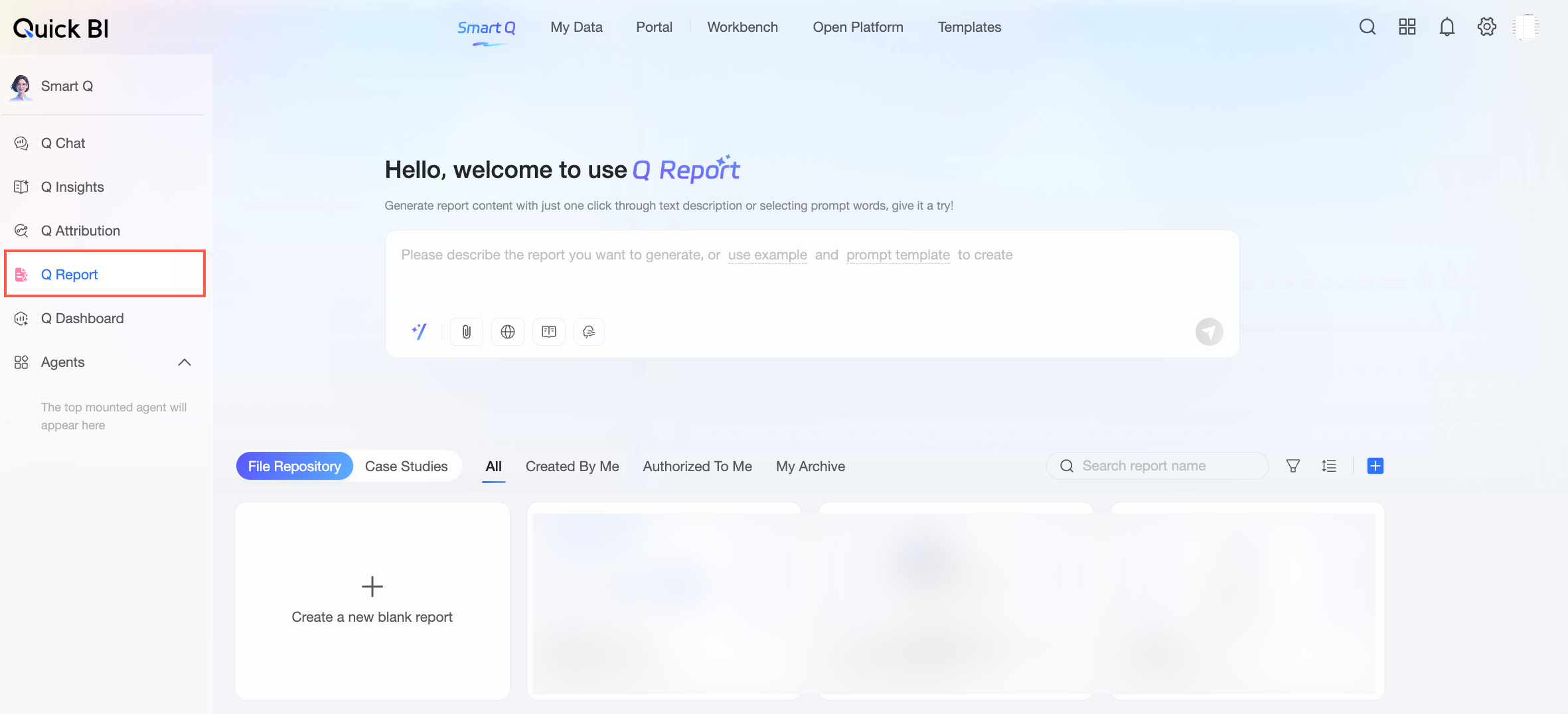
Entry point 2: On the Intelligent Xiao-Q page, hover over the menu bar on the left to display the navigation panel, and then click Xiao-Q Report to go to the Xiao-Q Report feature page.
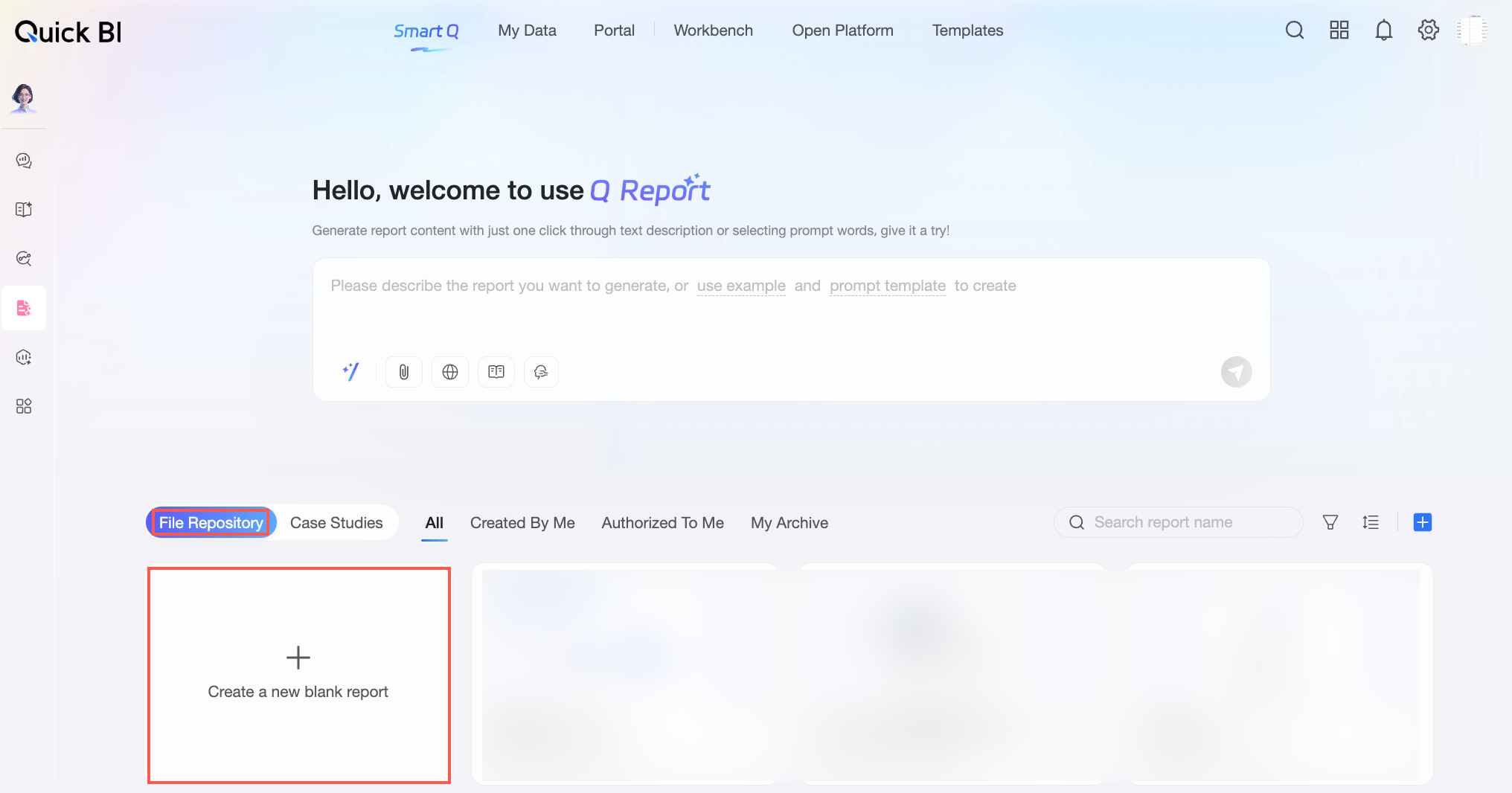
Entry points for blank report creation: If you need to create a new data report from scratch, go to the Intelligent Xiao-Q > Xiao-Q Report page and use one of the following two entry points.
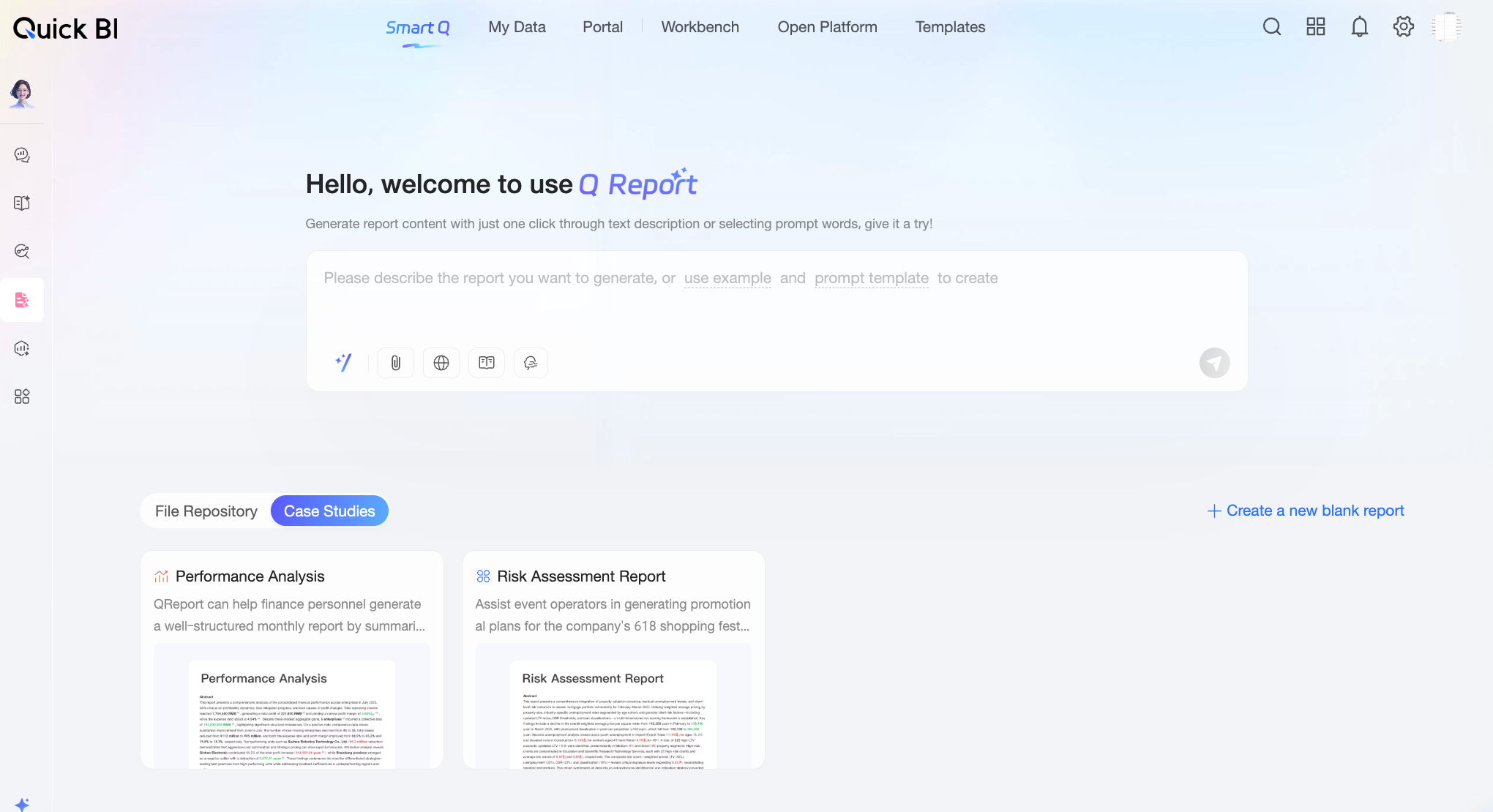
Entry point 1: For users who have never created a report, Quick BI provides sample cases based on real-world business scenarios for you to learn from. After exploring the Xiao-Q Report feature with these selected cases, click New Blank Report to start creating your own report.
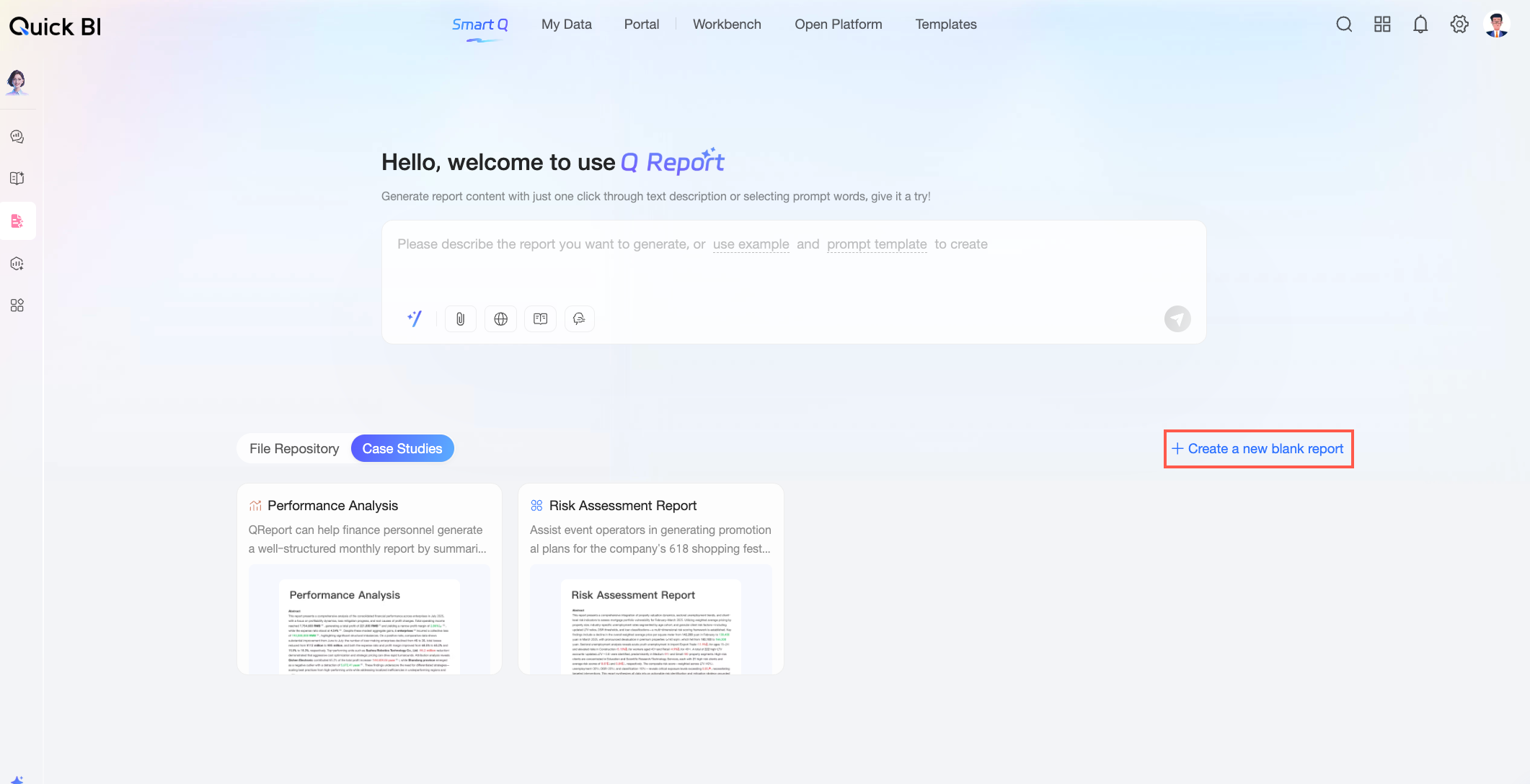
Entry point 2: For users who have already created reports, click New Blank Report on the Existing Reports tab to begin.
Selected cases
Before you start creating your Xiao-Q Report, you can browse the report creation examples in Selected Cases. These examples are based on real-world business scenarios and give you a direct look at how Xiao-Q Report works and what it can produce. This shortens the learning curve, helping you get started faster. Whether you are a new user or are looking for examples to improve your existing reports, these selected cases can help you better understand the features of Xiao-Q Report and get inspiration for your work.
Procedure
You can choose a report creation method based on your needs.
Method 1: Generate an intelligent report
Scenarios:
Large volumes of data: With traditional methods, creating reports from large and scattered datasets requires you to manually find data, analyze it, and compile the report. Xiao-Q Report automates data retrieval and analysis based on your instructions, generating a structured data report with a single click.
In-depth analysis in specific domains: When you need deep insights into your business data, such as in finance, traditional analysis often just lists data, failing to connect it to business scenarios, identify root causes, or predict trends. The insight and analysis capabilities of Xiao-Q Report can provide assessments of current business performance, predict future trends, identify potential risks, and suggest response strategies.
Rapid decision support: When management needs a quick overview of business status or project progress to make strategic decisions, or when business personnel need to track risks, traditional reports are often slow due to manual preparation. Xiao-Q Report can rapidly generate reports from project data, automatically summarize key risks, and provide timely information.
The large model for intelligent report generation is configured by your organization's administrator in Intelligent Xiao-Q General Settings > Large model configuration. For more information, see Large model configuration.
Follow these steps.
In the command dialog box, configure the following information.

Input
Recommendations
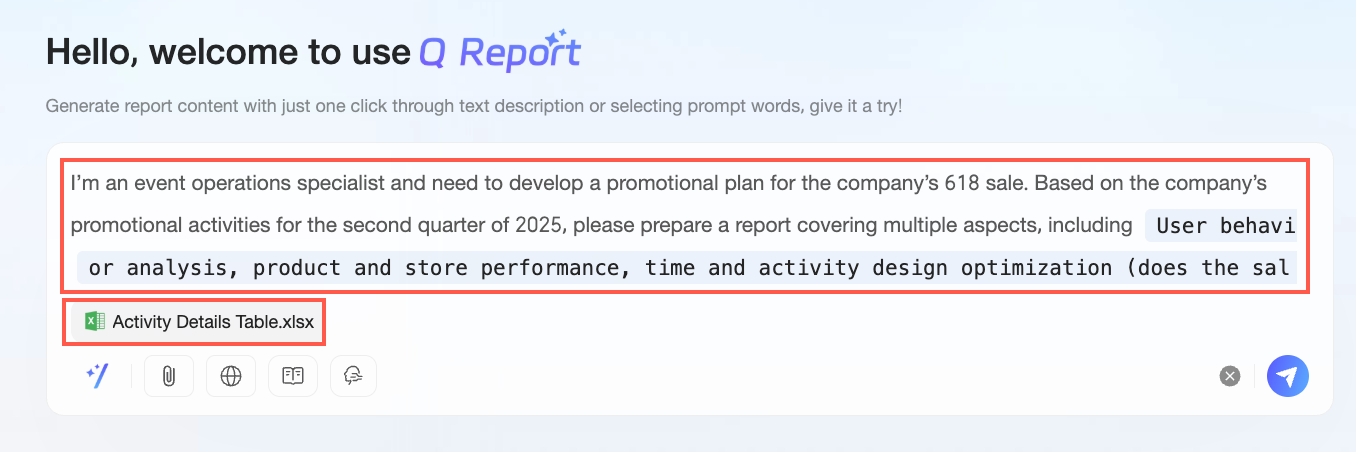
Use example
If you want to quickly get started with the Xiao-Q Report feature by using existing data, click Use Example in the dialog box to experience one-click report generation.
This action automatically populates the sample prompt and reference material for the 618 Promotion Campaign Optimization Analysis Report topic.
Prompt
Template input
Quick BI provides built-in prompt templates for various scenarios, such as business analysis and weekly/monthly reports, to help you quickly enter commands. You can also refer to multiple templates to create a prompt that is tailored to your specific business scenario and analysis needs.
In the dialog box, click Prompt Templates or the
icon to open the prompt templates and select one as needed.After you insert a template, replace the keywords with your actual business information to ensure the generated execution plan meets your requirements. For example, in a business analysis template, you can change the time keyword to 2020 and add cost and profit analysis to the content.
NoteAll content in a prompt template can be modified, not just the text in the blue boxes.
Custom input
If the built-in prompt templates do not cover your scenario, you can write your own. For professional results, your command should include the following:
① Your role, such as analyst or operations specialist.
② The current analysis scenario and goal, such as analyzing this month's business data to support business and financial decisions.
③ The report type, such as a monthly report or business analysis.
④ The desired report sections, such as key metric overview, root cause analysis, and improvement proposals.
⑤ Report requirements, such as providing actionable guidance and a trackable plan.
Reference material
Click the
icon to upload reference material. The following types are supported:Dataset: You can select up to 10 datasets that you have permission to use and have been successfully trained.
Dashboard: You can select a dashboard or chart components within a dashboard as a data source for the report.
Local file: You can upload up to 5 Word, Excel, CSV, or PDF files. Each file must be no larger than 10 MB.
NoteWhen uploading a dataset, ensure it meets the following requirements. Otherwise, it will not be available for selection in the Select Dataset dialog box.
① The dataset has been trained in the question-answering configuration. For more information, see Question-answering configuration.
② You have been granted question-answering permissions for the dataset. For more information, see Configure question-answering permissions.
You can upload different types of reference material at the same time. For example, you can add a business dataset as the main data source and upload a Word document as supplementary material for business logic.
When you add a dashboard as a reference, if you filter the selected chart components, the report is generated from the filtered data. For example, if you filter a sales details table for 2025 to show data only from January to June for a semi-annual sales analysis, the subsequent report will be based on that filtered data.
An Excel file can have a maximum of 10 sheets. Data on any sheets beyond the 10th will not be included in the report.
To ensure the system can effectively learn from your materials, follow these recommendations.
In Excel, store relevant business data in structured tables, such as activity details or sales details, to help the system better recognize and retrieve the data.
In Word, store business logic, calculation formulas, and other information, such as marketing campaign calculation formulas or business analysis logic. This helps the system learn your business logic and produce more relevant reports.
Online search
Select whether to perform an online search. This option allows the large model to access the internet to find and integrate relevant external information or data during its reasoning process.
When online search is enabled, the large model can incorporate the latest market data, industry trends, and other external information to enrich the report's content and timeliness.
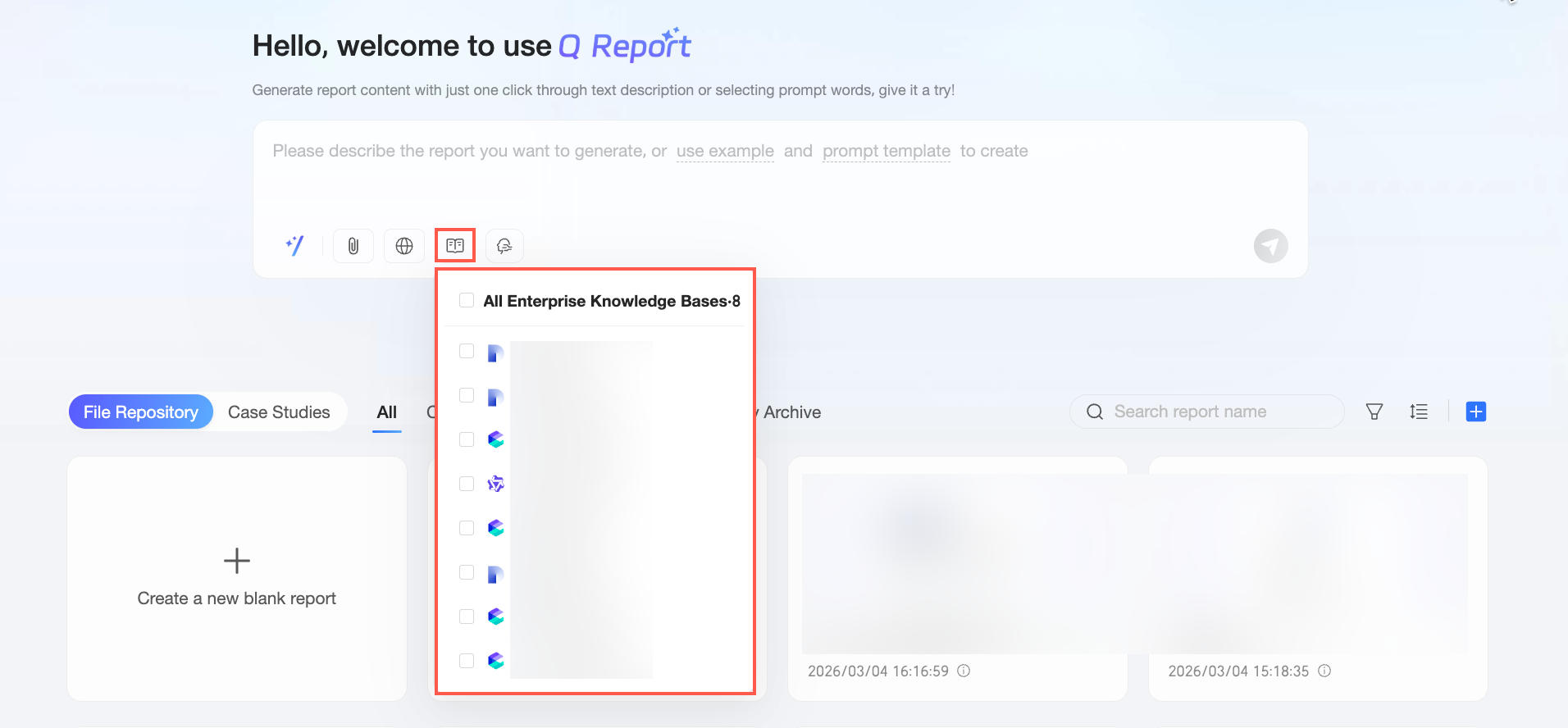
Enable enterprise knowledge base search
Select whether to enable enterprise knowledge base search. If enabled, you must also specify which knowledge base to use.
When this option is enabled, the large model can use the business information from the associated knowledge base to generate reports that are more aligned with your company's specific business context and management logic.
NoteA knowledge base can be selected here only if an organization administrator has configured and enabled it in Organization management. For more information about how to configure a knowledge base, see Knowledge base management.
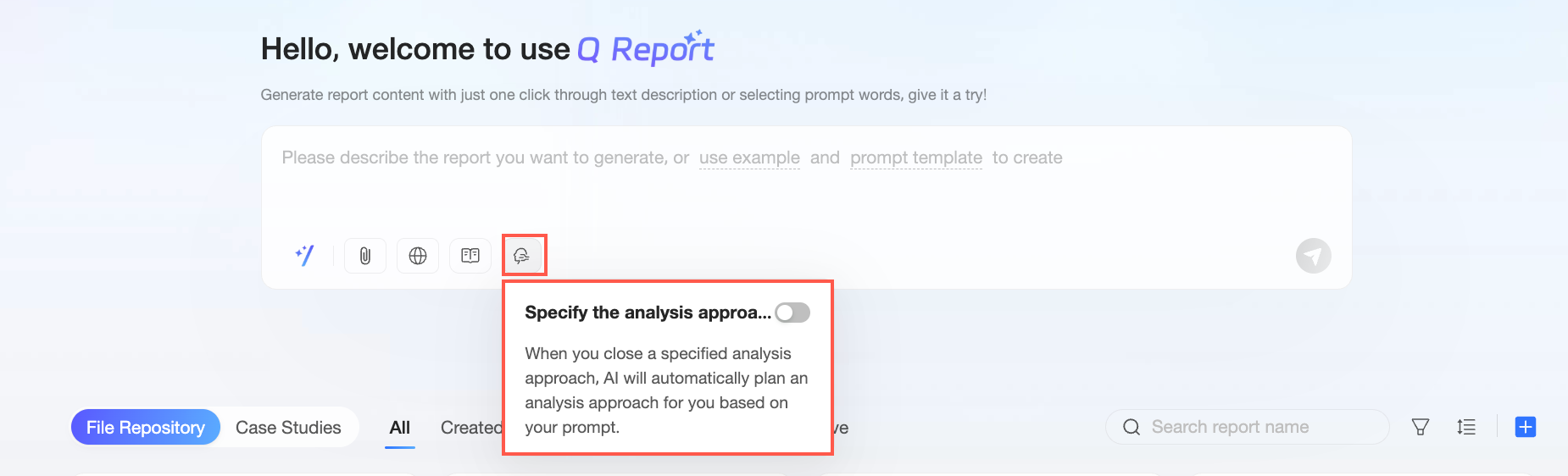
Analysis logic
Select whether to specify an analysis logic.
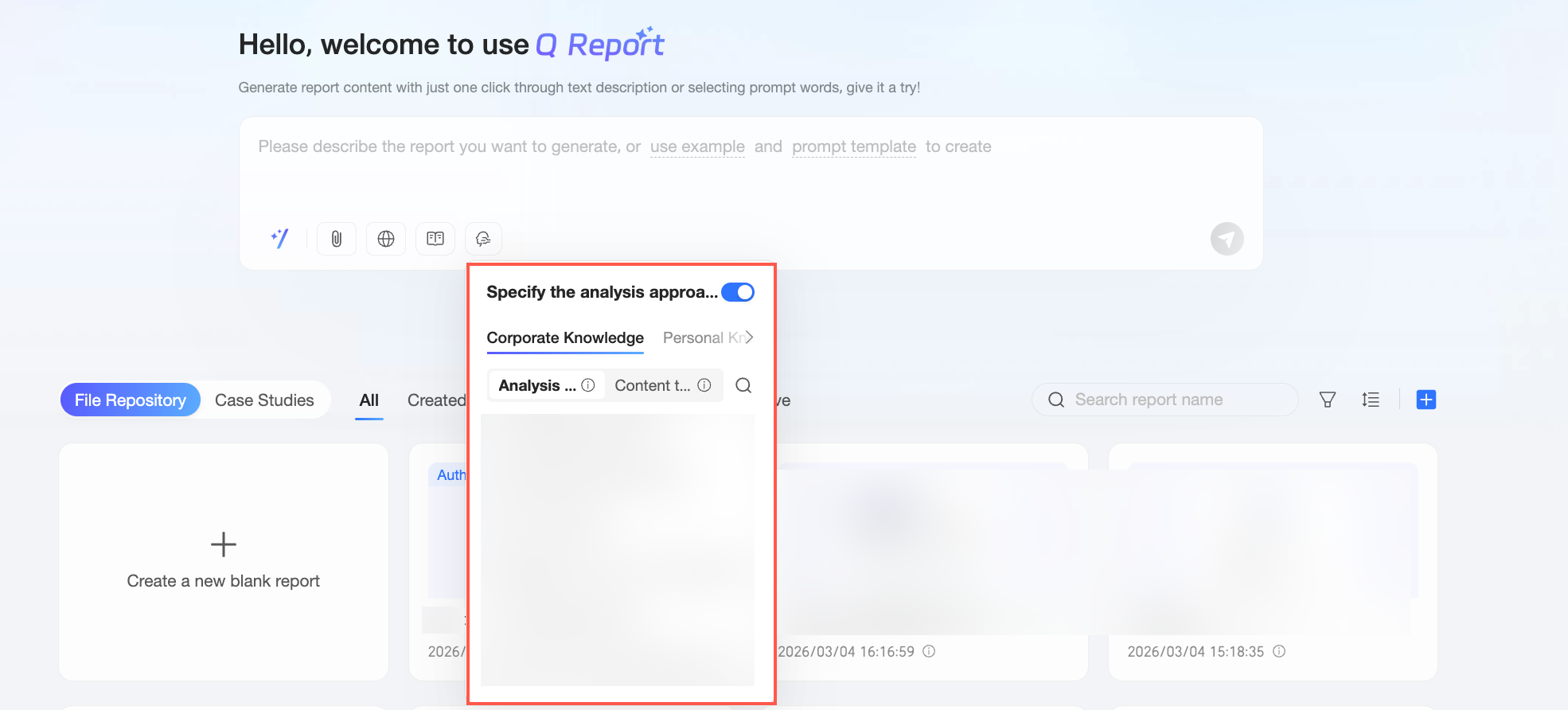
Enterprise knowledge
The Enterprise Knowledge tab displays common knowledge that is centrally configured and maintained for your organization. This standardizes the analysis scope and content structure, ensuring all reports meet organizational standards.
You can select the required analysis logic or Content Template.
Analysis logic: Specifies only the analysis logic. By configuring the analysis logic, you can guide the system to generate report content that is more aligned with your enterprise's analytical methods, avoiding generic or irrelevant results.
In this case, the large model generates the report's display structure. If you have specific requirements for the presentation layer, switch to the Content Template tab and select a template, or define the structure in the prompt or by uploading an attachment.
Content template: Specifies both the analysis logic and the output structure. By setting a content template, you can preset your enterprise's standard report framework and ensure that the analysis logic in the report meets expectations.
Click the
icon next to an analysis logic or content template to preview its details in the Specify analysis logic dialog box.NoteIf you do not specify an analysis logic, the large model automatically plans one based on your prompt.
An analysis logic or content template can be selected here only if an organization administrator has configured and enabled it in Organization management. For more information about configuration, see Knowledge base management.
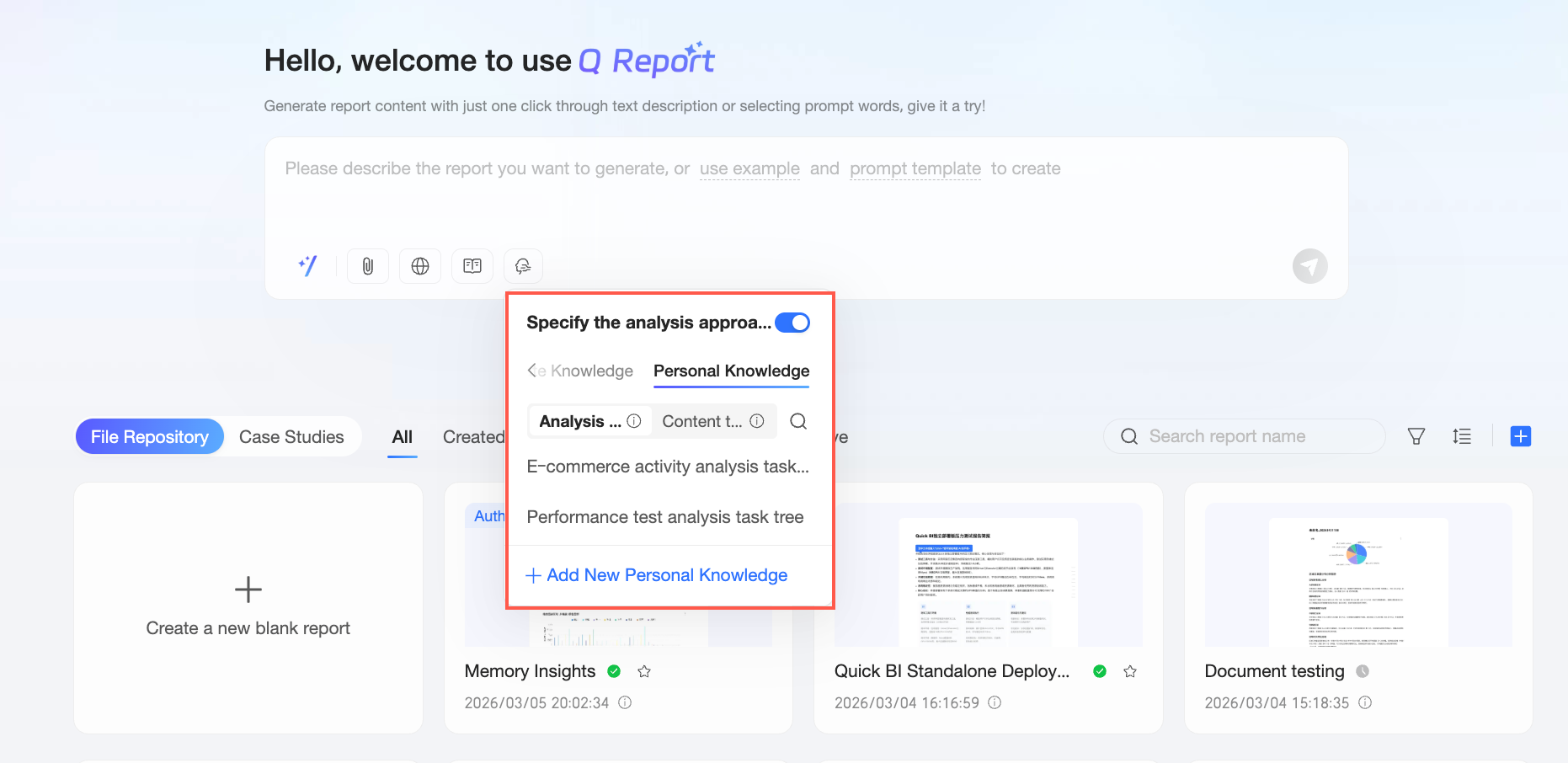
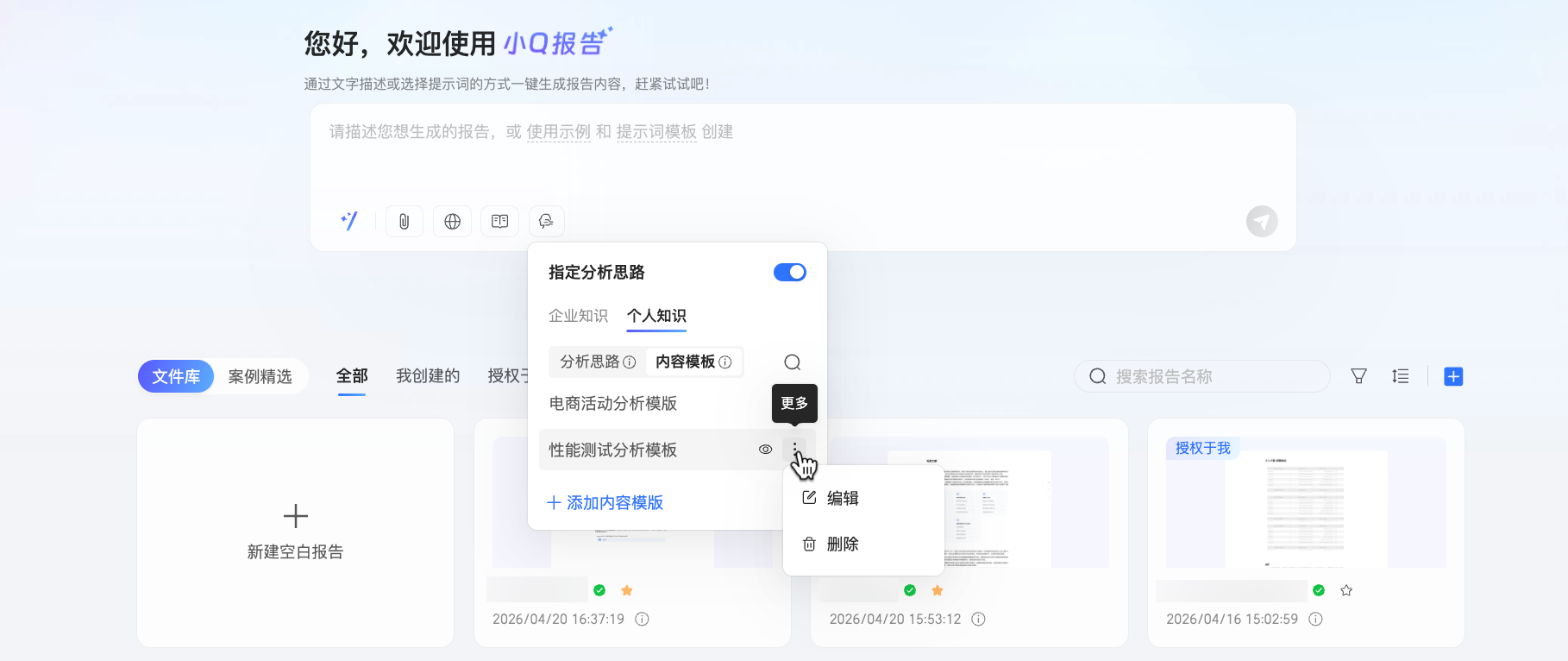
Personal knowledge
The Personal Knowledge tab displays your private knowledge, including analysis logic and content templates, that you have personally uploaded. You can upload personal knowledge derived from your own role and experience as local files and apply it when generating reports. This tailors the generated content to your individual needs and perspective.
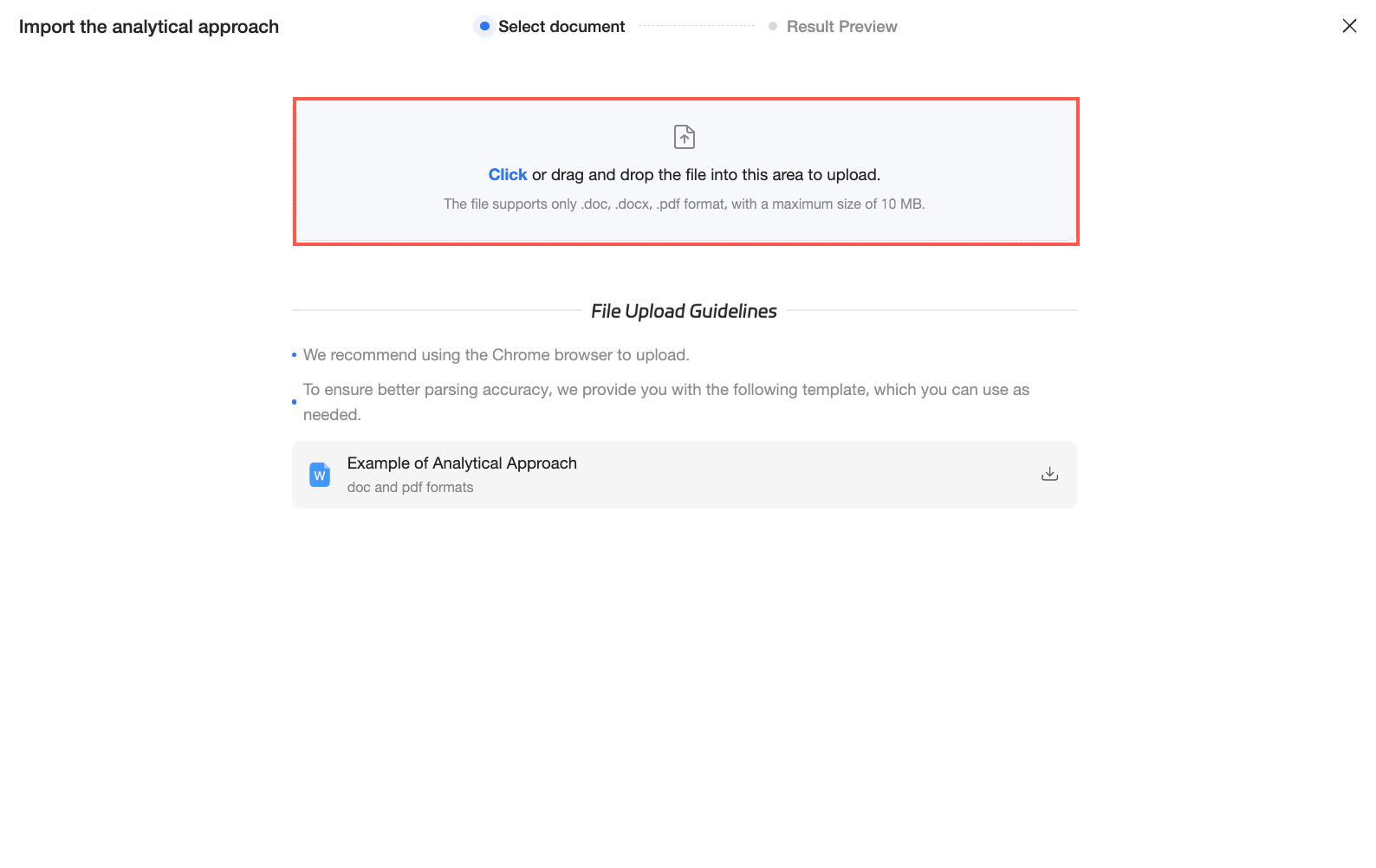
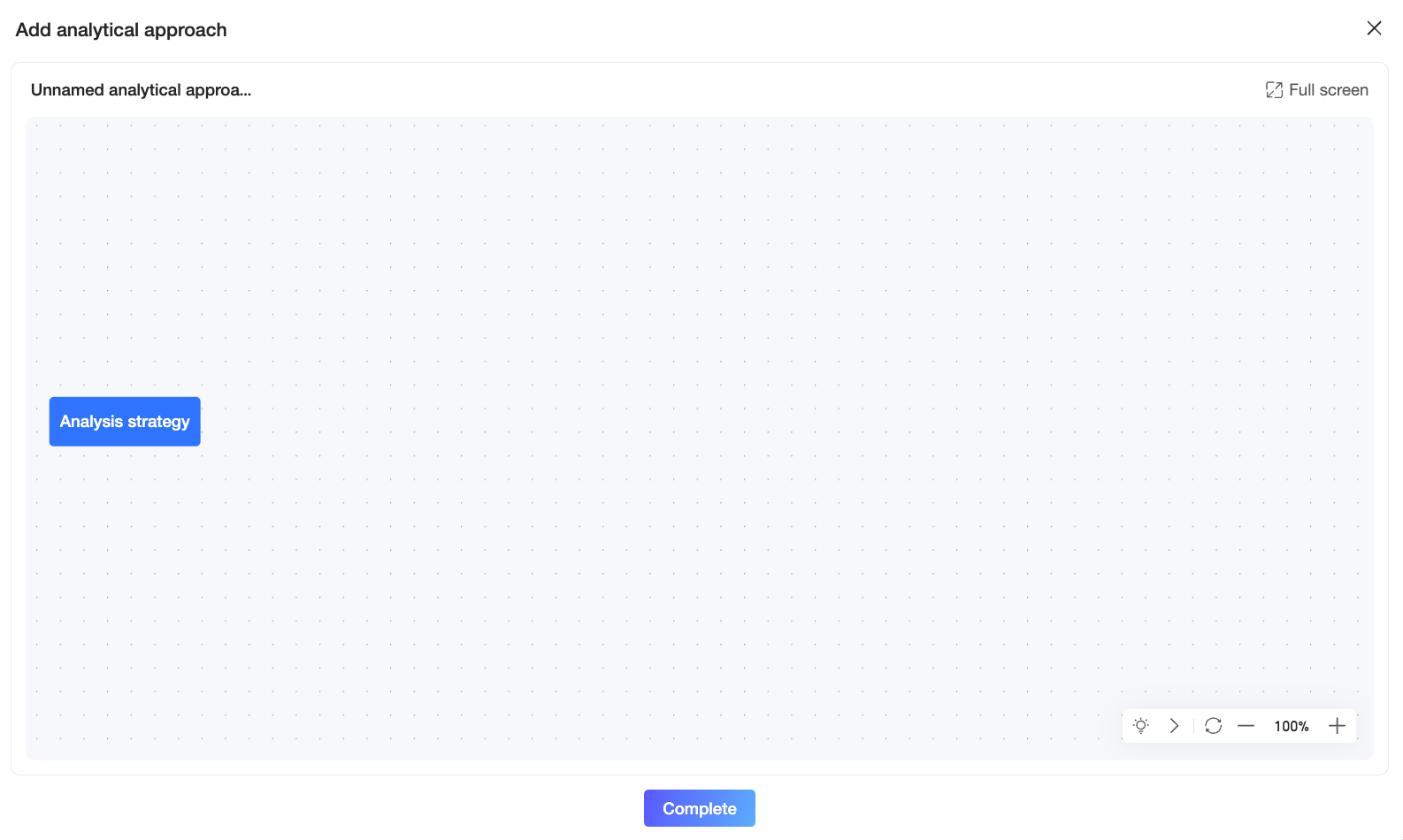
Click Add content template/Add analysis logic to add personal knowledge. You can upload content by using Import from Existing File or by Adding Manually:
Click Import from existing document and upload a knowledge file in the import dialog box.
NoteOnly .doc and .pdf files under 10 MB are supported.
After the system finishes parsing the file, a preview is displayed. Confirm the uploaded content, edit it if necessary, and then click Done.Click Add Manually, enter the knowledge content in the dialog box that appears, and click Done.
Once added, the knowledge content appears in your personal knowledge list. You can perform the following operations:
Select a knowledge item to apply it during report generation.
Click the
icon and enter a keyword in the search box to quickly find a specific item.Click the
icon to preview the knowledge details in the Specify analysis logic dialog box. You can also edit, delete, or add new items from here.Click the
icon to modify the knowledge content in the edit dialog box.Click the
icon to delete knowledge content that is no longer needed.
NotePersonal knowledge is private and visible only to the user who uploaded it. It is not shared with other members of the organization or synchronized with the enterprise knowledge base in Organization management.
If a report creator shares a report that was generated with personal knowledge for another user to edit, that user can update the data and regenerate the report. However, they cannot use the creator's personal knowledge for other tasks, such as one-click report generation outside of the shared report.
Click the
icon in the lower-right corner of the dialog box to send the command. You are automatically redirected to the execution plan generation page. Wait for the plan to be generated. If you no longer need the plan for the current command, click the icon to stop the generation process.NoteXiao-Q Report supports running generation tasks asynchronously in the background. For more information, see asynchronous generation in this topic.

 icon to open the prompt templates and select one as needed.

 icon to upload reference material. The following types are supported: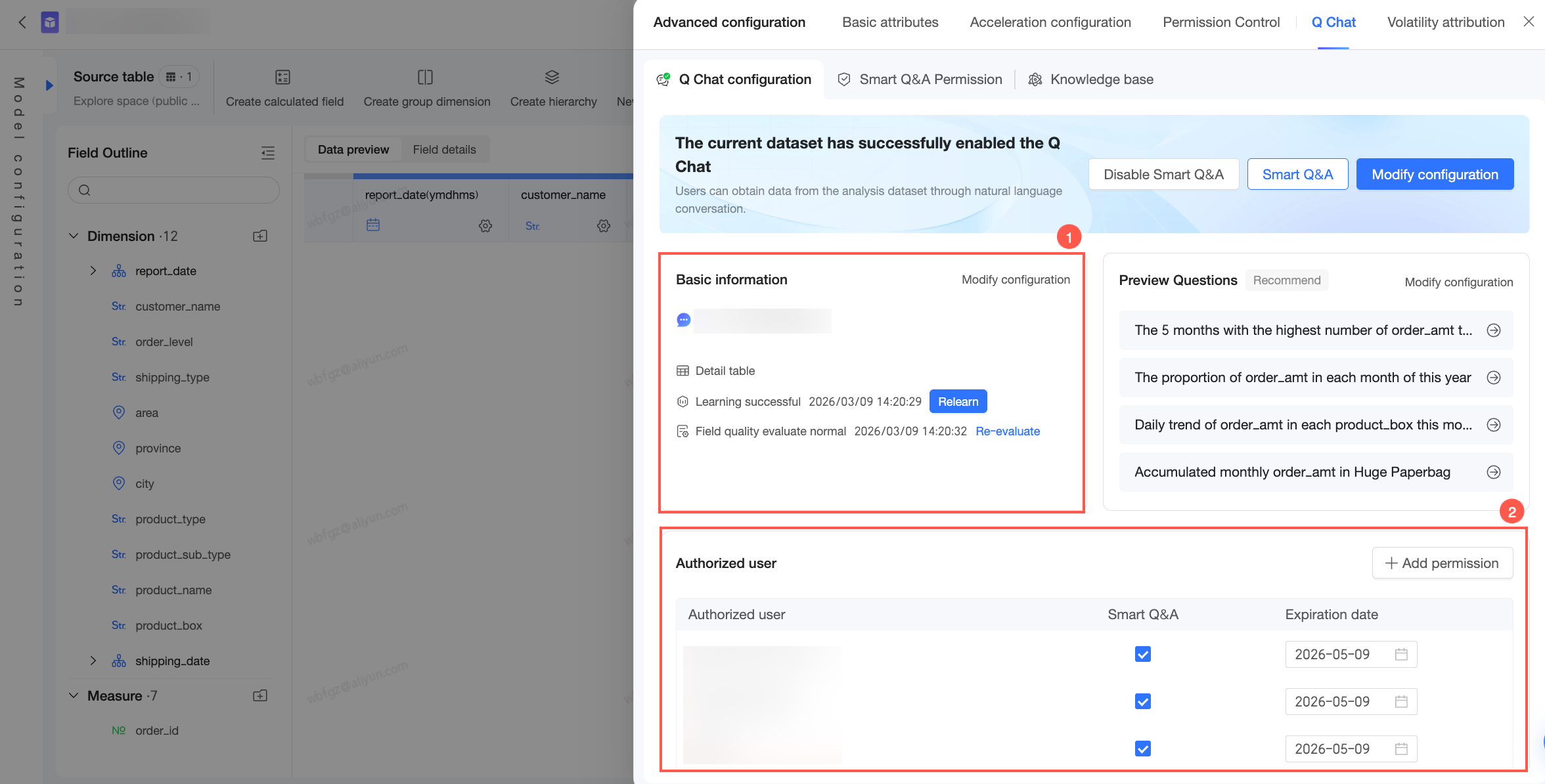
 icon next to an analysis logic or content template to preview its details in the Specify analysis logic dialog box.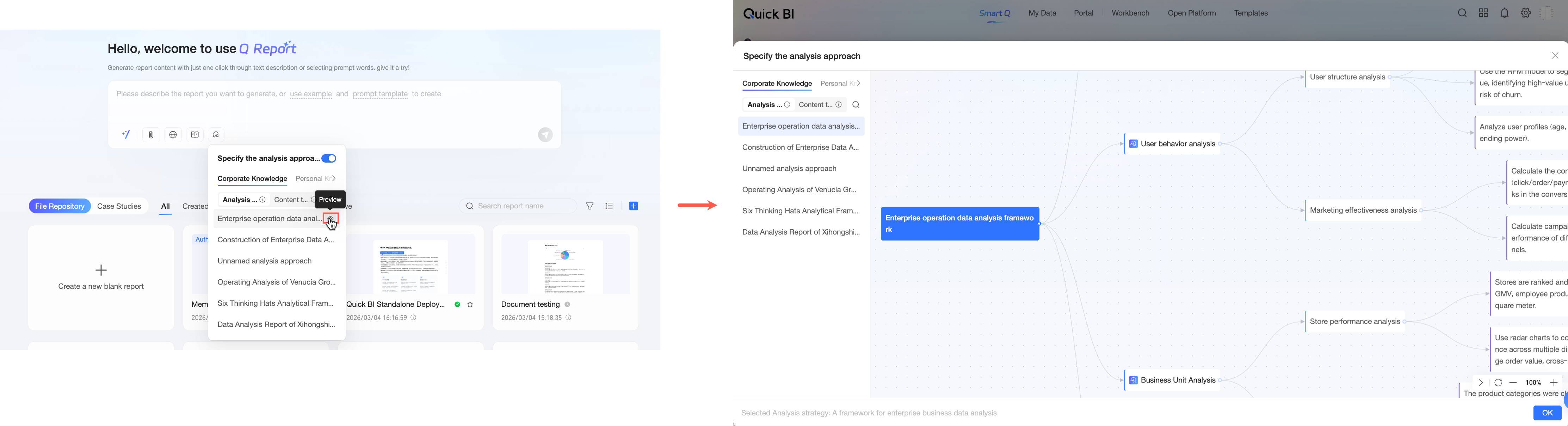
 After the system finishes parsing the file, a preview is displayed. Confirm the uploaded content, edit it if necessary, and then click Done.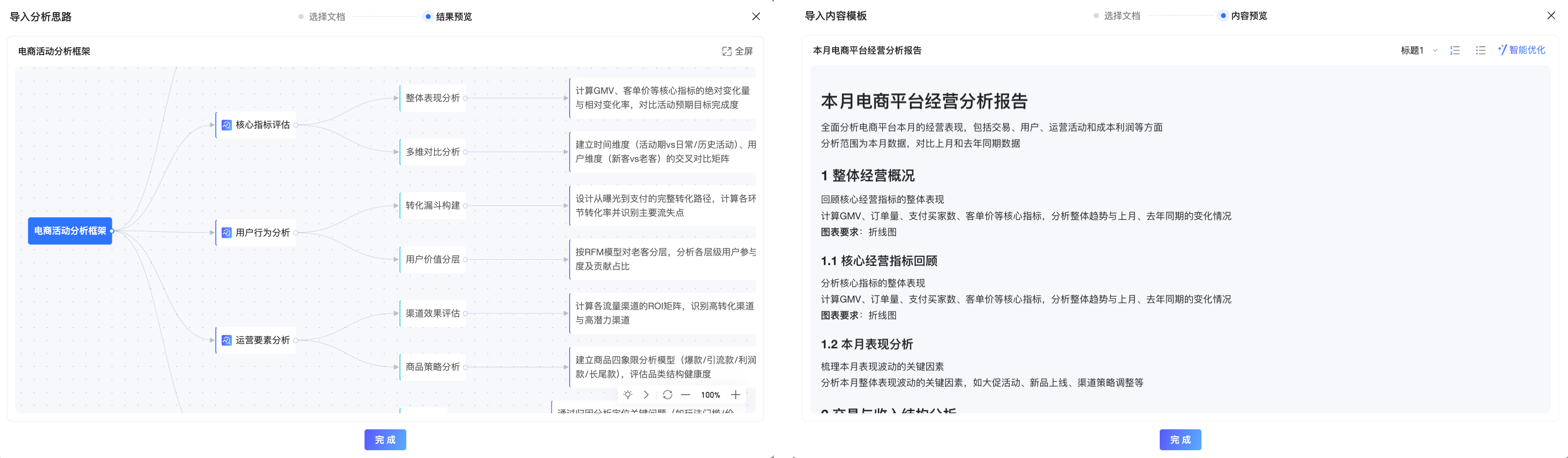
 icon and enter a keyword in the search box to quickly find a specific item.
 icon to modify the knowledge content in the edit dialog box.
 icon to delete knowledge content that is no longer needed.
 icon in the lower-right corner of the dialog box to send the command. You are automatically redirected to the execution plan generation page. Wait for the plan to be generated. If you no longer need the plan for the current command, click the
  icon to stop the generation process.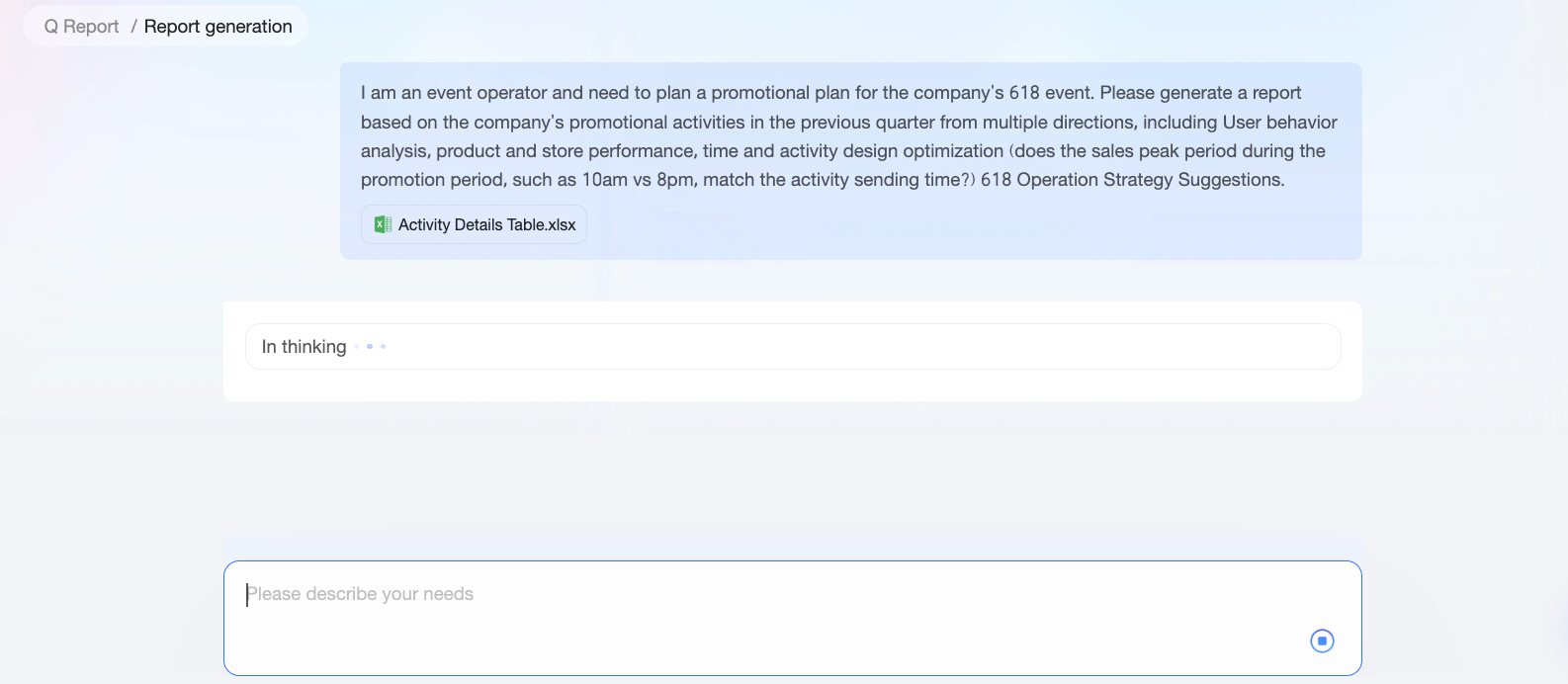
After the plan is generated, it is displayed on the page in sections. You can perform the following operations:
Click the
icon next to Thinking complete to expand and view the large model's thought process. This helps you understand the basis for each part of the execution plan and identify any potential misunderstandings by the model.Click Modify to correct any unexpected output and optimize the execution plan. For example, you can delete unnecessary parts or merge several steps into one.
Click OK to confirm the current plan. The system then automatically generates an intelligent data report based on the plan's steps and content.
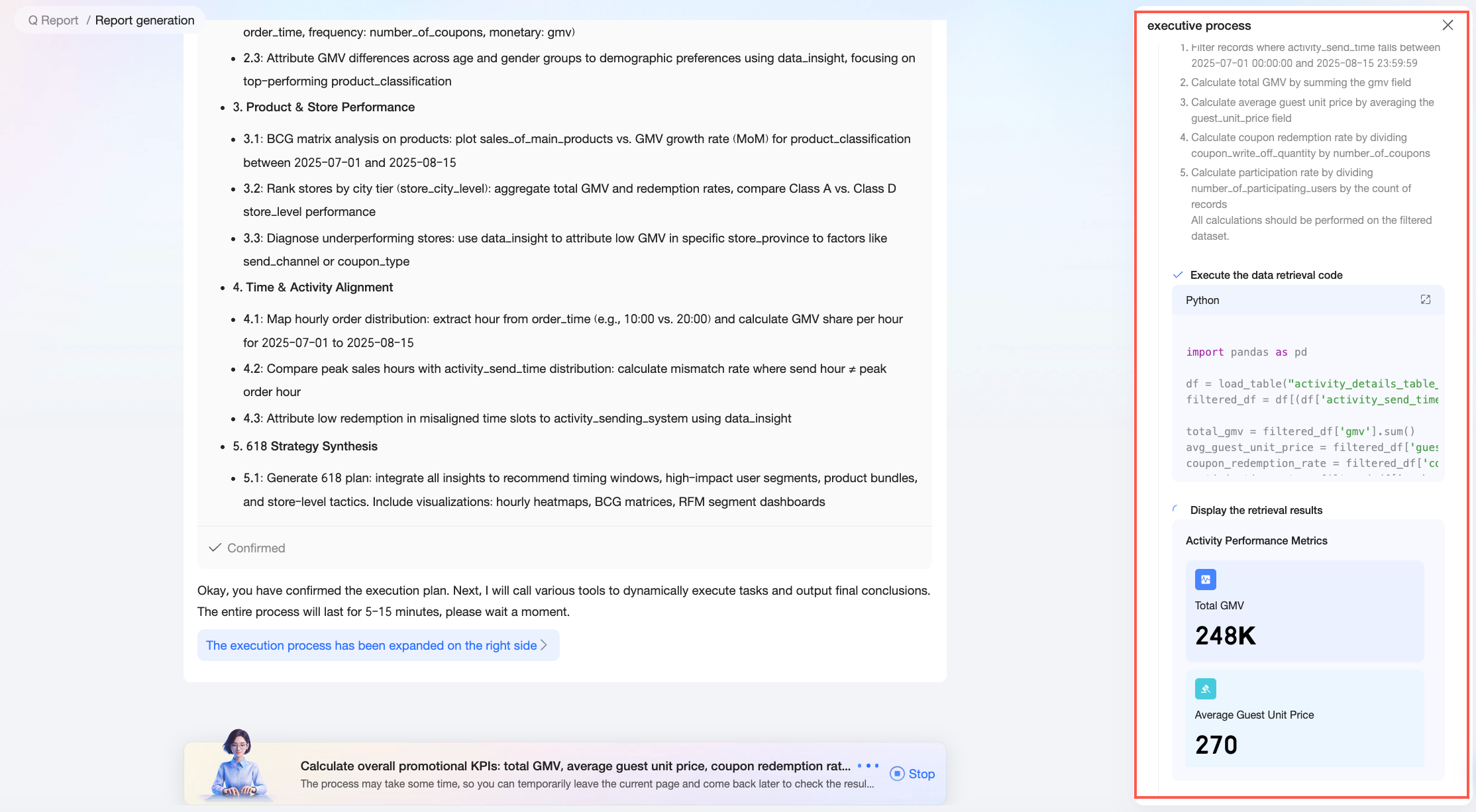
During plan execution, you can see the current progress and inference process on the right side of the page.
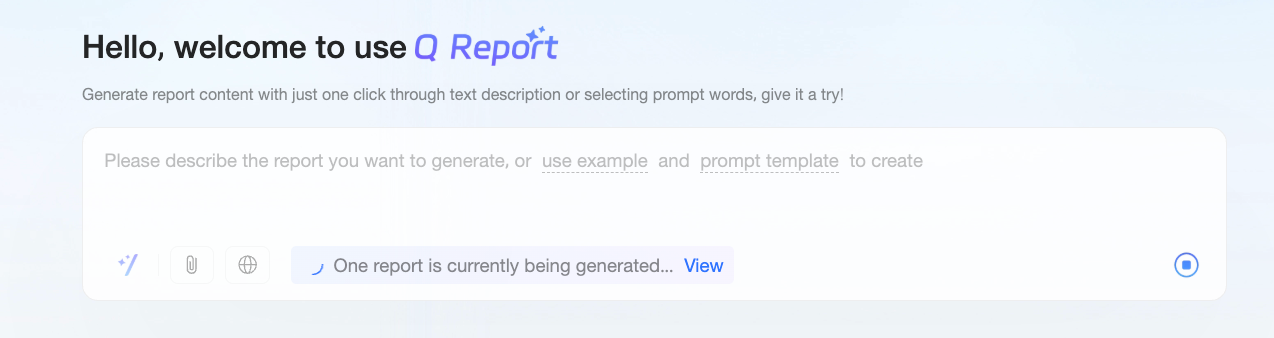
Generating an execution plan and its report content can be time-consuming. To avoid long waits and improve efficiency, Xiao-Q Report supports asynchronous generation in the background. If you accidentally close your browser or switch to another Quick BI feature page to perform other tasks, such as data processing or dashboard building, the system continues to run the task in the background. You do not need to keep the generation page open.
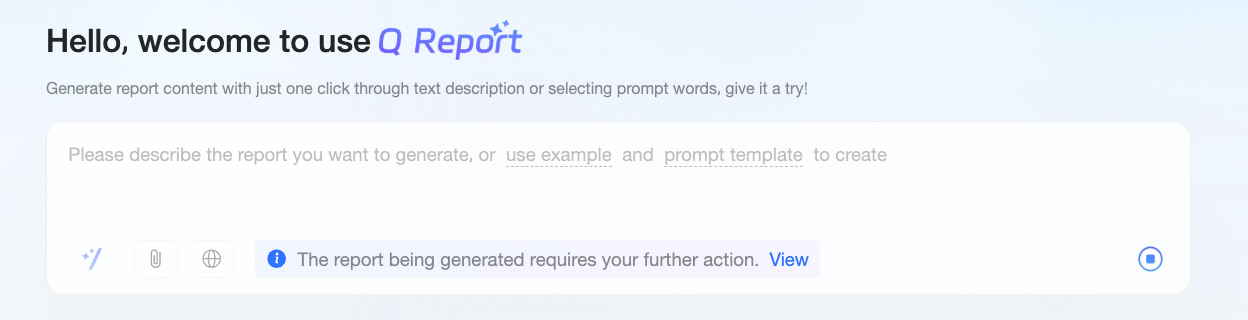
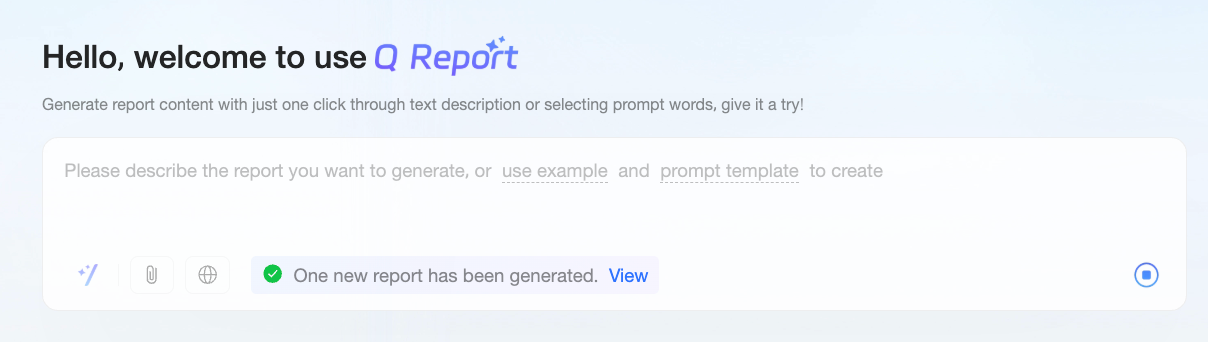
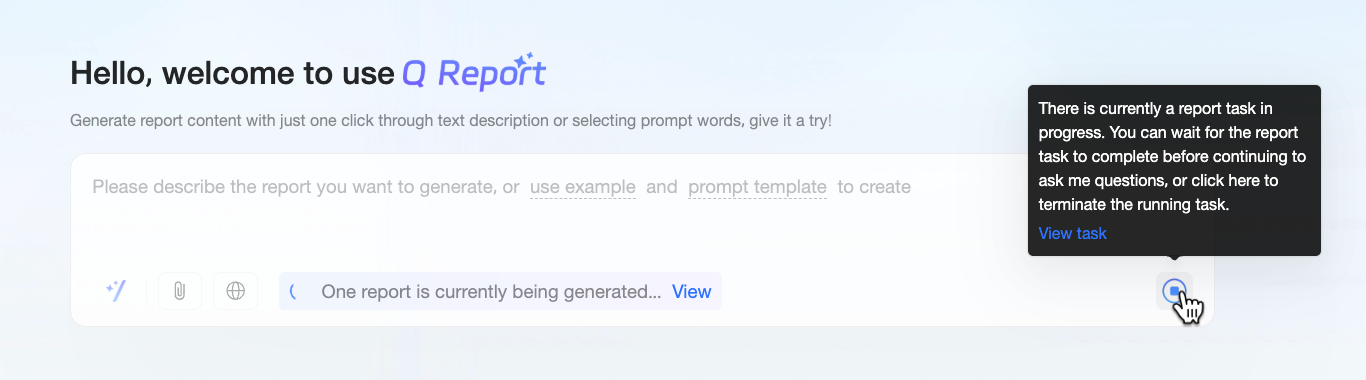
You can view the status of the current generation task in the dialog box on the Xiao-Q Report page and perform actions as needed.Execution status
Description
Actions
Report generating
The execution plan or report content is being generated.
View: Click View to go to the generation page and check the plan or report details.
Stop: If you no longer need the content, click the
icon to stop the task.
Report to be confirmed
The initial execution plan has been generated.
View: Click View to go to the generation page to confirm or adjust the analysis logic.
Report generated
The report content generation task is complete.
View: Click View to go to the preview page of the generated report to see the details.
Report generation failed
The execution plan or report content failed to generate due to a system error or another reason.
View: Click View to go to the generation page to see the reason for the failure and choose to retry or stop the task.
NoteCurrently, you cannot generate multiple reports simultaneously. If a report generation task is already in progress for your account, including a task running asynchronously in the background, you cannot open another page to start a new report generation task.
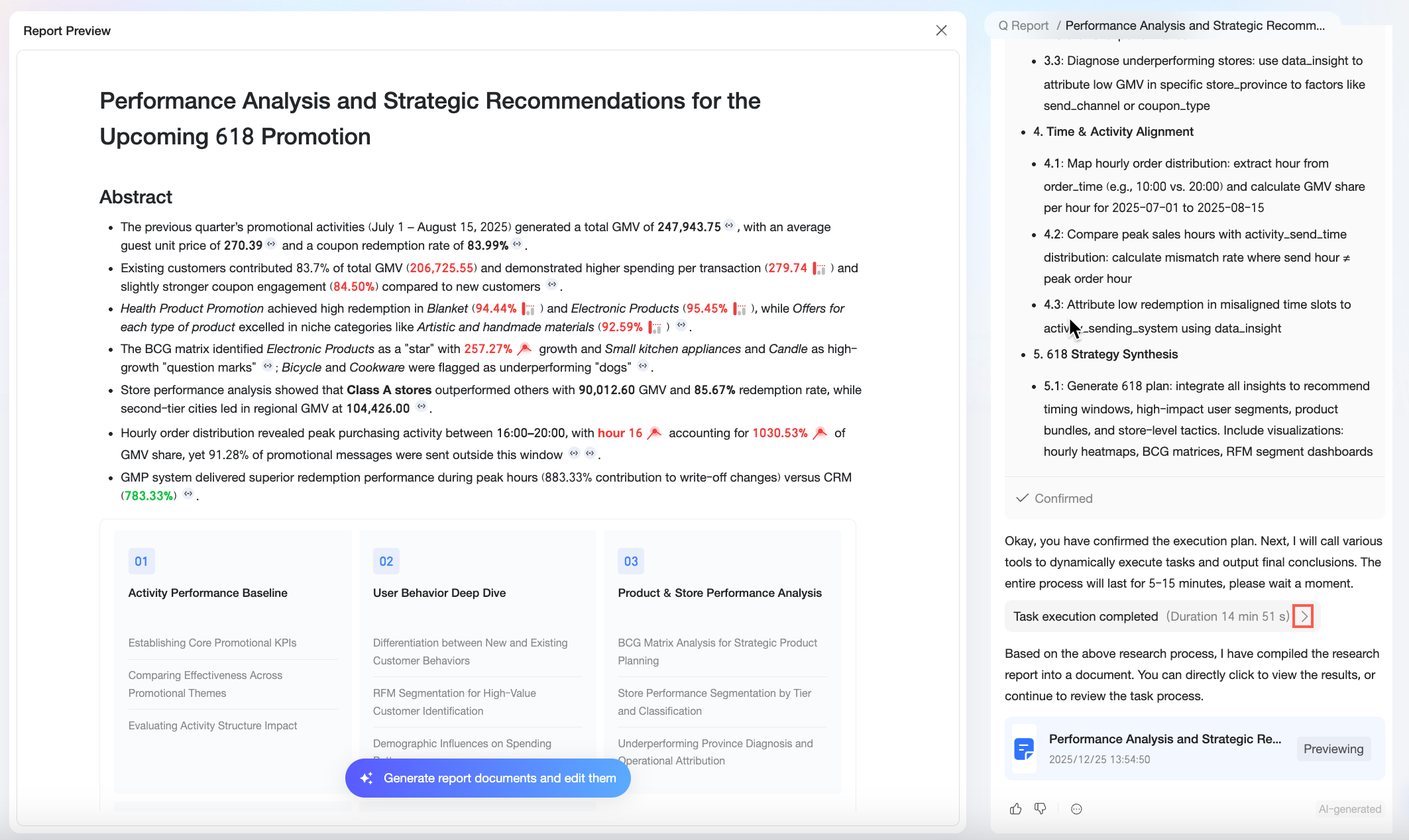
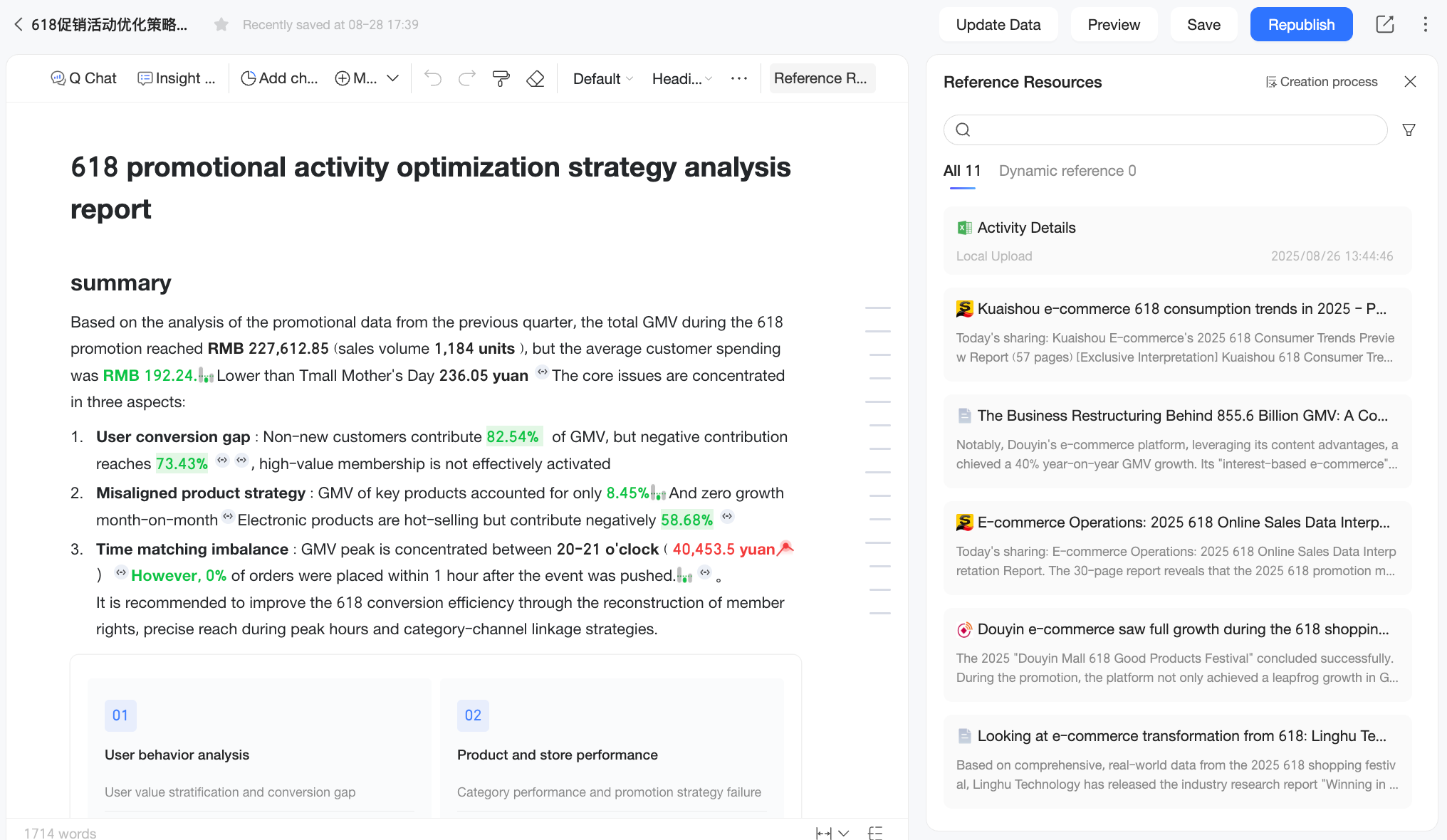
After the plan is executed, the generated result is automatically displayed on the left, and the execution process is collapsed into the right panel. To see the execution process that corresponds to the results, click the
icon next to Execution complete to expand it.If you are on another Quick BI feature page (such as Intelligent Xiao-Q, My Dashboards, Enterprise Portal, Workbench list page, Open Platform, or Template Marketplace) when the report generation is complete, a Report generated notification appears. Click Open Report to go directly to the report's preview page.You can also perform the following operations on this report preview page.
Actions
Description
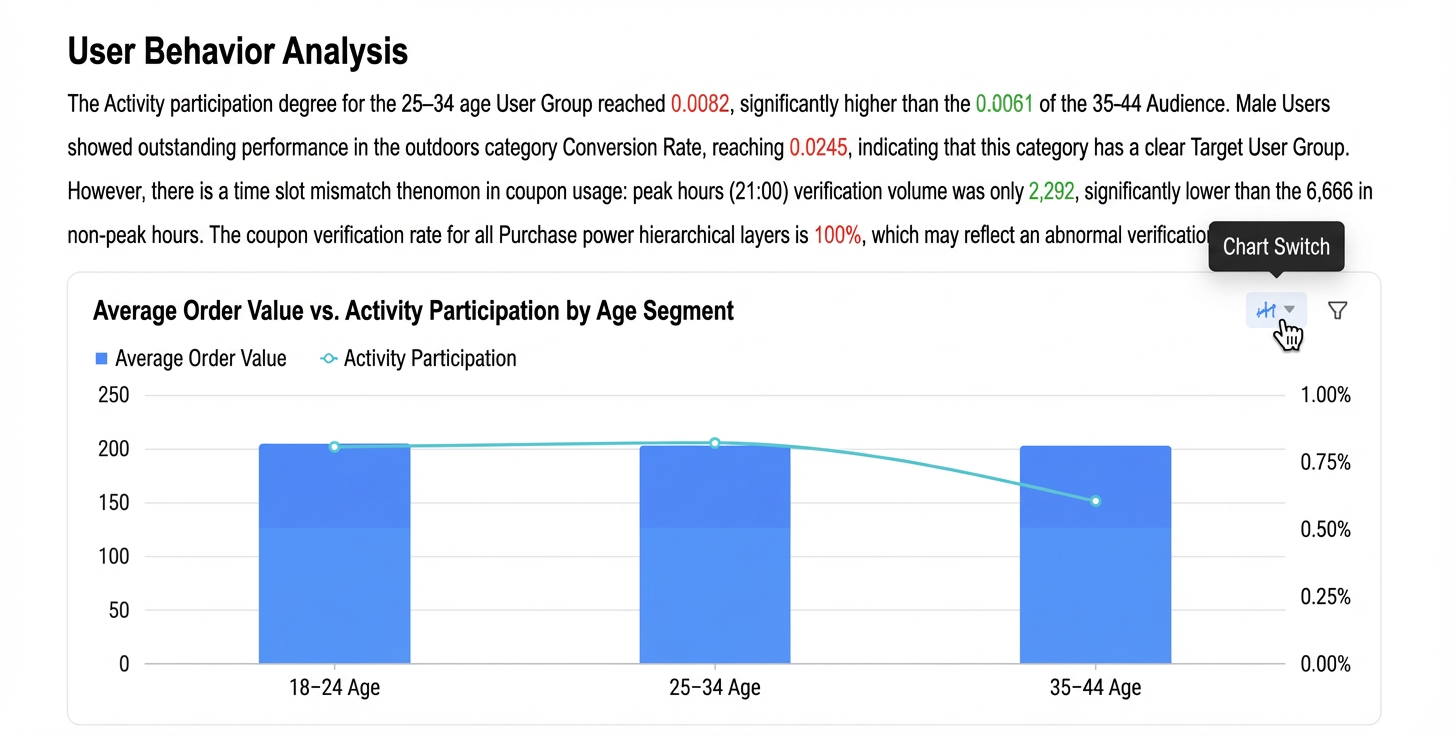
Switch chart type
During report generation, the system automatically creates charts based on the use case and data. If a generated chart does not meet your expectations, you can manually change its display type on this page to better align with your organization's data viewing habits.
View generation process
After the report is generated, an
icon appears next to key metrics and data conclusions. Click this icon to view the generation process for that specific content in the Execution Process panel. This helps you trace and verify the data analysis process.View referenced resources
If you enabled the online search mode and the final report includes information from the internet, an
icon appears next to data conclusions that cite external information. Click this icon to view the external sources in the Web Search panel, ensuring the information is traceable and credible.Click Generate Report Document and Edit to go to the report editing page. On this page, you can perform the following operations:
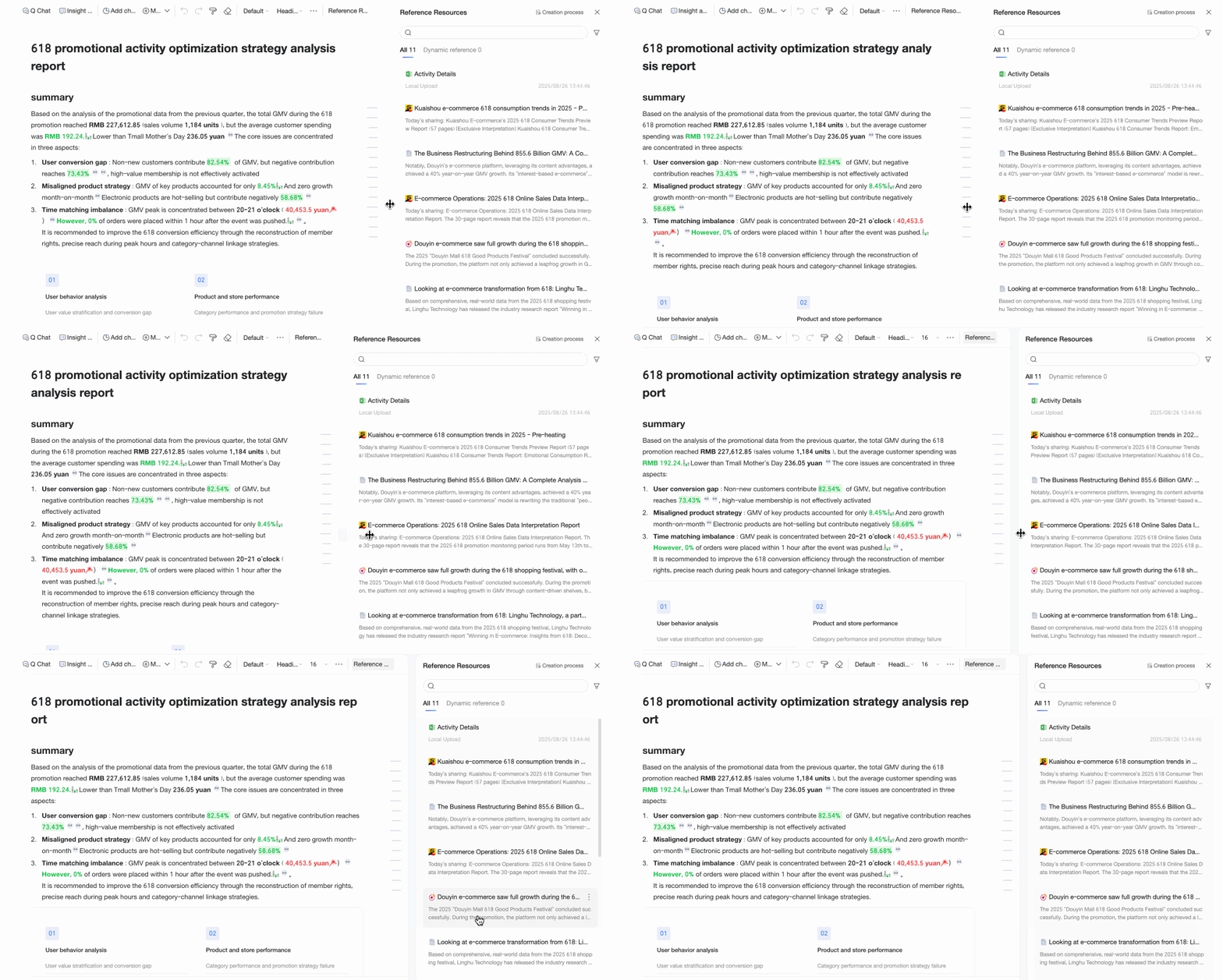
View generation process and referenced resources: On the editing page, trace the generation process of key data to verify the analysis. When using online search, you can also view the external sources to ensure information reliability.
NoteTo improve the reading experience, viewing the generation process and referenced resources is disabled on the preview page.
Adjust the execution panel width: Drag to adjust the width of the execution panel on the editing page to fit your operational habits.
Edit report content: Adjust the report's page style and visualization formats, or add resources like charts and question-answering results to enrich the content. This allows you to manually refine the generated report based on your business needs, creating a final product that is better suited to your specific analysis scenarios and enterprise requirements. For detailed instructions, see Edit a Xiao-Q Report.
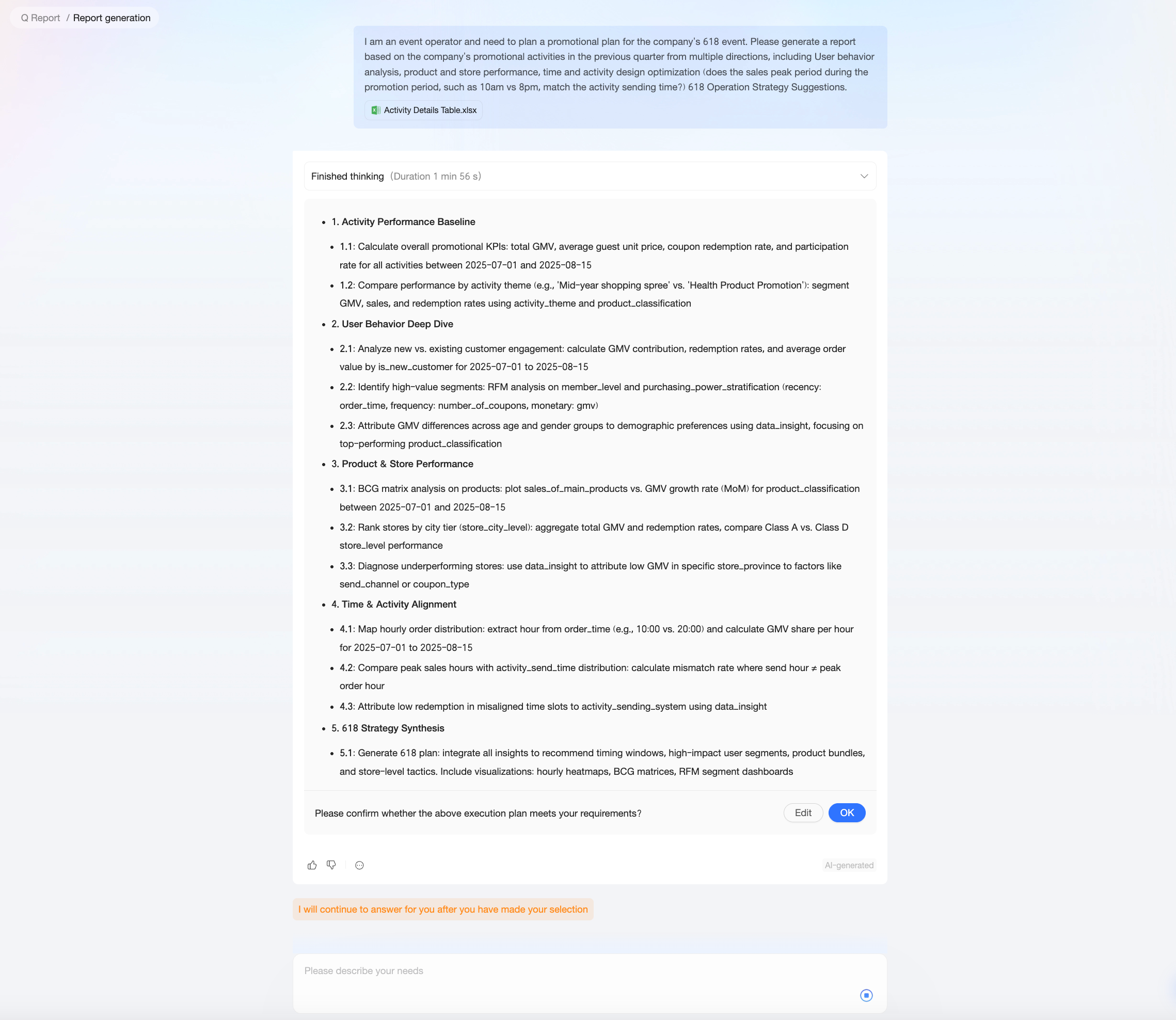
 icon next to Thinking complete to expand and view the large model's thought process. This helps you understand the basis for each part of the execution plan and identify any potential misunderstandings by the model.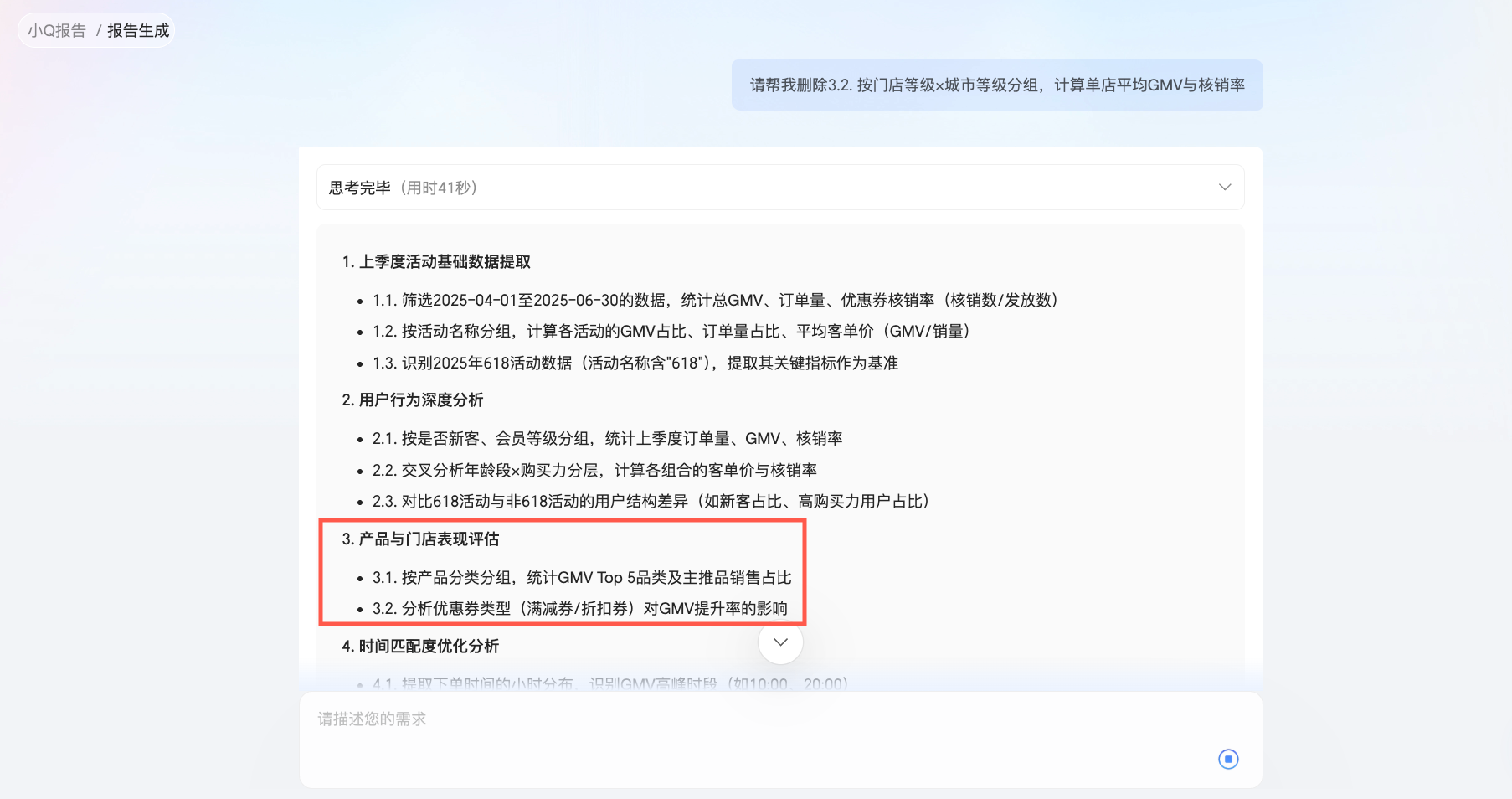
 You can view the status of the current generation task in the dialog box on the Xiao-Q Report page and perform actions as needed.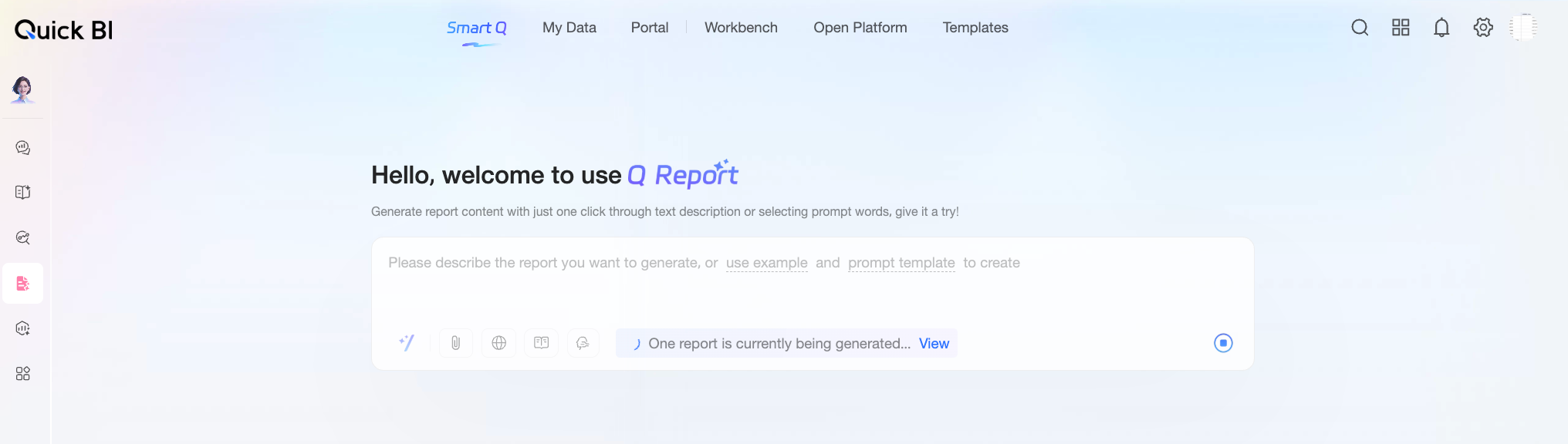

 icon next to Execution complete to expand it.
 If you are on another Quick BI feature page (such as Intelligent Xiao-Q, My Dashboards, Enterprise Portal, Workbench list page, Open Platform, or Template Marketplace) when the report generation is complete, a Report generated notification appears. Click Open Report to go directly to the report's preview page.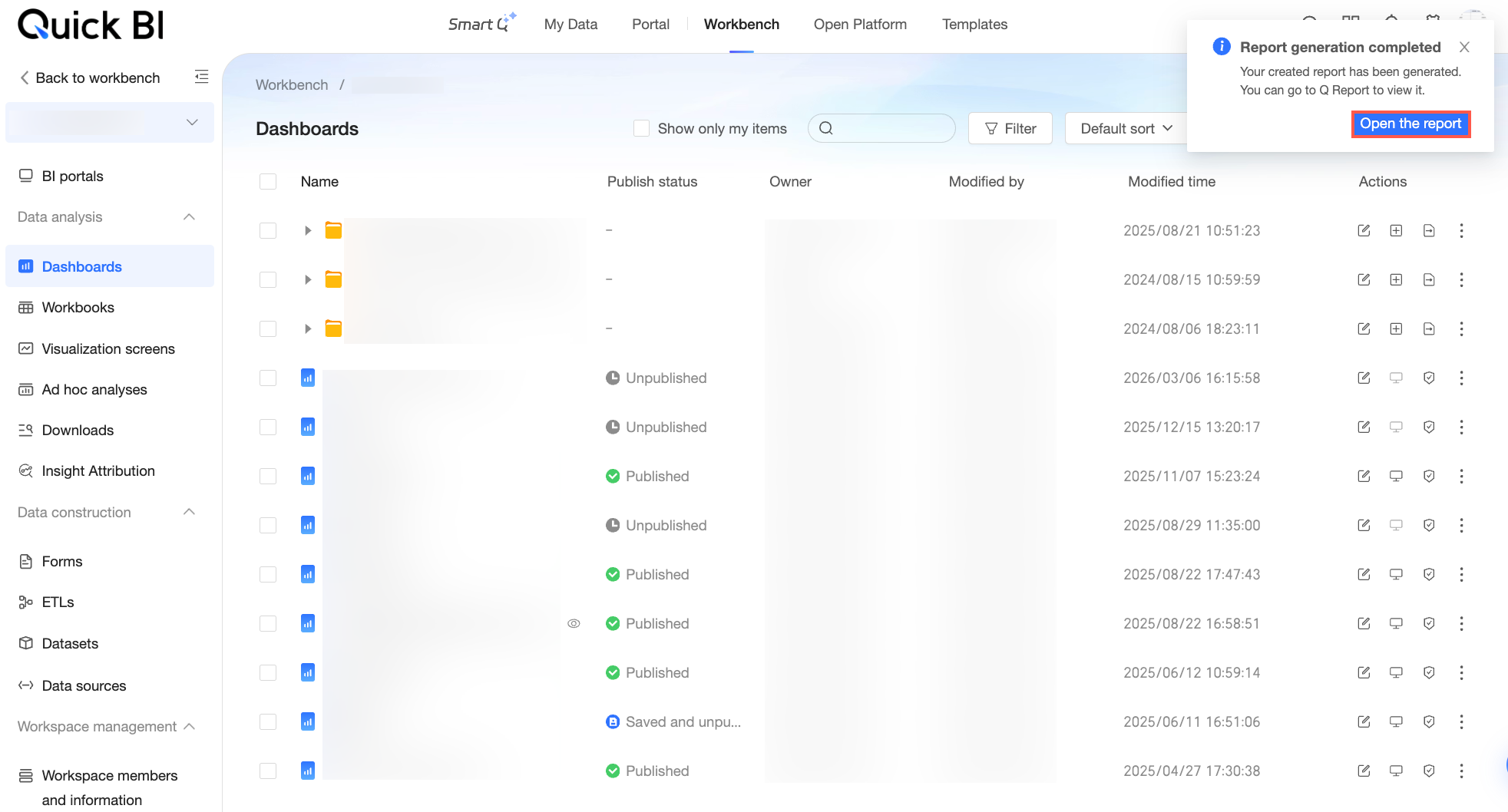
 icon appears next to key metrics and data conclusions. Click this icon to view the generation process for that specific content in the Execution Process panel. This helps you trace and verify the data analysis process.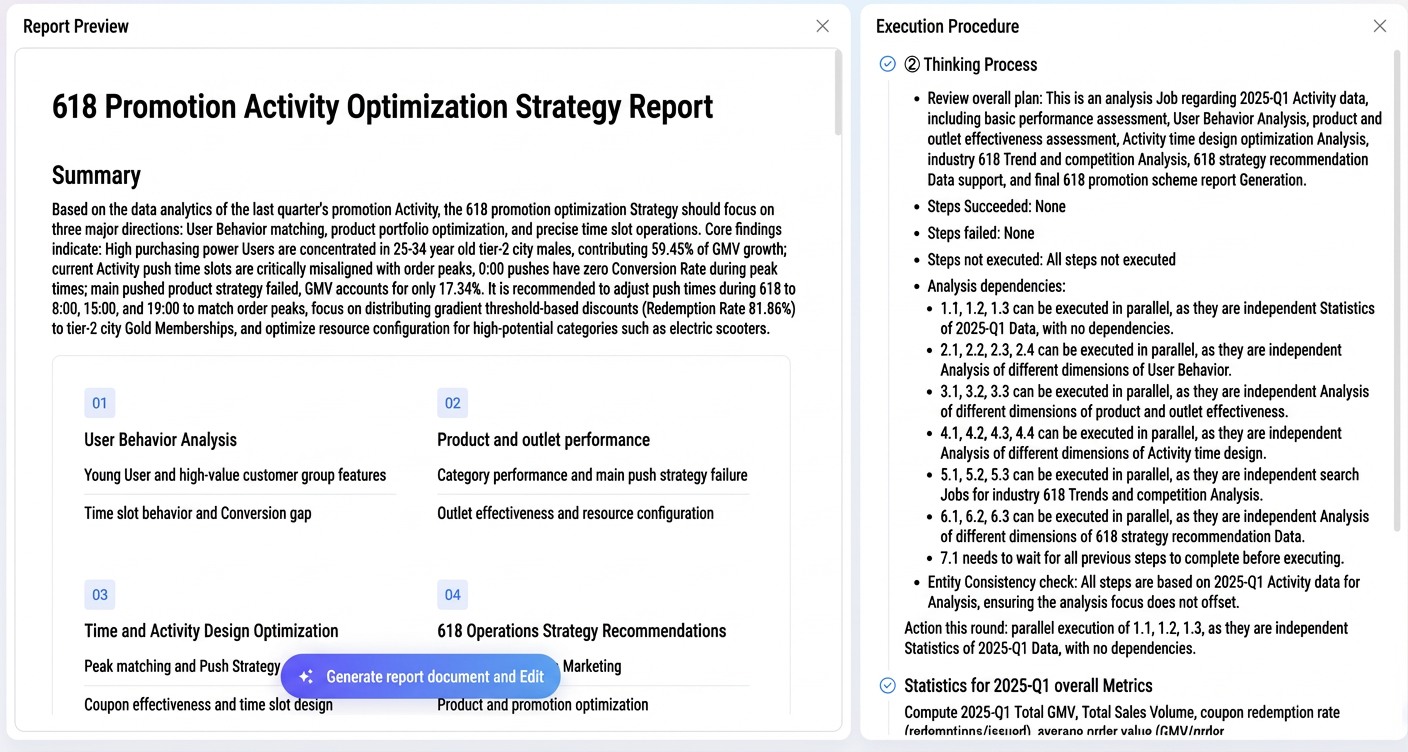
 icon appears next to data conclusions that cite external information. Click this icon to view the external sources in the Web Search panel, ensuring the information is traceable and credible.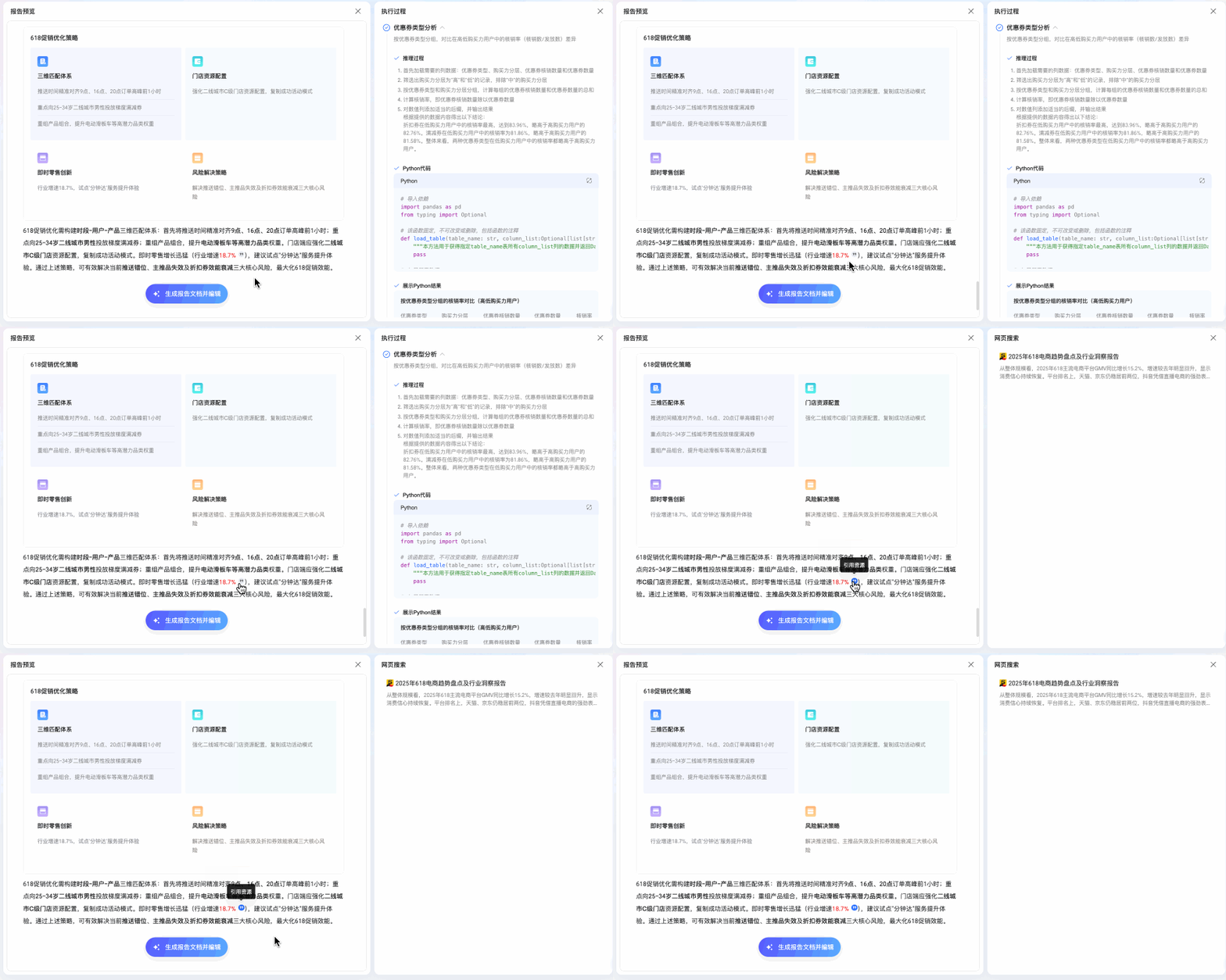
Method 2: Create a blank report
Scenarios:
Full control over report content: For reports requiring significant creativity or personalization, you need full control over the content. In this case, you can create a blank report and use the document editing capabilities and AI assistant provided by the Xiao-Q Report feature to build a report that is both professional and personalized.
The following steps describe the operations.
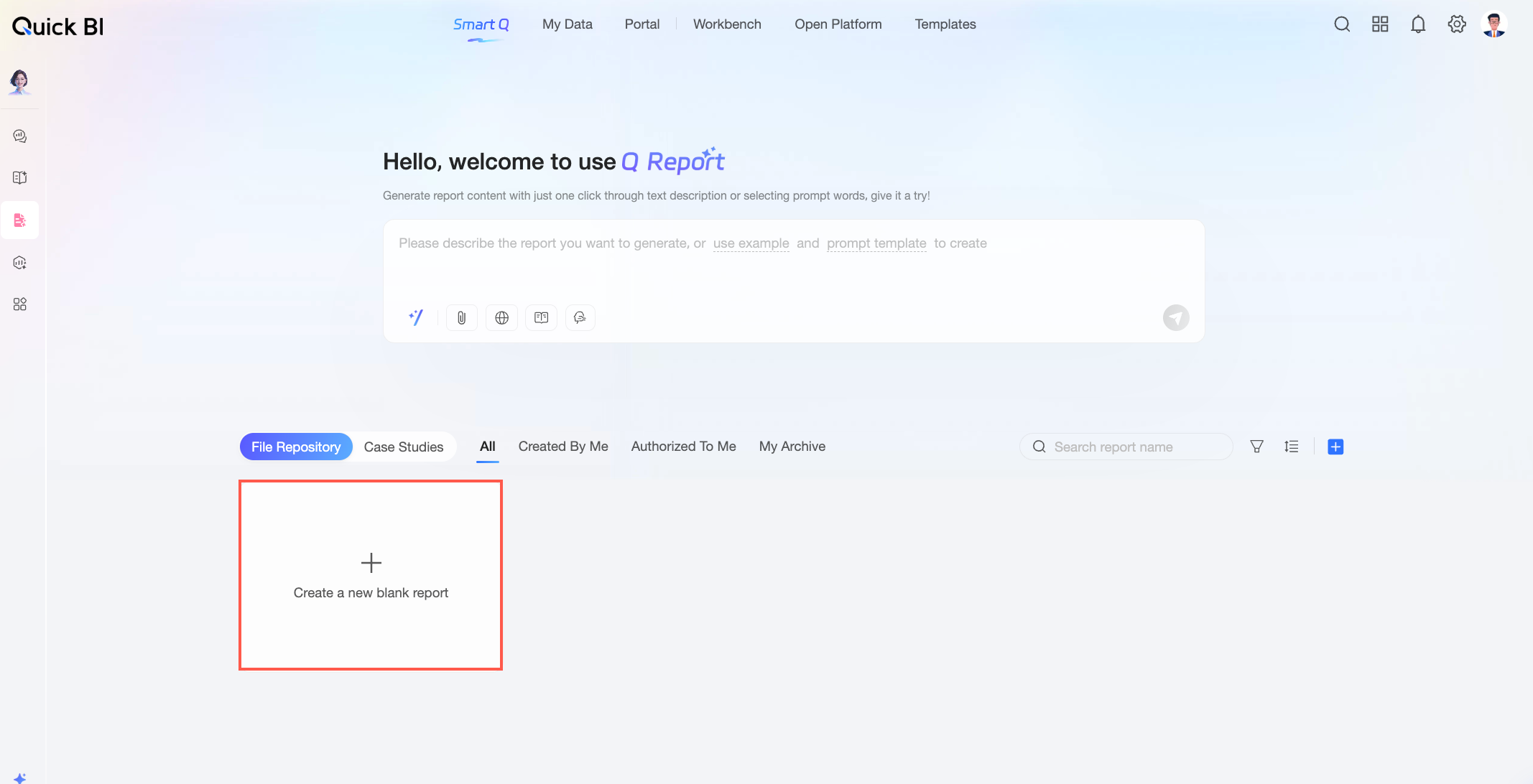
Click New Blank Report.
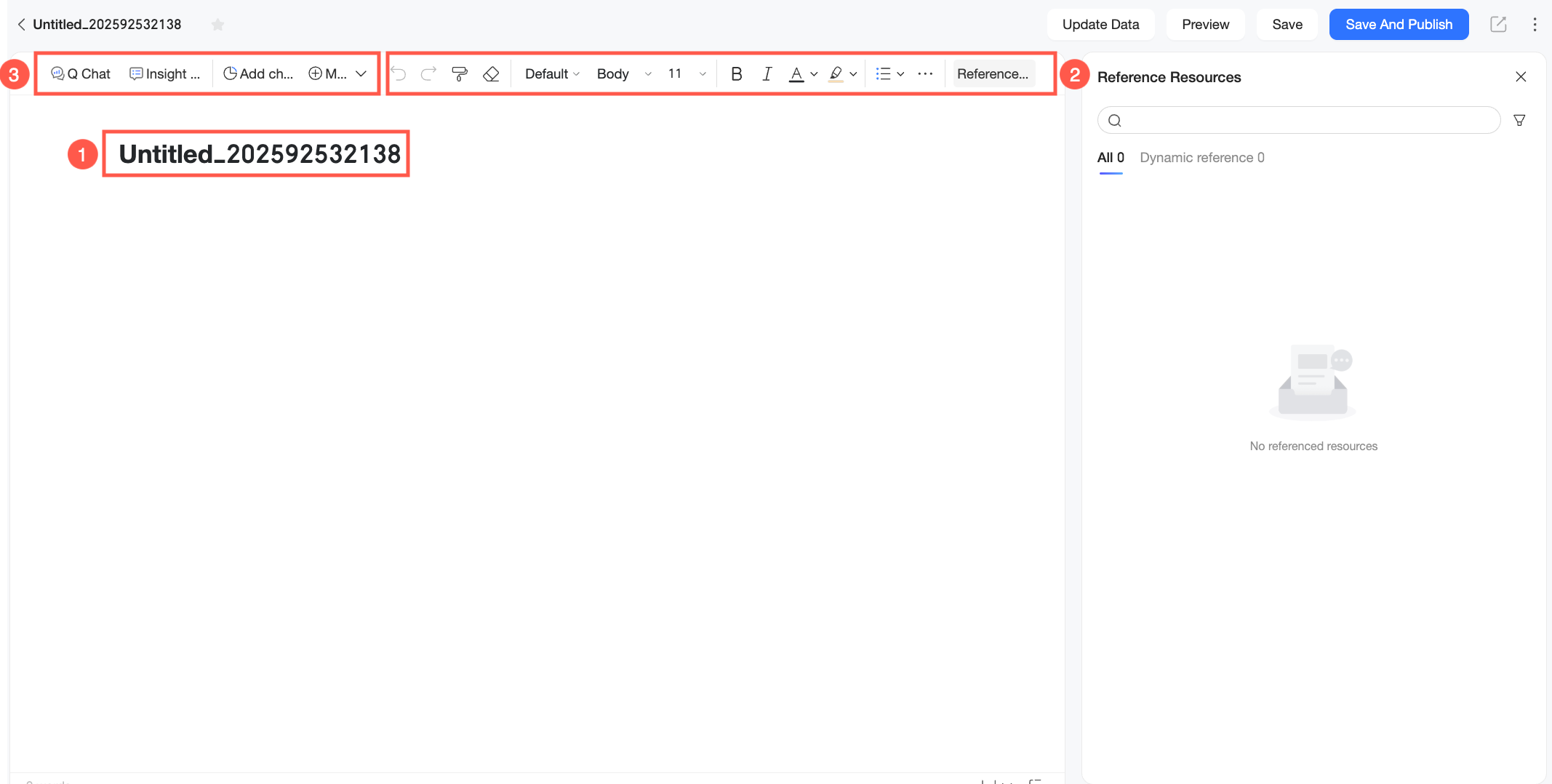
On the report editing page that appears, you can ① modify the report name, ② create and style the report content, and ③ add resources such as charts and question-answering results. For detailed instructions, see Edit a Xiao-Q Report.
After you finish creating the report, click Save or Save and Publish as needed.
NoteYou can only share reports that have been Published. If a report is only saved, it cannot be shared.
Next steps
After you create a report, you can adjust visualization formats, add resources like charts and question-answering results, and further analyze data on the report editing page. For more information, see Edit a Xiao-Q Report.
After you finish preparing the report, you can share it with others, configure its permissions, and manage your existing reports. For more information, see Manage Xiao-Q Reports.