Financial planning
After a company migrates to the cloud, its IT consumption model changes. Infrastructure procurement shifts from centralized to distributed. The focus of cost management shifts from upfront assessment to ongoing monitoring. Cost types change from fixed to variable. The decision-making model evolves from short-term choices to long-term operations. Cost responsibility transitions from centralized control to decentralized accountability. Proper financial planning makes post-migration cost management more efficient. Financial planning involves financial management planning, financial asset planning, budgeting, and selecting billing methods.
Accurately allocating cloud costs to business units is a key part of cloud cost management and an important prerequisite for continuous cost optimization. Allocating costs establishes accountability. Regularly monitor and analyze the costs allocated to each responsible team and track the reasons for overspending. This allows teams to proactively and continuously optimize costs.
Financial management planning
Before migrating to the cloud, a company should plan its financial management model. This includes defining strategies for discounts, credit control, funds, invoices, and financial assets. Alibaba Cloud provides two planning scenarios: cross-account financial management and cross-account finance trusteeship.
Cross-account financial management
In a financial management relationship, financial data and IT resources are isolated at the account level between the root account and linked accounts. Linked accounts have full control over their own data and permissions and can operate independently. The root account can manage linked accounts in batches only after a management relationship is established and the necessary information is configured. In a Financial Management relationship, a company can implement the following sub-scenarios:
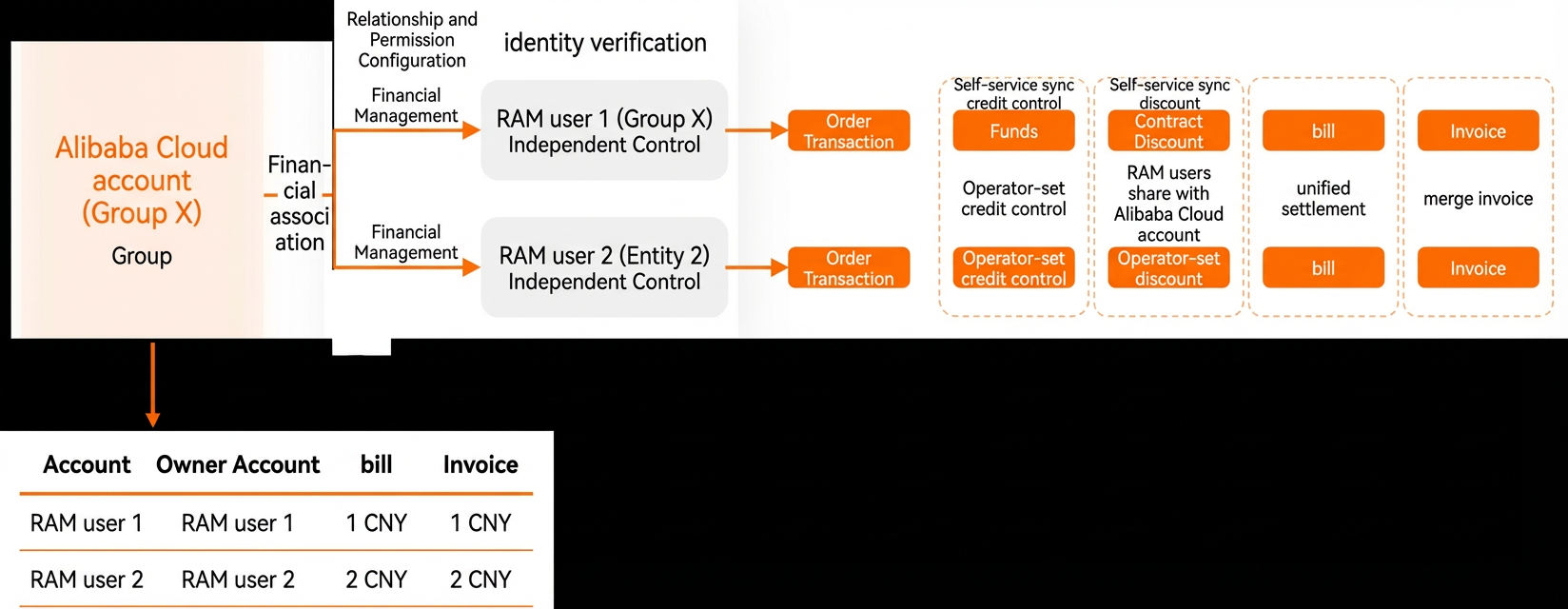
Sub-scenario 1: Share discounts
Use the account linking tool and select the 'Allow syncing discounts to linked accounts' permission to share contract discounts across accounts.
Sub-scenario 2: Share credit control
Share the root account's allocatable credit limit with linked accounts. This allows accounts to share a single credit line while maintaining independent available credit.
Use the account linking tool. When you establish the financial relationship, select 'Allow syncing credit control status to linked accounts' to allocate the root account's credit limit to the linked account.
Sub-scenario 3: Manage funds easily
Use the unified settlement tool to manage top-ups, cash, vouchers, and credit for all accounts from a single account.
Sub-scenario 4: Pay easily
Use the unified settlement tool to make consolidated payments for multiple accounts from a single account.
Sub-scenario 5: Unified bills
Use cloud bill management to retrieve bills for all other accounts in one place. You can also merge bills from multiple accounts into a single bill.
Sub-scenario 6: Unified invoices
Use cloud invoice management to retrieve invoices for all other accounts in one place. You can also merge invoices from multiple accounts.
Cross-account finance trusteeship
A company can use the cross-account finance trusteeship solution to avoid configuring controls for individual business units. This also allows for some aggregation of usage across accounts, balancing efficiency with economy.
In a finance trusteeship relationship, IT resources are isolated at the account level. However, all financial data generated by a member account is automatically owned and managed by the root account. Specifically, when a member account in a finance trusteeship places an order, it automatically receives the root account's contract discounts. The expenses, invoices, settlements, and repayments generated by the member account are all attributed to the root account. The root account is the only one that needs to handle financial interactions with Alibaba Cloud. With proper configuration, you can also consolidate usage from multiple accounts for billing.
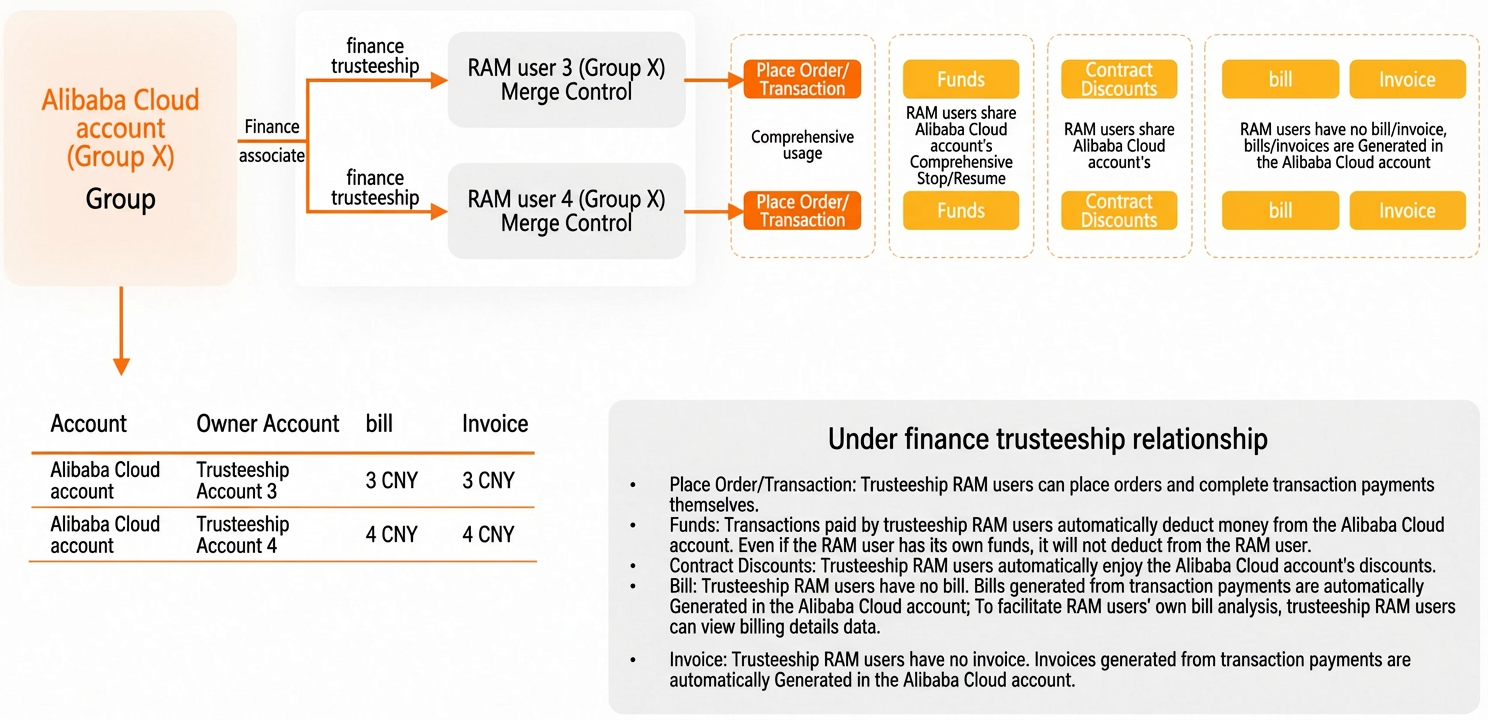
In a finance trusteeship relationship, a company can implement the following sub-scenarios:
Sub-scenario 7: Consolidated service suspension/resumption
With finance trusteeship, control over service suspension and resumption for all member accounts is consolidated under the root account, allowing them to share funds. This consolidated approach is less complex than managing suspension and resumption for individual accounts.
Sub-scenario 8: Aggregated usage
The usage from each account is consolidated under a single account, which allows for the sharing of tiered discounts, reserved instance discounts, and Savings Plans. Compared to individual account usage, aggregated usage can reduce costs for projects, departments, or the entire company. You can use resource sharing to set up shared accounts and resource information, which automatically enables consolidated billing for aggregated usage across multiple accounts.
Financial asset planning
Corporate financial management is often centralized. A well-planned, multi-account financial management system on the cloud allows a company to centrally control financial assets and entitlements. This includes the root account allocating funds and credit limits to member accounts and performing management operations such as revoking those allocations. Alibaba Cloud supports the following financial asset planning options:
Allocate: The root account transfers funds to a member account. The received funds are credited to a transfer-in balance. These funds can only be used for consumption and cannot be withdrawn or transferred again.
Revoke: The root account reclaims funds previously allocated to a member account.
Credit limit settings: The root account sets the consumable credit limit for each member account.
Available credit alert settings: The root account sets an available credit alert threshold for member accounts. An alert notification is triggered if the credit drops below this threshold.
Invoice settings: The root account can manage invoice information for member accounts in batches.
Resource sharing: The root account can share its resources with member accounts that have a finance trusteeship relationship.
Voucher pool: The root account creates custom vouchers and can assign them to be shared by one or more member accounts.
Budgeting and planning
A company's overall budget must include cloud budget management. Digital cloud budget management is significant for the following reasons:
It links the annual budget of each business unit (BU) to the utilization rate of existing resources for performance assessment. This, combined with technical optimization metrics, helps to continuously improve resource utilization and maximize efficiency.
It builds a foundation for integrating business and finance in the cloud under a responsibility-based management system. A unified digital platform can be used to meet the different analytical needs of finance, business, Operations and Maintenance (O&M), and Research and Development (R&D) teams.
It makes budgeting less reliant on human judgment using a system where personnel can monitor their own cloud spending. Data and algorithms are used to more accurately reflect historical trends and provide predictive insights for future decisions. This helps calculate the cost of every cloud transaction.
It helps upgrade a company's organizational structure through a digital filter interaction model that links budget, resources, personnel, entities, and cost administration. This allows business units to promptly perceive cost changes.
It lets you combine costs and revenue. At the end of the fiscal year, profits gained from fine-grained management can be distributed back to the business BUs as dividends.
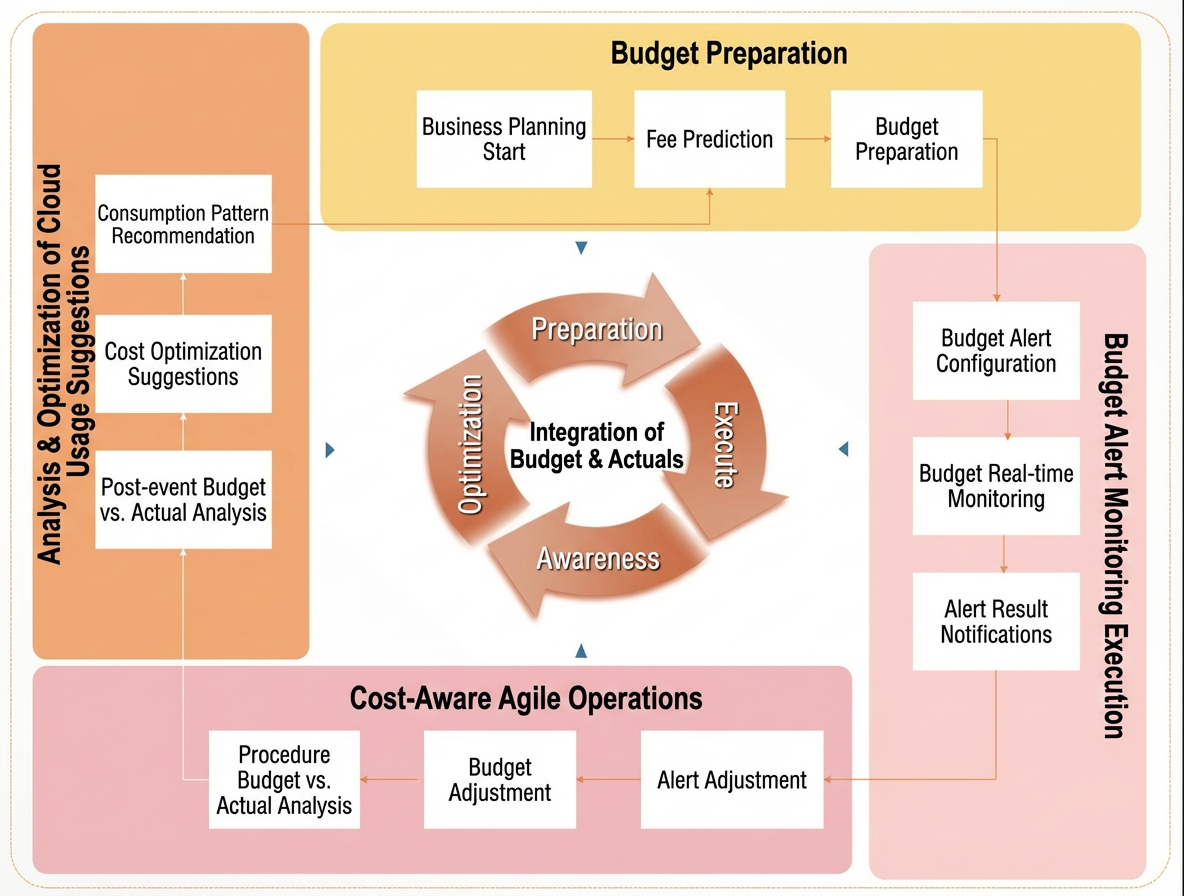
A company can use the Budget Management tool provided by Alibaba Cloud for upfront cloud cost planning and budgeting, in-process budget monitoring and alert notifications, and post-event estimate-to-actual comparison analysis. This improves the level of fine-grained cloud cost management.
You can use the various budgeting methods provided by Alibaba Cloud to implement trend-based or business driver-based approaches, or a combination of both, in your budgeting and prediction process. For example, a cost budget can monitor expenses against a set budget amount and send alert notifications when custom thresholds are reached. Cost budgets can manage budgets for different scopes, such as by account, cost center, product, region, or consumption type. Usage-based budgeting lets you set budget amounts based on resource usage, monitor costs against that budget, and send alerts when custom thresholds are reached.
Billing method selection and combination models
A company can choose a suitable combination of billing methods based on its business characteristics to optimize cloud costs. The following are some billing methods relevant to cost management.
When a company purchases products on a pay-as-you-go basis, it pays only for what it uses without any upfront commitment. This helps maintain resource flexibility and meet evolving business needs. The pay-as-you-go billing method lets you flexibly adjust resource usage based on changing business demands. After choosing pay-as-you-go, you can also obtain lower discounts by committing to a certain level of spending.
Savings Plan
A company can use a Savings Plan to increase savings. By committing to a certain amount of hourly spending over a period, typically one or three years, you can obtain lower discounts. When combined with pay-as-you-go, a Savings Plan can reduce costs by up to 76% compared to using pay-as-you-go alone.
You can use the 'Savings Plan purchase optimization' feature, which provides recommendations based on your historical consumption data using consumption prediction and optimization algorithms. You can use these recommendations as a reference to adjust your hourly Savings Plan commitment and increase its coverage for greater savings.
Resource plan
Many cloud products offer corresponding resource plans. A resource plan is typically purchased upfront to obtain discounted credits that can offset the costs of pay-as-you-go cloud resources. Combining a resource plan with pay-as-you-go resources usually results in greater cost savings.
Spot instance
Proper use of on-demand instances can reduce the cost of using ECS instances in certain scenarios. A spot instance is a type of on-demand instance that is offered at a discount compared to the price of a standard pay-as-you-go instance.
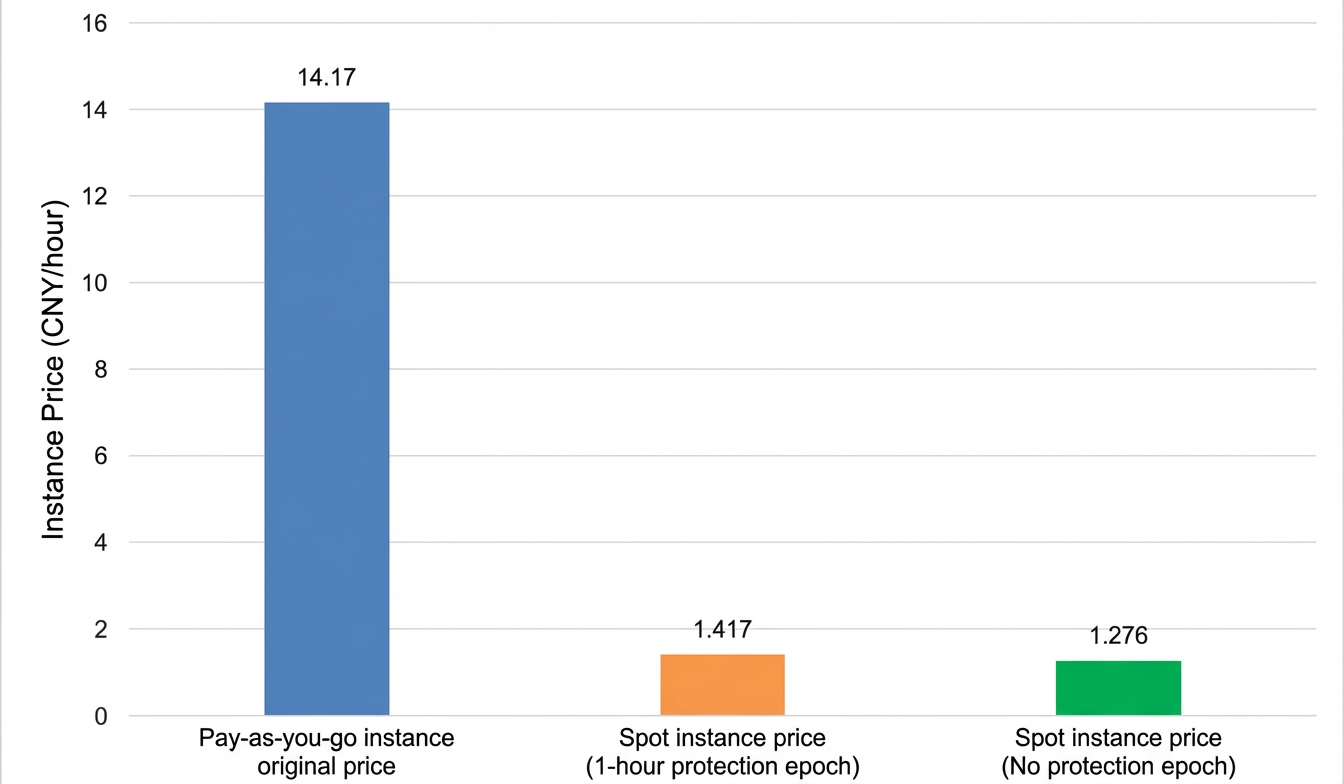
For example, consider an ecs.g5.8xlarge instance in China (Beijing) Zone H. Assume the following:
The current price of a pay-as-you-go instance is CNY 14.17/hour.
A spot instance with a 1 hour protection period is currently priced at CNY 1.417 per hour, which is 10% of the original price.
Network billing optimization - CDT
You can use Cloud Data Transfer (CDT) for unified billing and statement generation for cloud traffic. CDT supports consolidated billing for Internet traffic and cross-region private network traffic. In addition, after you enable CDT for public network products that are billed by data transfer, you can benefit from a tiered pricing model where higher usage results in lower prices. Using CDT provides a company with the following benefits: better prices, simpler management, and more intuitive overall usage data.
You can use the 'Network billing optimization' feature. This feature allows a company to compare and calculate the effects of optimizing billing methods based on historical consumption data. For example, you can estimate the consumption amount after switching the billing method for the traffic fees of an Elastic IP Address to Cloud Data Transfer.