Jade annulus chart
This topic describes the styles and configuration options for the jade annulus chart.
When you add a BI analysis widget in the canvas editor, an analyzer is automatically generated above the current BI widget in the Layers pane. You must create a dataset in advance before you can select and configure it for the BI analysis widget. For more information, see Add a dataset and BI analyzer interaction instructions.
Chart style
A jade annulus chart uses rotated bars to display and compare the values of categorical data. When a column chart has too many categories, its text labels must be rotated for a proper layout, which makes them difficult to read. Compared to a vertical column chart, a jade annulus chart is more suitable for scenarios with many categories.
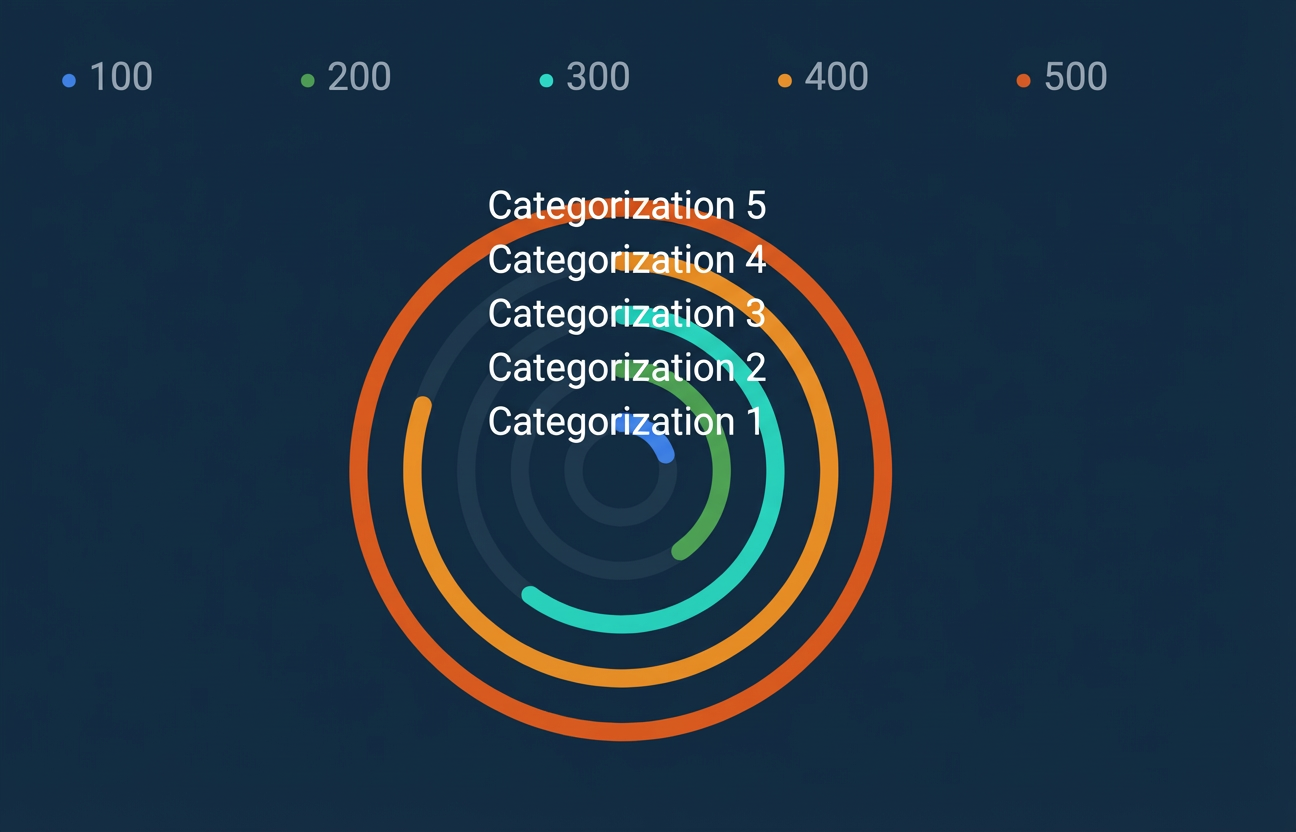
Configuration panel
- Search for Configurations: In the right-side panel of Canvas Editor, click the Settings tab, and click Search for Configurations in the upper-right corner. Enter the required configuration item in the search box, and click the search icon to quickly locate the configuration item. Fuzzy match is supported. For more information, see Search for Configurations.
- Size: indicates the size of a widget, including its pixel width and height. You can click the
 icon to proportionally adjust the width and height of a widget. After you click this icon again, you can adjust the width and height as needed.
 - Position: the position of a widget, which is indicated by pixel X and Y coordinates. X-coordinate indicates the pixel distance between the upper-left corner of the widget and the left border of the canvas. Y-coordinate indicates the pixel distance between the upper-left corner of the widget and the upper border of the canvas.
- Rotation Angle: the angle of a rotation that uses the center point of a widget as the rotation point. The unit is degrees (°). You can use one of the following methods to control the rotation angle of a widget:
- Directly enter the degrees in the Rotation Angle spin box or click the plus sign (+) or minus sign (-) to increase or decrease the value in the Rotation Angle spin box.
- Drag the black dot in the
 icon.
icon. - Click the
 icon to horizontally flip a widget.
 - Click the
 icon to vertically flip a widget.
- Opacity: the opacity of a widget. Valid values: 0 and 1. If this parameter is set to 0, the widget is hidden. If this parameter is set to 1, the widget is completely displayed. Default value: 1.
Graphics
Parameter
Description
Chart Margin
Click the
 icon to show or hide the chart margin settings. When enabled, configure the distance in pixels (px) between the chart area and the top, bottom, left, and right borders of the widget.
Max Arc
The maximum arc of the bars in the jade annulus chart. The value ranges from 0 to 360. The unit is degrees (°).
Arc Shape
The shape of the bars. Options are Right Angle and Rounded Corner.
Arc Width
The width of the bars in pixels (px).
Arc Color
The color of the arcs. For more information, see Color mapper instructions to configure the color mapping for different arcs.
Background Color
The background color of the arcs.
Arc Outline
The outline style for the arcs, including the line type, thickness, and color.
NoteWhen the line type is Dashed or Dotted, you can also configure the length of the dashes and the distance between them.
Arc Label
The style of the labels on the arcs. Click the
icon to show or hide the arc label settings.Label Field: The content of the label must correspond to a field in the data panel. By default, it retrieves content from the t field.
Number Format: The number format for the label. Options include Default, 11 (Integer), 11.1 (Floating-point), 11.11 (Floating-point), 11% (Percentage), 11.1% (Percentage), 1,111 (Thousands separator), and 1,111.1 (Thousands separator). For more information about data display formats, see Data display format instructions. This option is available only when the label field is set to t.
Prefix and Suffix: The prefix and suffix for the bar labels.
Relative Offset: The vertical and horizontal offset of the arc labels relative to the widget, in pixels (px).
Text Style: The text style for the arc labels, including font, weight, size, and color.
Text Outline: The text outline style for the arc labels, including the outline thickness and color.
Texture
The texture style of the bars. Click the
icon to show or hide the texture settings.Type: The type of texture. Options include Point, Line, and Square.
Fill Style: The fill style of the texture. For more information, see Color picker instructions to configure the texture color.
Outline Style: The outline style of the texture. For more information, see Color picker instructions to configure the texture color. This option is available only when the type is set to Point or Square.
Extra Style: Other texture styles, including shape size, shape spacing, line spacing, rotation angle, and an option to enable or disable interlacing.
Coordinates: Configures the style of the radius axis.
Show Radius Axis: Shows or hides the radius axis.
Data Type: The data type of the radius axis. Options are Categorical and Time.
Radius Range: The inner and outer radius of the arc bars, in percentage (%).
Axis Line: The style of the radius axis line, including type, thickness, and color. Click the
switch to show or hide the axis line settings.NoteWhen the line type is Dashed or Dotted, you can also configure the length of the dashes and the distance between them.
Axis Title: The style of the radius axis title. Click the
switch to show or hide the axis title settings.Parameter
Description
Title Display
The text content of the axis title.
Display Method
The display method for the axis title, including the angle and offset.
Text Style
The font, weight, size, and color of the axis title text.
Tick Line: The style of the radius axis tick lines, including length, thickness, and color. Click the
switch to show or hide the tick line settings. Axis Label: The style of the radius axis labels. Click the
switch to show or hide the axis label settings. Parameter
Description
Label Display
The display style of the labels, including prefix and suffix, angle, offset, and alignment.
Text Style
The font, weight, size, and color of the axis label text.
Gridline: The style of the radius axis gridlines, including line type, thickness, color, length, and spacing. Click the
switch to show or hide the gridline settings.NoteWhen the line type is Dashed or Dotted, you can also configure the length of the dashes and the distance between them.
Animation: Configures the animation effect of the jade annulus chart.
Parameter
Description
Enable Animation
Turn on to configure animation effects.
Animation Effect
The type of animation effect. The system provides several common effects, including Scale In, Slide In, Horizontal Grow, and Vertical Grow. This can be configured only when animation is enabled.
Animation Duration
The duration of the animation in milliseconds (ms). This can be configured only when animation is enabled.
Interaction: Configures the interaction effects of the jade annulus chart widget.
Tooltip: Configures the style of the tooltip that appears when you hover over or click an arc in Preview or Publish mode. Click the
switch to enable or disable the tooltip. Parameter
Description
Mode
The tooltip mode. Options are Simple and General.
Trigger Method
The method to trigger the tooltip. Options are Hover and Click.
Display Position
The position of the tooltip. Options are Top, Bottom, Left, and Right.
Title Spacing
The spacing between titles in the tooltip, in pixels (px).
Title Text
The text style of the tooltip title, including font, weight, size, and color.
Content Display
Click the
or icon to add or delete a content series for the tooltip. Click the or icon to arrange multiple content series. Click the icon to copy the current content series configuration and create a new one with the same settings.Field Name: The field name for the tooltip content. It must match a field in the data panel.
Display Name: The display name for the tooltip content.
Suffix: The suffix for the tooltip content.
Content Spacing
The spacing between content text in the tooltip, in pixels (px).
Content Text
The text style of the tooltip content, including font, weight, size, and color.
Suffix
The suffix for the tooltip content.
Dialog Background
The background style of the tooltip.
Background Margin: The horizontal and vertical margin of the tooltip background.
Background Color: The background color of the tooltip.
Border Style: The border style of the tooltip, including line type, border radius, line width, and border color.
Axis Pointer
The style of the axis pointer line in the tooltip, including type, thickness, and color. Click the
icon to show or hide the axis pointer.NoteWhen the line type is Dashed or Dotted, you can also configure the length of the dashes and the distance between them.
Selected State: Configures the style of an arc when it is selected. Click the
switch to enable or disable the selected state style. Parameter
Description
Trigger Method
The method to trigger the selected state. Options are Hover and Click.
Selection Method
The method for selecting bars. Options are Single Select and Multi-select.
Arc Color
The color of the bar in the selected state.
Arc Outline
The outline style of the bar, including line type, thickness, and color.
NoteWhen the line type is Dashed or Dotted, you can also configure the length of the dashes and the distance between them.
Legend: Configures the style of the chart legend.
Parameter
Description
Legend Switch
Turn on to configure the legend style. Turn off to disable it.
Legend Position
The position of the legend relative to the widget's origin. Options include Top Left, Top Center, Top Right, Bottom Left, Bottom Center, Bottom Right, Left Top, Left Center, Left Bottom, Right Top, Right Center, and Right Bottom.
Text Style
The font, weight, size, and color of the legend text.
Chart Spacing
The horizontal and vertical spacing between the legend and the chart.
Categorical Legend
The style of the classification legend. The legend for component types is displayed only when Graphics > Arc Color > Mapping Type in the widget style panel is set to Categorical.
Legend Marker: The shape and size of the legend markers.
Legend Spacing: The horizontal and vertical distance between different legend items.
Max Width: The maximum width for each legend item, in pixels (px).
Allow Pagination: Turn on to enable legend pagination. You can configure the style for page numbers and arrows when the number of legend items requires pagination. Turn off to display all legend items on a single page.
Page Number Style: The style of the page numbers, including font, weight, size, and color.
Arrow Style: The size and color (default and disabled) of the pagination arrows.
Continuous Legend
Styles for a continuous legend. The legend is displayed as a continuous legend only when the Graphics > Arc Color > Mapping Type option in the widget's style panel is set to Continuous Value or Value Partition.
Slider Track Style
Type: The type of the legend slider track. Options are Rectangle and Triangle.
Length: The length of the slider track.
Height: The height of the slider track.
Background Color: The background color of the slider track.
Slider Handle Style: The style of the handle on the slider track.
Minimum: The minimum value of the slider. You can enter a custom value or select Auto to use the minimum value from the data.
Maximum: The maximum value of the slider. You can enter a custom value or select Auto to use the maximum value from the data.
Size: The size of the slider handle.
Color: The color of the slider handle.
Label Style: The style of the text labels on the legend.
Alignment: The alignment of the text labels relative to the slider track. Options are Top, Center, and Bottom.
Spacing: The distance between the text labels and the slider track.
Conditions: Configures conditional style rules.
Conditional Style: Click the
or icon to add or delete a conditional style. Click the or icon to arrange multiple conditional styles. Click the icon to copy the current conditional style configuration and create a new one with the same settings. For more information, see Conditional tree instructions.Arc Color: Turn on this switch to configure the arc color for this conditional style. Turn off this switch to disable it.
Arc Outline: Turn on this switch to configure the arc outline style for this conditional style, including line type, thickness, and color. Turn off this switch to disable it.
 icon to show or hide the chart margin settings. When enabled, configure the distance in pixels (px) between the chart area and the top, bottom, left, and right borders of the widget.
 or
or  icon to add or delete a content series for the tooltip. Click the
  or
or  icon to arrange multiple content series. Click the
  icon to copy the current content series configuration and create a new one with the same settings.
Data panel (default mode)
Field configuration
Field |
Description |
|
The category for each bar in the jade annulus chart. |
|
The value for each bar in the jade annulus chart. |
|
(Optional) The color mapping field. Used to configure the mapping between colors and data values for each bar. |
Table 1. Parameters
| Parameter | Description |
| Controlled Mode | If you turn on the switch, data is not requested when a widget is initialized. Data requests are triggered only based on callback IDs or the method configured in Blueprint Editor. If you turn off the switch, data requests are automatically triggered. By default, the switch is turned off. |
| Auto Data Request | After you select the Auto Data Request check box, you can enable dynamic polling, and manually specify the polling interval. If you do not select this check box, data is not automatically requested. You must manually refresh the page to request data or use Blueprint Editor or callback ID events to trigger data requests. |
| Data Source | In the right-side panel of Canvas Editor, click the Data tab. Click Set next to Static Data. In the Configure Datasource panel, select a data source from the Data Source Type drop-down list. Enter code for data query in the code editor, click Preview Data Response to preview the response of the data source, and then view the response. For more information, see Configure asset data. |
| Data Filter | If you select the Data Filter check box, you can convert the data structure, filter data, and perform simple calculations. If you click the plus sign (+) next to Add Filter, you can configure the script for the data filter in the editor that appears. For more information, see Use the data filter. |
| Data Response Result | The response to a data request. If the data source changes, you can click the  icon next to Data Response Result to view the data response in real time. icon next to Data Response Result to view the data response in real time. |
Data panel (analysis mode)
Before you can use the BI analysis feature that is provided by DataV datasets, the system makes the following changes to the jade annulus chart.
The data source Jade Annulus Chart API is switched from static data to a DataV dataset.
The DataV dataset configuration is updated. This operation does not cause any loss of field configurations.
For more information about operations on the data panel in BI analysis mode, see BI analysis mode data panel features.
Field configuration
Field |
Description |
|
The category for each bar in the jade annulus chart. |
|
The value for each bar in the jade annulus chart. |
|
(Optional) The color mapping field. Used to configure the mapping between colors and data values for each bar. |
The data panel is in analysis mode by default for widgets that are added using the BI analysis module. For widgets from versions earlier than v5.x that do not use BI analysis, the data panel is in default mode. If a widget was added in analysis mode, you can switch to default mode. To do so, click Default Mode in the upper-left corner of the data panel and confirm the action in the dialog box. This exits analysis mode and deletes the analyzer that is associated with the widget. The widget is then converted to a v5.x widget, and its data panel switches to default mode.
Interaction panel
Interaction instructions
Interaction |
Description |
When a data item is selected |
Select Enable to turn on the interaction feature for the widget. The Jade Annulus Chart widget has an interaction configuration. When a data item is clicked, a callback value is triggered. By default, the x and y fields from the data are passed. For more information about the configurations, see How to configure the callback ID for a ticker board widget. |
When a legend item is clicked |
Select Enable to turn on the interaction feature for the widget. The Jade Annulus Chart widget has an interaction configuration. When a legend item is clicked, a callback value is triggered. By default, the value and checked fields from the data are passed. For more information about the configurations, see How to configure the callback ID for a ticker board widget. |
Blueprint editor interaction configuration
Jade annulus chart widgets in BI analysis mode cannot be configured in the blueprint editor. You can configure blueprints only in Default Mode.
- In Canvas Editor, right-click a widget in the Layer panel and select Add to Blueprint Editor.
- Click the icon in the upper-left corner of the page.
In the blueprint editor configuration page, click the Jade Annulus Chart widget in the import nodes pane. The following image shows the blueprint configuration parameters for the jade annulus chart.
Events
Event
Description
When the Jade Annulus Chart API request is successful
This event is triggered after the data API request is successfully returned and processed by the filter. The event passes the processed data in JSON format. For a data example, see the Data Response area on the Data tab of the widget's configuration panel in the canvas editor.
When the Jade Annulus Chart API request fails
This event is triggered if the data API request fails (for example, due to network issues or API errors) and is processed by the filter. The event passes the processed data in JSON format. For a data example, see the Data Response area on the Data tab of the widget's configuration panel in the canvas editor.
When a data item is selected
This event is triggered when an arc in the jade annulus chart is clicked. The event passes the data item that corresponds to the arc.
When a legend item is clicked
This event is triggered when a legend item of the jade annulus chart is clicked. The event passes the data item that corresponds to the legend item.
Actions
Action
Description
Request Jade Annulus Chart API
Re-requests data from the server-side. Data passed from upstream data processing nodes or layer nodes is used as parameters. For example, if the jade annulus chart is configured with an API data source of
https://api.test, and the data passed to the Request Jade Annulus Chart API action is{ id: '1'}, the final requested API ishttps://api.test?id=1.Import Jade Annulus Chart API
Processes data according to the widget's drawing format and then imports it to redraw the widget. It does not need to re-request data from the server-side. For a data example, see the Data Response area on the Data tab in the widget's configuration panel in the canvas editor.
Highlight
Highlights the element corresponding to a data item. The following is an example of reference data.
return {
  "data": {
    "x": data.x, // The data item to highlight
    "colorField": data.colorField
  },
  "style": {
    "fillStyle": "#f00" // Fill color
  }
}
Reset Selections
Clears and resets the widget's selections. No parameters are required.
Update Widget Configuration
Dynamically updates the style configuration of the widget. First, in the widget's Configuration panel, click Copy Configuration to Clipboard to get the widget configuration data. Then, change the field values for the corresponding styles in the data processing node of the blueprint editor as needed.
Show
Shows the widget. The following is an example of reference data.
return{
  "animationType": "",
  "animationDuration": 1000,
  "animationEasing": "linear"
}
Hide
Hides the widget. The following is an example of reference data.
return{
  "animationType": "",
  "animationDuration": 1000,
  "animationEasing": "linear"
}
Toggle Visibility
Toggles the visibility of the widget. The following is an example of reference data.
return {
  "animationIn": {
    "animationType": "",
    "animationDuration": 1000,
    "animationEasing": "linear"
  },
  "animationOut": {
    "animationType": "",
    "animationDuration": 1000,
    "animationEasing": "linear"
  }
}
Move
Moves the widget to a specified position. The following is an example of reference data.
    return{
      // Movement type. 'to' for absolute positioning, 'by' for relative. Default is 'to'.
        "positionType": "to",
      // Specified position. x-coordinate, y-coordinate.
      "attr": {
        "x": 0,
        "y": 0
      },
      // Animation method.
      "animation": {
        "enable": false,
        // Animation duration.
        "animationDuration": 1000,
        // Animation easing. Optional values: linear|easeInOutQuad|easeInOutExpo.
        "animationEasing": "linear"
      }
    }
 icon in the upper-left corner of the page.